From model to mindset: why the last mile of AI determines success or failure
24 December, 2025 | Current General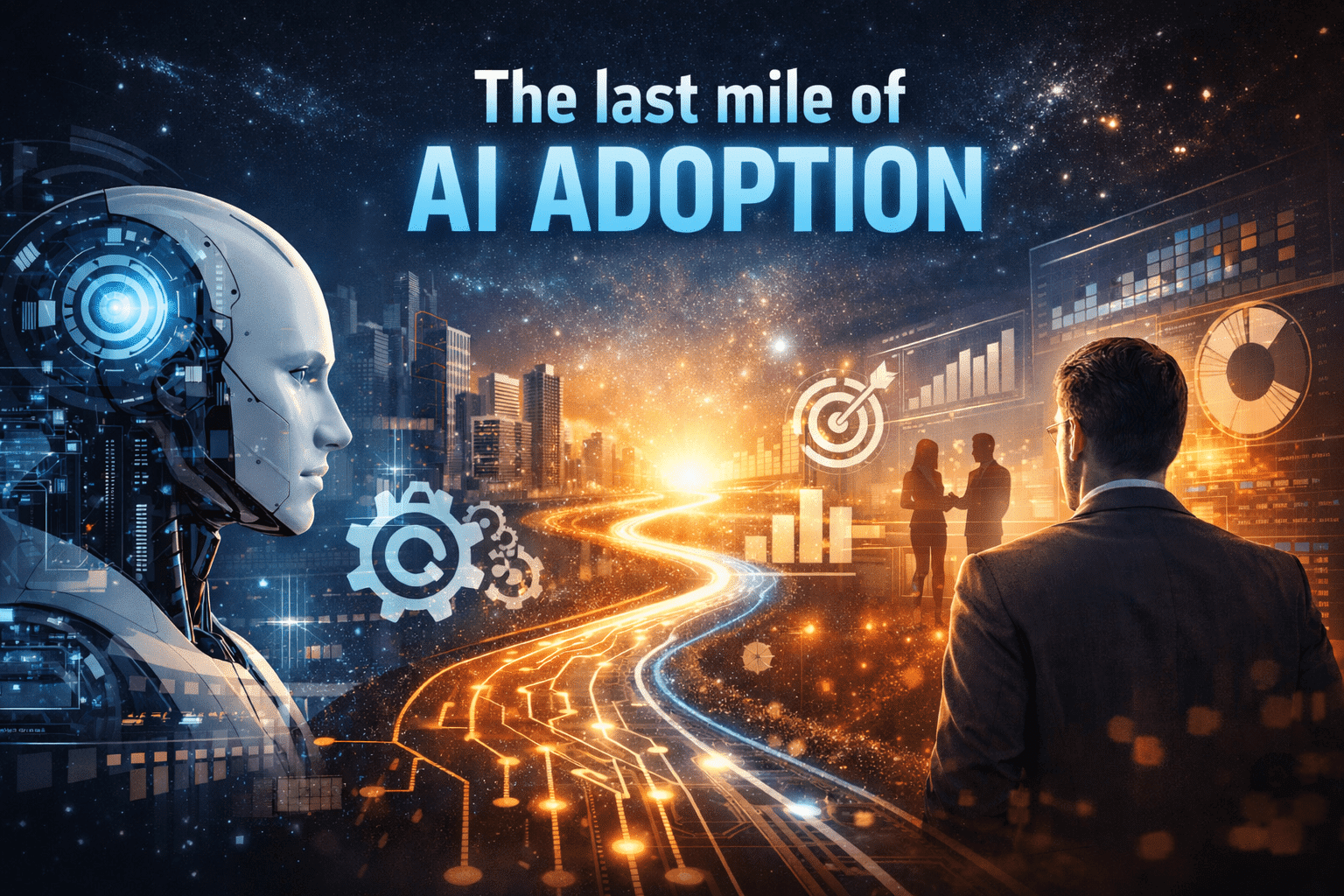
Artificial intelligence has arrived, at least technically, in many companies. Models are being trained, tools piloted and use cases defined. And yet the economic impact often falls short of expectations. This is precisely where the webinar “From Models to Mindset: The Last Mile of AI Adoption”, recently presented by MIT Sloan lecturer Paul McDonagh-Smith, comes in. His central thesis: it is not the performance of the models that determines the success of AI, but the ability of organizations to fundamentally adapt the way they think, work and measure.
McDonagh-Smith advocates a clear change of perspective. In recent years, companies have invested a lot of energy in models and technologies, but too little in mindset, adoption and suitable success metrics. AI should no longer be seen as a purely technical project, but as an organization-wide transformation.
In his view, there are three steps to getting there: from the models to the mindset to new metrics. Sustainable added value is only created when these three levels interact. Traditional KPIs, which were developed in stable, linear environments, often fall short. AI changes the speed of work, autonomy, knowledge utilization and decision-making and therefore requires “AI-native” metrics.
Evolution instead of perfection
A central theme of the lecture was the analogy to evolution. Both biological systems and AI develop complexity from simple rules that are constantly repeated, tested and adapted. Applied to companies, this means that instead of waiting for perfect end solutions, organizations should experiment, learn and scale iteratively.
This explorative mindset is particularly relevant for sectors such as insurance and financial services, which are traditionally highly regulated and risk-oriented. AI cannot simply be “superimposed on existing processes” here. Instead, it forces companies to critically scrutinize processes, roles and responsibilities and redesign them if necessary.
The “last mile” of AI
McDonagh-Smith’s concept of “last mile AI engineering” is particularly impressive. This refers to the often underestimated distance between a functioning model and its actual use in everyday life. It is this last mile that determines whether AI is accepted or rejected.
Five principles are at the forefront of this: thinking about decisions in terms of specific use cases, consciously interlinking humans and machines, prioritizing domain knowledge over pure computing power, starting small and learning quickly, and considering trust from the outset. Governance, transparency and risk scaling are not obstacles, but prerequisites for scaling.
Adoption is more than just an application
Another key point: AI adoption is not the same as AI application. Many companies use AI without it really being accepted. Acceptance only arises where employees understand when AI helps and when the human factor remains decisive. This distinction is particularly important in sensitive customer interactions or complex decision-making processes.
McDonagh-Smith also warns against viewing adoption exclusively as an internal issue. Customers and partners are also part of the system. If their expectations, fears or reservations are ignored, AI will quickly become an acceptance problem.
What managers should do now
In conclusion, the MIT lecturer formulates three concrete impulses for action: firstly, companies should specifically develop AI-native key figures that make the actual added value visible. Secondly, they need a clear adoption playbook, a kind of blueprint for how technology, people and processes interact. And thirdly: time. Time to learn, to experiment and to reflect.
The webinar made one thing clear: AI is not a sure-fire success. It does not replace leadership, but it does replace managers who do not engage with it. Or, as McDonagh-Smith pointedly put it:
For companies in the insurance and financial sector, this means that the future of AI will not be decided in the data center, but in the everyday life of the organization and on the last mile between technology and people.
Binci Heeb
Read also: Hallucinating AI: Significant risks for insurers and risk managers
Suche:
Sponsoren: