
At a round table in Zurich, industry experts explored how intelligent claims systems, real-time process insights and modern payment technologies can transform the insurance sector. The discussions revealed a clear message: Swiss insurers have the tools to innovate if they are willing to rethink old habits.
The Intelligent Claims Round Table with 14 participants from 8 different insurers began with a reminder of why collaboration matters. Freek Teunen Head of Product of Apolix emphasized that innovation rarely happens when people remain in the confines of familiar routines. Many professionals work for years within well-established processes, making it difficult to see where improvements are possible. New perspectives, whether from colleagues, partners or technology, can spark the kind of rethink that enables progress.
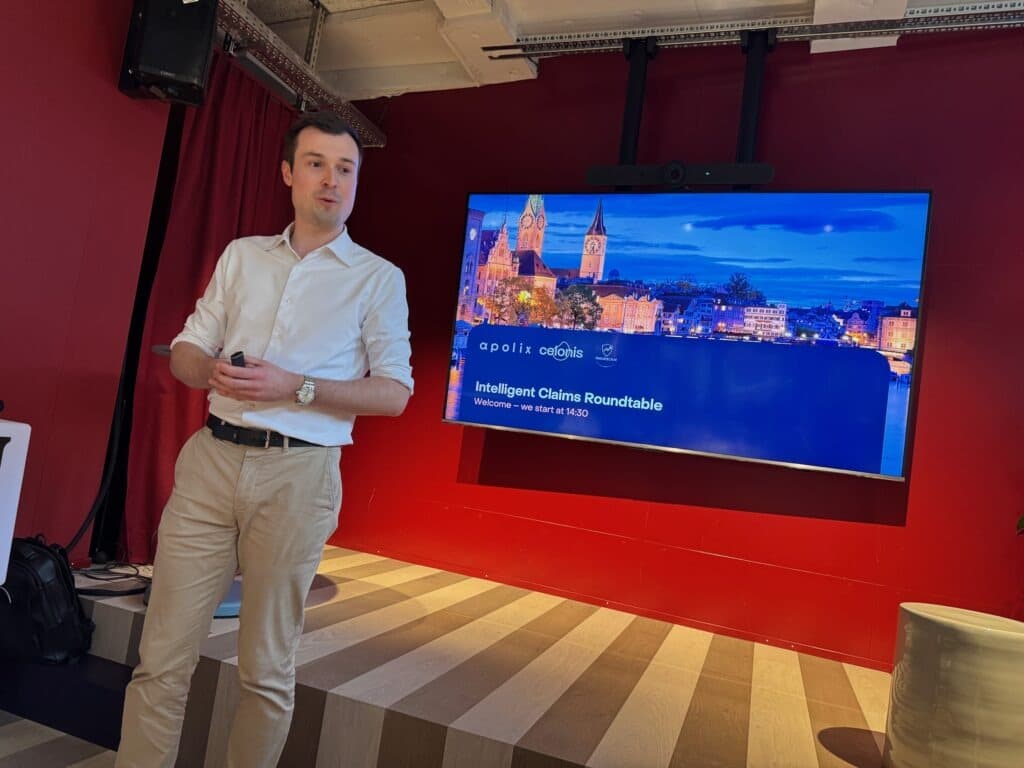
Participants created an open environment for honest discussion and cross-company learning. The intention was not only to exchange views but also to bring fresh thinking to the Swiss insurance market and inspire more innovative approaches to claims.
Continuous Improvement: Claims Processes Under the Microscope
A central theme was the role of process intelligence in modernizing claims management. Freek presented how a digital twin of the claims process, created through Celonis, allows insurers to see the real workflow rather than relying on anecdotal reports or traditional brown-paper mapping sessions. Instead of working with subjective impressions, insurers can observe the entire claims journey from first notification of loss to settlement and identify precisely where inefficiencies occur.
He illustrated this with a case from a motor insurer, where incomplete information and misclassified salvage categories significantly delayed claims. These deviations extended the average claims duration by eight days, long enough to jeopardize customer satisfaction. By combining process intelligence with AI-supported classifications, the insurer managed to reduce leakage and intervene earlier when human assessments and AI predictions diverged. The solution kept human handlers fully in control but supported them with insights drawn from patterns in real operational data.
AI in Claims: Promise, Pressure, and the Need for Oversight
AI was a recurring topic throughout the discussion. Many in the room had already experimented with AI tools, yet there was broad recognition that the technology introduces new risks. James NIcholson, Zurich’s chief claims officer stated in the Insurance Times that he expects more AI-driven errors next year, simply because adoption is increasing.
The round table explored how process intelligence can serve as a safeguard. AI agents can be orchestrated inside the digital twin of the process, which means insurers always know when and where the models are making decisions. When inconsistencies occur, workflows can escalate cases or prompt manual review. This approach not only reduces risk but also offers a clearer view of the actual impact that AI has on a business process.
The Netflix Moment: Rethinking Claims Payments
While much of the conversation focused on processes, Mirela Dimofte, Founder and CEO of Finsurtech.AI, shifted attention to an area that has received far less innovation: claims payments. With experience in both fintech and insurance, she noted that payment solutions widely used in financial technology have not yet found their way into insurance. Virtual, single-transaction cards are one example of a system that could make reimbursements faster, safer and more convenient.
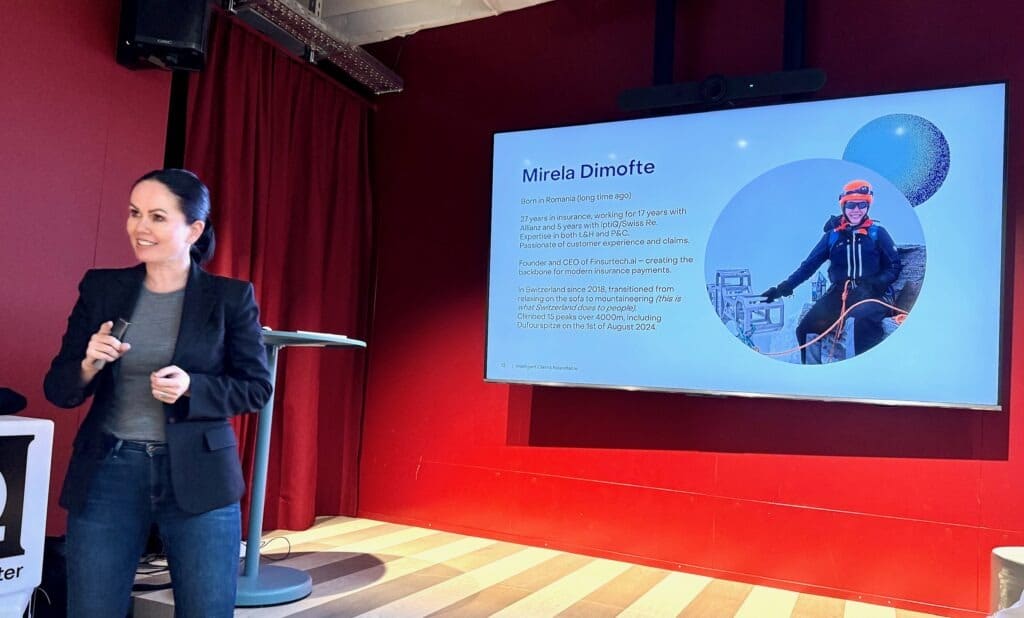
Such solutions could make claims payments faster, more transparent and more secure, offering customers an experience that is more reminiscent of streaming services than traditional insurance processes. Currently, many payment steps are fragmented and slow, creating friction on both the customer and company side. Dimoote’s appeal was clear: payments are one of the most neglected but most effective levers of claims modernization.
When data reality meets process design
The open exchange showed how complex claims processing can be in practice. Cases of total loss often suffer from incomplete documentation, which makes it difficult to assess the economic loss and leads to lengthy discussions with claimants.
In addition, there are long waiting times for external documents such as police reports or workshop documents. While the processes are at a standstill, the key performance indicators are deteriorating. This is an area of conflict that was familiar to all those present.
Internal conflicts of objectives also became apparent: while claims departments focus on rapid settlement, the finance department often prefers a later formal closure of cases. Even the definition of the term “closure” varies within individual companies, which makes comparisons difficult.
These discussions made it clear that technological transparency is only effective if there is strategic clarity. Process intelligence can make processes visible, but it cannot define which results a company prioritizes.
An industry on the move
The round table ended with a feeling of confidence. The tools to fundamentally modernize claims processing are available and are called: Real-time insights into processes, AI-supported decisions and contemporary payment technologies. The task now is to break down traditional patterns and develop the courage to experiment.
Everybody talking about AI
The honest perspective on the fact that AI is something everyone is talking about, but it more serves as a starting point for other types of initiatives such as automation or data quality projects were shared. The discussions in Zurich showed that innovation begins where experts come together, question habits and allow new perspectives. Most companies are focusing on quality instead of productivity as the group clearly said that they rather have a 1%-2% improved quality of claims handling instead of speed.
The future of claims processing belongs to those insurers who are prepared to rethink not only their technology, but also the way they work.
Binci Heeb
Read also: Damage claims in 47 seconds: Zurich’s AI in action (part 2)
Search:
Sponsors: