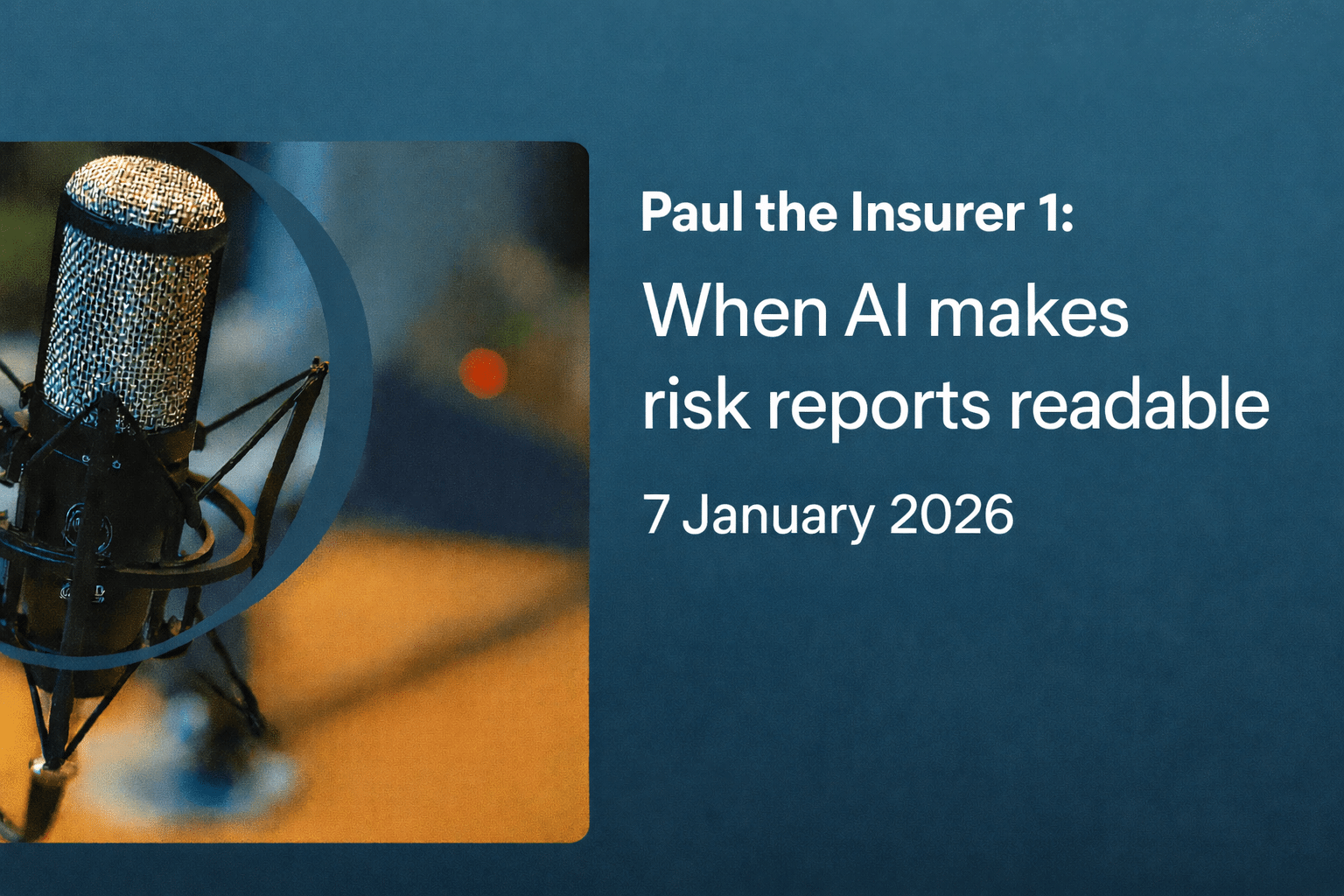
Risk surveys provide valuable insights, but their reports are long, complex and time-consuming. Two young insurance experts show how artificial intelligence is finally making risk surveys efficiently usable for captives and large companies .
In Paul the Insurer ‘s first podcast of the new year, he shows where artificial intelligence can be of greatest benefit in everyday insurance life.
Anyone who thinks that work on the boards of directors of insurance and reinsurance captives is routine and uneventful is mistaken. Captives are a central instrument in the risk management of large corporations. They must constantly adapt to a dynamic environment: Mergers and acquisitions, new production locations and geopolitical shifts are constantly changing risks and insurance programs.
Against this backdrop, the question of what role artificial intelligence can play in captives is becoming increasingly important.
AI and data: skepticism meets pragmatism
There are two camps in the discussion about AI in captives. Some doubt the benefits due to the supposedly too small amount of data. The others are solution-oriented and develop applications that not only provide added value for the captive itself, but also for the parent company.
One well-known example is AI tools that compare insurance conditions from dozens of countries and check them against standard models. But AI can do even more.
The unsolved problem of risk surveys
Risk surveys are a must in the industrial insurance business. Inspections of production facilities, warehouses or special plants result in comprehensive reports that are often 40 to 60 pages long.
For risk managers, this means reading, filtering, extracting measures, forwarding them and monitoring their implementation. With 50, 60 or even 70 reports per year, this quickly becomes a considerable resource problem, even for experienced specialists.
Two perspectives, one solution
This is where Ines and Anna come in. Ines has years of experience as a property underwriter and knows the content and weaknesses of risk surveys in detail. Anna is fresh out of university, with a sound knowledge of insurance and finance and the ability to communicate with IT specialists on an equal footing.
Together with a team of IT experts, they developed an AI-based solution that analyzes and structures risk survey reports and extracts the key messages.
From idea to internal showcase model
The result: significant time savings, greater transparency and better traceability of recommendations and measures. The solution was so convincing not only internally, but also to top management, that it was presented to executives from the insurance industry.
The tool will not be sold. It remains an internal application and at the same time an incentive for other insurers and captives to develop similar solutions.
AI as a silent efficiency driver
This example shows impressively where artificial intelligence can be of greatest benefit in day-to-day insurance operations: not as a spectacular sales argument, but as a pragmatic tool that relieves the burden on experts and ensures quality.
For captives and risk managers, this could be the decisive competitive advantage in the coming years.
Binci Heeb
Paul the Insurer has other content that may interest you, such as the series of interviews with insurance industry executives.
Read also: Paul the Insurer 30: Polar bears as an insurance case
Search:
Sponsors: