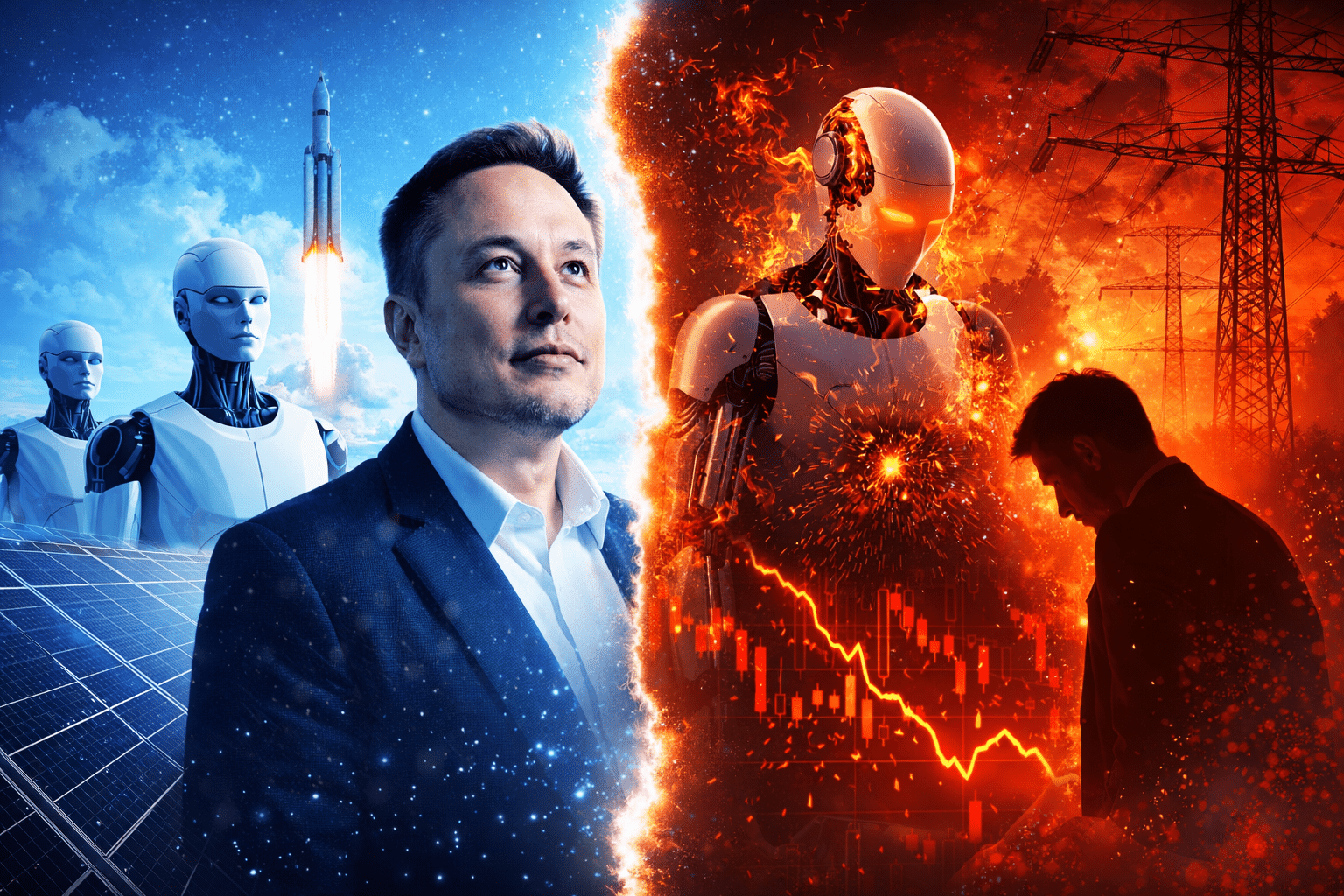
While geopolitical disruptions and systemic risks were being discussed in Davos, Elon Musk was outlining a radically optimistic vision of the future. For insurance companies and investors, it is less a promise than an analytical touchstone.
At the World Economic Forum in Davos, Elon Musk deliberately set a counterpoint to the prevailing crisis rhetoric. While many participants talked about geopolitical fragmentation, inflation and growth risks, the tech entrepreneur painted a picture of an imminent “age of abundance”, made possible by artificial intelligence, humanoid robots and virtually unlimited solar energy.
For insurance companies, capital markets and risk management, this vision is less science fiction than a thought experiment with real consequences.
Productivity explosion and the reassessment of risks
Musk’s core thesis is that if robots and AI take over work on a large scale, productivity will explode. In terms of economic logic, this not only means higher growth, but also a structural shift in risks. Traditional assumptions about labor markets, income and consumer demand are being shaken.
For insurers, this raises the question of how risks will be distributed in the future. If human labor becomes less important, liability issues, occupational disability models and, in the long term, the premium logic of entire lines of business will change. Productivity may increase, but so will volatility in transitional phases.
AI as a systemic factor in the capital market
Musk’s prediction that AI could be more intelligent than the entire human race in just a few years is particularly far-reaching. This poses a double challenge for capital markets: on the one hand, there will be enormous efficiency gains in analysis, trading and asset management. On the other hand, the model risk is growing.
If markets are increasingly controlled by similar AI systems, the risk of procyclical effects increases. For institutional investors and reinsurers, diversification is becoming a question not only of asset classes, but also of algorithms and data sources.
Energy as an underestimated cluster risk
It is remarkable that Musk himself names the biggest bottleneck in his vision: energy. The computing power for AI is growing exponentially, while electricity production is only growing linearly. This is a classic mismatch risk for risk management.
Energy shortages can become a systemic trigger with a direct impact on industrial production, infrastructure and therefore insurable losses. Musk’s focus on solar energy underlines how strongly technological visions of the future are now linked to energy policy and infrastructure investments.
Elon Musk’s optimism about the future: relevance for insurance companies & capital markets
PRO
- Productivity boost: AI and robotics could increase growth and insurable values in the long term.
- Risk reduction through automation: fewer human errors in transportation, industry and medicine.
- Attractive infrastructure investments: energy, grids and data centers as a long-term asset class.
- Stabilizing narrative: Technological optimism counteracts cyclical crisis fears.
CONTRA
- High transition risks: Labor markets, social systems and consumer structures under pressure.
- Unresolved liability issues: Autonomous systems create new risks that are difficult to calculate.
- Energy as a cluster risk: AI growth meets limited electricity capacities.
- Capital market homogenization: AI models increase the risk of synchronous mispricing.
Progress creates new markets, but also new systemic risks.
Optimism as a strategic narrative
Musk’s appearance in Davos was less a forecast than a positioning statement. Optimism acts as a strategic narrative for investors, political decision-makers and markets. It is precisely this optimism that is a touchstone for insurance companies: which scenarios are underestimated today because they appear too positive? And where does a belief in progress conceal new systemic risks?
Hope is no substitute for a risk model
Musk’s vision is valuable for the insurance and finance industry, not as a blueprint, but as a stress test for existing models. A possible “age of abundance” would not eliminate risks, but redistribute them.
The central task therefore remains unchanged: To classify optimism analytically, to take transition risks seriously and not to confuse long-term technological promises with short-term stability.
Binci Heeb
Read also: Elon Musk offers 94.4 billion dollars for OpenAI assets
Search:
Sponsors: