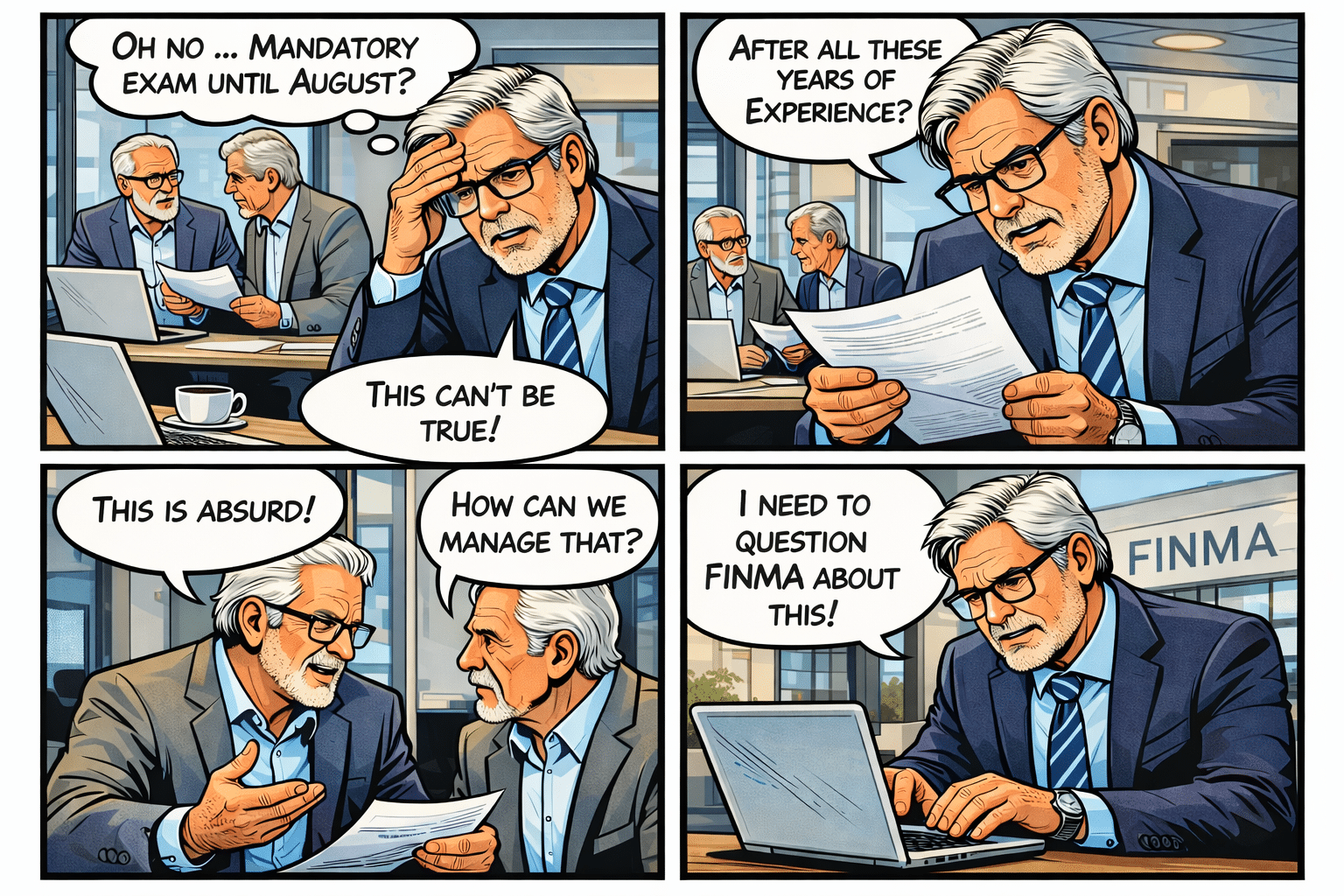
The training requirements are putting pressure on long-standing industry professionals: older brokers feel devalued by examination requirements and some are even considering early retirement.
A retired owner of a brokerage firm, who is still partially professionally active, recently received a request from the Vocational Training Association of the Insurance Industry (VBV): he had to complete a further training examination by August, otherwise he would effectively be banned from working.
The industry veteran reacted with surprise and sought an exchange with other experienced insurance experts and former company owners. The feedback was unanimous: Many of those affected feel offended.
After decades of work and a successful career, they find the periodic audit requirement unnecessary and disrespectful in its form.
Experience versus formal qualification
The main criticism is that even long-standing specialists with high professional qualifications should not be granted any exemptions. For those affected, the question of proportionality arises: does a standardized examination make sense for people who have been working successfully in the market for 30 or 40 years?
Several interviewees argue that the market regulates quality itself anyway. Those who do not meet the requirements or provide poor advice automatically lose customers and disappear from the competition. The obligation to undergo further training is therefore not perceived as a quality instrument, but as an administrative hurdle.
In response to an inquiry, the Swiss Financial Market Supervisory Authority (FINMA) commented as follows: The regulations on the training and further education of all insurance intermediaries are enshrined in the Insurance Supervision Act (ISA). The legislator has given the industry the authority to develop minimum standards within the framework of self-regulation. These standards have been jointly developed by the relevant industry associations; operational implementation is the responsibility of the VBV.
FINMA has recognized these minimum standards as they address the qualifications required by law and take appropriate account of the different requirements for each insurance sector.
During the transitional period provided for by the legislator, the minimum standards would also have included generous “grandfathering” provisions for intermediaries with many years of experience. For detailed questions, however, the supervisory authority refers to the VBV, which is responsible for the design and application of the standards.
Grandfathering regulations
According to point A.2.5 of Annex 2 of the “Minimum standards for insurance intermediaries – education and training in accordance with Art. 43 ISA”, the regulation applies to those insurance intermediaries who have been registered by FINMA under a “grandfathering” provision without having passed a formal examination and who have not yet been members of the CICERO system.
For this group of persons, a transitional regulation applies to the proof of continuing education: In the period from January 1, 2024 to December 31, 2025, they could fulfil their continuing education obligation in accordance with Art. 190 para. 3 of the Supervision Ordinance either via the CICERO system or by providing proof of documented learning activities.
The provision thus created a temporary special solution for “grandfathering” brokers without an audit certificate and enables flexible fulfillment of the training obligation during the transition phase. From January 1, 2026, the ordinary requirements of the minimum standards will apply to them.
Lack of differentiation by experience
FINMA answers the question as to why the current regime does not provide for any further protection or facilitation regulations for older, still active industry professionals: The transitional provisions had taken this concern adequately into account. Further exceptions are not provided for in the current framework.
Demonstrable customer benefit
thebrokernews also wanted to know whether it can be proven that experienced insurance intermediaries provide incorrect advice more frequently without periodic checks or what concrete added value these checks bring for customer protection… According to FINMA, a comprehensive survey of brokers, intermediaries and insurance companies would be required to answer this question in order to make reliable statements. The authority does not currently intend to conduct such a survey.
At the same time, the supervisory authority emphasizes that it is taking action against irregularities and abuses in the intermediary market and, if necessary, taking measures to protect policyholders.
Risk of loss of know-how
The situation appears to be particularly delicate in view of demographic change. According to statements from the field, some brokers are already considering terminating their activities prematurely instead of undergoing another audit process. If this trend spreads, valuable experience could disappear from the market, especially in an area that is strongly based on trust, customer relationships and practical knowledge.
In response to the question of whether possible side effects such as the premature market exit of experienced intermediaries have been assessed from a regulatory perspective, FINMA refers to the relevant documents on the revision of the ISA and the Supervision Ordinance (SO) as well as the associated messages and explanatory reports.
Barriers to learning in old age
There is also a practical aspect: many older professionals doubt that they will be able to pass the exams at all. Not because of a lack of professional competence in everyday life, but because of the school examination format.
The challenge lies less in consulting practice than in memorizing current teaching content. The fear of failure and the associated loss of face within the company further increases resistance.
Criticism of the reforms
Discussions have also led to fundamental criticism of the regulatory developments of recent years. Some industry representatives suspect that the reforms would primarily cause additional costs without bringing clear benefits for customers, insurers or brokers.
Whether and to what extent there could be relief for long-standing practitioners in the future therefore remains an open question. What is clear is that the debate does not only concern individual cases, but also fundamental questions about the balance between formal regulation, self-regulation of the industry and the value of many years of professional experience in the Swiss insurance market.
Binci Heeb
Read also: Reporting obligation for insurance intermediaries to FINMA: Where are the details?
Search:
Sponsors: