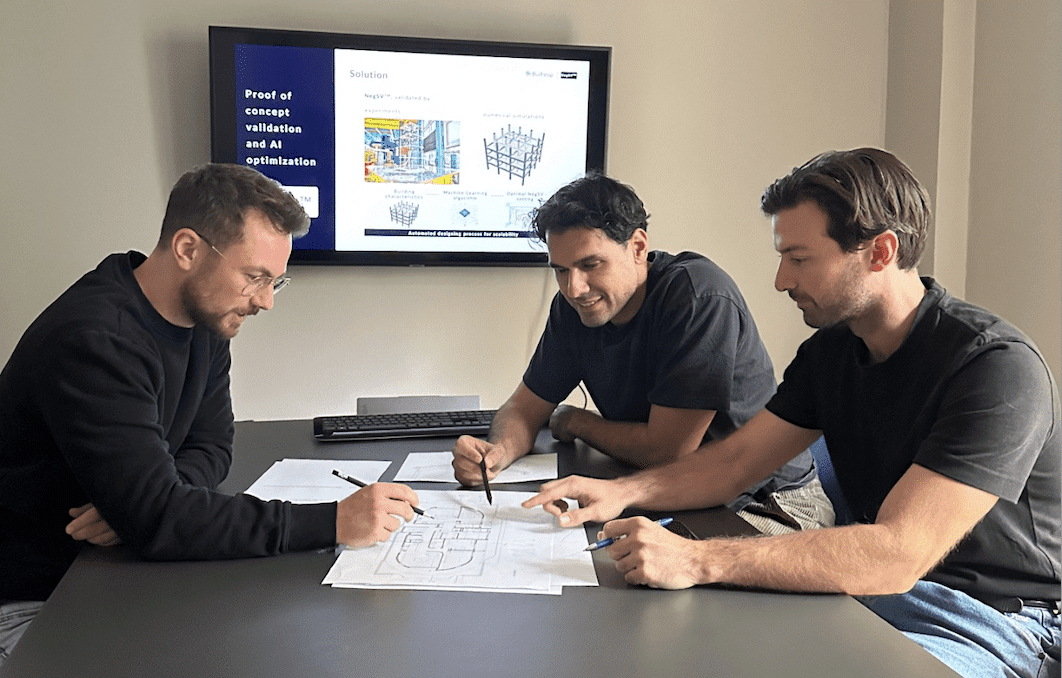
Builtstop, a Swiss engineering startup, has just won the Swiss Sustainability Challenge 2025 for its groundbreaking innovation NegSV. It is a smart seismic energy absorber that can be installed on the top floor of existing buildings without invasive construction work. The company was founded by a multidisciplinary team of civil engineers and researchers from ETH Zurich and leading European institutions and makes earthquake safety a matter of sustainability: protecting human lives, avoiding construction waste and extending the lifespan of buildings.
With planned pilot installations in southern Europe and long-term ambitions in Japan, Builtstop aims to redefine how cities can prepare for earthquake risks while reducing their carbon footprint. Thebrokernews speaks with Konstantinos Chondrogiannis.
In simple terms, how does NegSV work and how does it differ fundamentally from conventional earthquake protection measures?
NegSV acts as an energy arrester for buildings. It is installed on the top floor and absorbs and diverts earthquake energy away from critical building components. Unlike conventional retrofits, no heavy materials or foundation work is required. The system is non-invasive, lightweight, faster to install and far less expensive, making large-scale earthquake protection practical and sustainable.
What scientific breakthroughs or research results have made this technology possible?
NegSV builds on advances in metamaterial mechanics and negative stiffness systems. Research at ETH Zurich has shown that controlled negative stiffness can efficiently dissipate vibration energy without adding mass, making lightweight, modular earthquake protection possible for the first time.
Is NegSV suitable for both old and new buildings or is it more suited to a specific typology?
NegSV was developed primarily for existing buildings, particularly those built before the introduction of modern seismic regulations, and offers a practical and cost-effective way to improve safety without structural alterations. However, it can also be integrated into new buildings to optimize their design. By incorporating NegSV at the design stage, engineers can safely reduce the dimensions of certain building components to achieve the same or better seismic performance at a lower overall construction cost. This makes NegSV valuable for both retrofit and forward-looking, cost-effective design.

How can disruption to tenants and companies be avoided during installation?
NegSV is only installed on the top floor, leaving the lower floors and the majority of day-to-day operations unaffected. The installation process is quick and non-invasive and is usually completed within a few days. Only tenants on the top floor may need to temporarily relocate for a very short period of time to ensure safety during installation. Once installed, the system requires no structural demolition work or heavy equipment, so buildings can remain largely occupied, functional and undisturbed throughout the process.
You position seismic safety as a sustainability measure. Why do you think that the resilience of cities has so far been neglected in the sustainability debate?
Sustainability often focuses on energy and emissions and overlooks resilience to disasters. Yet earthquakes cause enormous environmental and economic damage. By preventing damage and avoiding reconstruction, seismic resilience is one of the most effective forms of sustainability.
How much CO₂ can cities save by retrofitting instead of building new ones?
Retrofitting with NegSV can save up to 300 percent of CO₂ emissions per building, as demolition and reconstruction are avoided. Extrapolated to the entire city, this means a saving of thousands of tons of carbon, which is directly in line with the goals of climate protection and the circular economy.
Do you see potential for NegSV to become part of building regulations or ESG frameworks?
Yes, NegSV is in line with ESG and EU resilience goals and combines safety and sustainability. As the regulatory framework evolves to include resilience metrics, NegSV can help cities and investors meet both structural and environmental compliance standards.
Why are your first pilot projects planned for Southern Europe and what criteria were used to select them?
Southern Europe has some of the oldest and most vulnerable building stock in earthquake zones, coupled with increasing regulatory pressure to retrofit. These regions offer ideal conditions to validate the technology and demonstrate its social and economic impact on a large scale.
Japan is an important market for seismic innovations. What are your long-term expectations there?
Japan is the global benchmark for seismic technology. Our aim is to enter this market through strategic research and industrial partnerships and offer a complementary solution to existing high-end systems that is lighter, more cost-effective and easier to retrofit in densely built-up urban areas.
How do you convince local authorities and building owners who assume that earthquake protection is too expensive or too disruptive?
We show you data. NegSV is 80 percent cheaper and 90 percent faster to install than conventional methods. No heavy construction work and minimal downtime are the key benefits of our technology. The building remains operational and security is significantly improved. That’s a clear win in terms of cost, time and community resilience.
What regulatory challenges have you encountered so far?
Compliance with local seismic regulations and certification standards is required, but there are no structural or legal barriers. Full validation by ETH Zurich ensures a smooth path to certification and compatibility with Eurocode 8 and national guidelines.
Who do you see as your biggest competitors? Traditional retrofits, new technologies or the inertia of the market?
Our main competitor is still market inertia. The widespread belief that seismic retrofits are too complex or too costly. Traditional methods such as base isolation or shear wall strengthening are well validated and effective, but they are also highly invasive, time consuming and add significant weight to existing structures, often making them impractical for widespread application. New technologies show potential but rarely achieve full validation. Builtstop bridges this gap, offering scientifically proven performance with a lightweight, fast and non-invasive solution.
What happens when the next big earthquake hits a city where NegSV is used? Can you quantify the expected damage reduction?
In simulations and full-scale experiments, NegSV reduces acceleration and displacement between floors by up to 50 percent, significantly lowering the risk of structural damage or collapse. This results in fewer injuries, lower repair costs and faster recovery for entire communities. In addition, in densely populated cities where buildings are very close together, NegSV helps prevent collisions between buildings, an often overlooked but serious cause of earthquake damage in urban environments.
Your founding team combines academic research with practical engineering work. How has this multidisciplinary approach shaped Builtstop’s culture and progress?
This is our greatest strength. We combine academic precision with practical pragmatism. Our culture is based on experimentation and problem solving, which allows us to translate cutting-edge research into practical, scalable products that truly improve the resilience of cities.
What is the most common misconception that engineers or policy makers have about earthquake protection today?
That earthquake safety must be associated with high costs, disruptions and downtimes. NegSV proves the opposite. Earthquake protection can be affordable, fast and sustainable, making resilience an achievable standard rather than an expensive luxury.
The questions were asked by Binci Heeb.
Read also: Courage for the future – the winners of the Swiss Sustainability Challenge 2025
Search:
Sponsors: