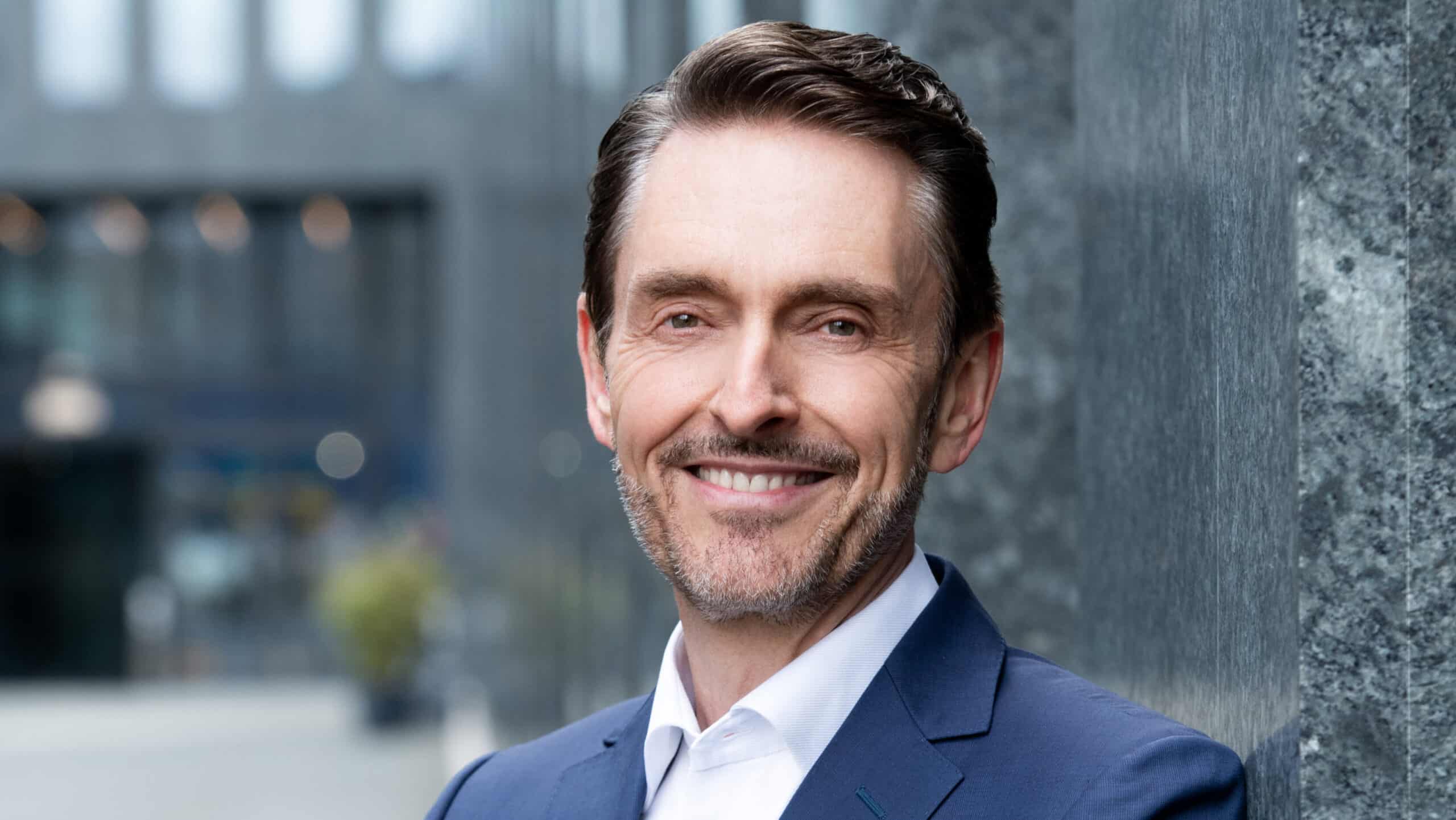
With a carefully planned change in management, the company is focusing on a mix of continuity and innovation. On January 1 of this year, Marc Rothenbühler took over the operational management from Urs A. Bleisch. He has been with Funk for 13 years, was a key figure at the Bern branch for around nine years and has been a member of the Executive Board for four years. At the same time, Rafael Fischbach is strengthening the management team and bringing in in-depth digital expertise. This is a clear signal of the importance of technological transformation in the insurance and risk industry.
While Funk is thus laying the foundations for further growth, Urs A. Bleisch remains a stable constant in the background as Chairman of the Board of Directors. Thebrokernews talks to him about the strategic motives behind the change, the challenges facing the industry and how an owner-managed company navigates between stability and future orientation.
Urs, after more than 15 years, you are handing over operational management to Marc Rothenbühler. What was the decisive moment when it became clear to you? Now is the right time for a generational change?
I have managed the company for around ten years in the dual role of Chairman/CEO and will be 65 next summer. Given these conditions, we have been carefully planning the generational change for some time. In addition to encouraging organic growth, complexity and the pace of change have continued to increase during this decade, which is why a separation between operational and strategic management was necessary.
What does it mean to you personally that you will continue to play an important role as Chairman of the Board of Directors? How is your perspective on the company changing?
This is also a matter close to my heart. Many initiatives and measures are currently being implemented. I would like to continue to support their implementation and take responsibility for them and, of course, enjoy the results.
The change in leadership is described as “targeted” and “carefully prepared”. Can you give us an insight? How far in advance does an owner-managed company like Funk think about its succession?
I got to know Marc Rothenbühler over 25 years ago. Even back then, he was an ambitious employee whose potential I recognized. After a change of management at the Bern branch 13 years ago, I got in touch with him again after around ten years of “radio silence”.
In your opinion, what made Marc Rothenbühler particularly qualified to take over operational management?
The most important thing for me is suitability of character. We are also both officers in the Swiss Army and approach the challenges methodically in the same or very similar ways. Marc also sets high standards for himself and his employees in terms of quality and reliability, which is very important to me.
The media release emphasizes stability and innovation. Where are the greatest areas of tension between the two and how can they be resolved in practice?
By creating an organization that constantly develops the core business and consciously drives innovation alongside it. This is why, since 2022, we at Funk have been working with a team responsible for the development organization in addition to a classic operational organization, which is the responsibility of the management. This hierarchy-independent, interdisciplinary team has the relevant skills and works on problems and innovation projects independently. This has generated an incredible boost in innovation and motivation for us.
Or something even more specific: With our focus on purely organic growth, the high level of customer trust and our long-standing specialists at all levels, we are creating stability. With our Application Development unit and RiskLab, which was founded in 2016, we have two strong drivers of innovation within the company in addition to the organizational measures mentioned above.
With Rafael Fischbach, you are bringing digital expertise into the management team. What specific transformation projects or IT initiatives have tipped the scales?
We have the ambition to become the leading integral risk management service provider in Switzerland. In addition to the content-related challenges, the requirements for a state-of-the-art infrastructure are particularly essential in this transformation. The aim is to reduce complexity for our customers as much as possible and ensure that processes and tools are as user-friendly as possible.
The Services division includes IT, Corporate Development, Finance, HR and Legal. That’s a broad portfolio. What priority will the digital transformation have within the Funk Group Switzerland in the future?
Digital transformation has probably become a high priority not only for us, but also for most of our competitors. However, we also aim to create an environment that is characterized by a unique culture. In addition to all digital topics, our focus is and remains on people.
Many insurance brokers struggle with inefficient processes and legacy systems. How does Funk intend to create a competitive advantage here?
A few years ago, we decided to part ways with one of our software suppliers and take matters into our own hands. That’s why we set up our application development team around three years ago. This enables us to react much more quickly and efficiently to market requirements. Two specific development projects have already been successfully implemented. We are learning new things every day, as IT projects can be very demanding in terms of content and time. In Rafael Fischbach, we also have a quality and process expert who has helped us make progress in these areas over the past 14 years and will continue to do so in the future.
The risk landscape is changing dramatically: cyber, supply chains, climate change. Which of these developments do you personally consider to be underestimated?
All of them. As an integral risk management service provider, we therefore also support our clients “beyond insurance” with products, services and tools outside the traditional insurance market. In future, it will become increasingly challenging to transfer risks adequately to the insurance market.
How is digital automation changing the role of the broker? Will it become more advisory-intensive, more technical or both?
Basically both, although of course it also depends on the customer segment. We are 100% active in the B2B segment and have a heterogeneous customer structure in terms of industries. That is why there are certain limits to scalability here, apart from industry clusters and associations. Our company will therefore continue to develop as a hybrid in the future. In doing so, we will consistently make use of the resources and possibilities of IT and sharpen the focus of our colleagues on the customer front towards the entire risk landscape of our customers.
Critics accuse the industry of overburdening customers with rising premiums and high complexity. Does the industry have a transparency problem?
It is not us as advisors, but the insurance market that is currently putting a strain on Swiss corporate customers with rising premiums and coverage restrictions. This is sometimes met with a lack of understanding on the part of customers, as insurers are publishing ever better business results. One of our tasks is to evaluate the best possible conditions for our customers and, if necessary, to find solutions outside the insurance market.
In terms of complexity, the insurance dossier – paired with the right consultant – is a much smaller challenge for our customers than, for example, setting up a new production site at home or abroad or reorganizing the global supply chain in a fundamental and risk-adjusted manner.
Marc Rothenbühler is described as “deeply rooted in radio culture”. How do you define this culture?
When someone asks me about our company’s greatest asset, I spontaneously mention “our corporate culture” alongside our customers. Over the past few years, we have developed, lived, cultivated and refined our culture together with the entire team. This is characterized by mutual respect, trust, reliability, personal responsibility, openness, appreciation and fairness. Marc was right in the middle of this and fully identifies with our values.
What remains – despite transformation – non-negotiable in the Funk Group’s self-image?
We remain an independent company in which motivated personalities can develop in order to meet demanding customers as service partners on an equal footing. We do not have the ambition to be the biggest in the market, we have the claim to top quality.
Is owner management an advantage or rather a challenge in today’s digitalized market?
Clearly an advantage. At our Board of Directors meetings and General Meetings, all owners sit around one table. We can make investment decisions independently and do not have to keep shareholders in a purely profit-oriented mood. I am convinced that this makes it easier to ensure sustainable development.
If you look five years ahead: What risks will Swiss companies be facing that hardly anyone is talking about today?
As this question is difficult to answer, it is necessary to constantly monitor world events and position yourself as a company in such a way that you can react quickly to risks that are still unknown today: Geopolitical, economic, technological, climatic and social developments must be continuously assessed in terms of probability of occurrence and impact. Spontaneously, I see the topics of cyber, albeit in a much more intensive form, especially the topic of AI with the associated risks. The first signs indicate that insurers are giving a lot of thought to exclusions for AI risks. In my opinion, we should also not lose sight of the inflationary potential that is building up worldwide and the dependence on large technology companies.
And on a personal note: what part of your professional experience would you particularly like to draw on in your new role as Chairman of the Board of Directors?
Strategy: The ability to recognize strategically relevant aspects in good time and to prepare the necessary foundations for operational implementation together with the CEO and the Executive Board.
Leadership: To continue to support the upcoming generational change at senior management level and ensure that know-how and cultural achievements are retained.
Relationship management: Intensive exchange with customers and partners at VR and C level to ensure the customer and partner perspective at a strategic level.
Urs Andreas Bleisch was CEO and Partner of Funk Insurance Brokers AG from 2010 to 2025 and Chairman of the Board of Directors since 2017. Since 2018, he has also chaired the Board of Directors of Funk in the Principality of Liechtenstein. He began his career as an underwriter and corporate consultant at a major Swiss insurer, followed by senior positions in the back office and field sales force. He spent seven years as an independent general agent and member of the management of a life insurer, where he was responsible for the corporate and later the private client business. Bleisch was a lecturer at the FHS St. Gallen and ZHAW Winterthur. He is a federally certified insurance specialist, CFP® license holder and holds an Executive MBA (SKU/CAS-HSG). In the military, he served as a general staff officer in the Swiss Air Force.
The questions were asked by Binci Heeb.
Read also: Funk: Funk: Smart pension planning: Understanding the tax rules in pillar 2 and 3a
Search:
Sponsors: