Shortly before the summer break, the Swiss InsurTech Hub (SIH) hosted a virtual mid-year meeting. Silvia Signoretti and Sharan Kaur led the way through a packed agenda, which ranged from a review of an eventful first half-year to the introduction of a new market intelligence platform and a welcome for three new InsurTechs. The common thread: Between symposia, roadshows, and a growing ecosystem, it’s clear just how much the collaboration between established insurers and young technology providers in Switzerland has become more professional.
Silvia Signoretti, President of SIH, gave a positive assessment of the past six months. Through thematically focused symposia, the Hub successfully attracted audiences interested in specific challenges facing the industry and, at the same time, organized roadshows in Switzerland, London, and Italy. In the process, engagement with established insurers has been continuously expanded. With summer approaching, a brief respite is on the horizon before the next major event takes place in September.
Resilience Conference with Swiss Re to Kick Off the Fall Season
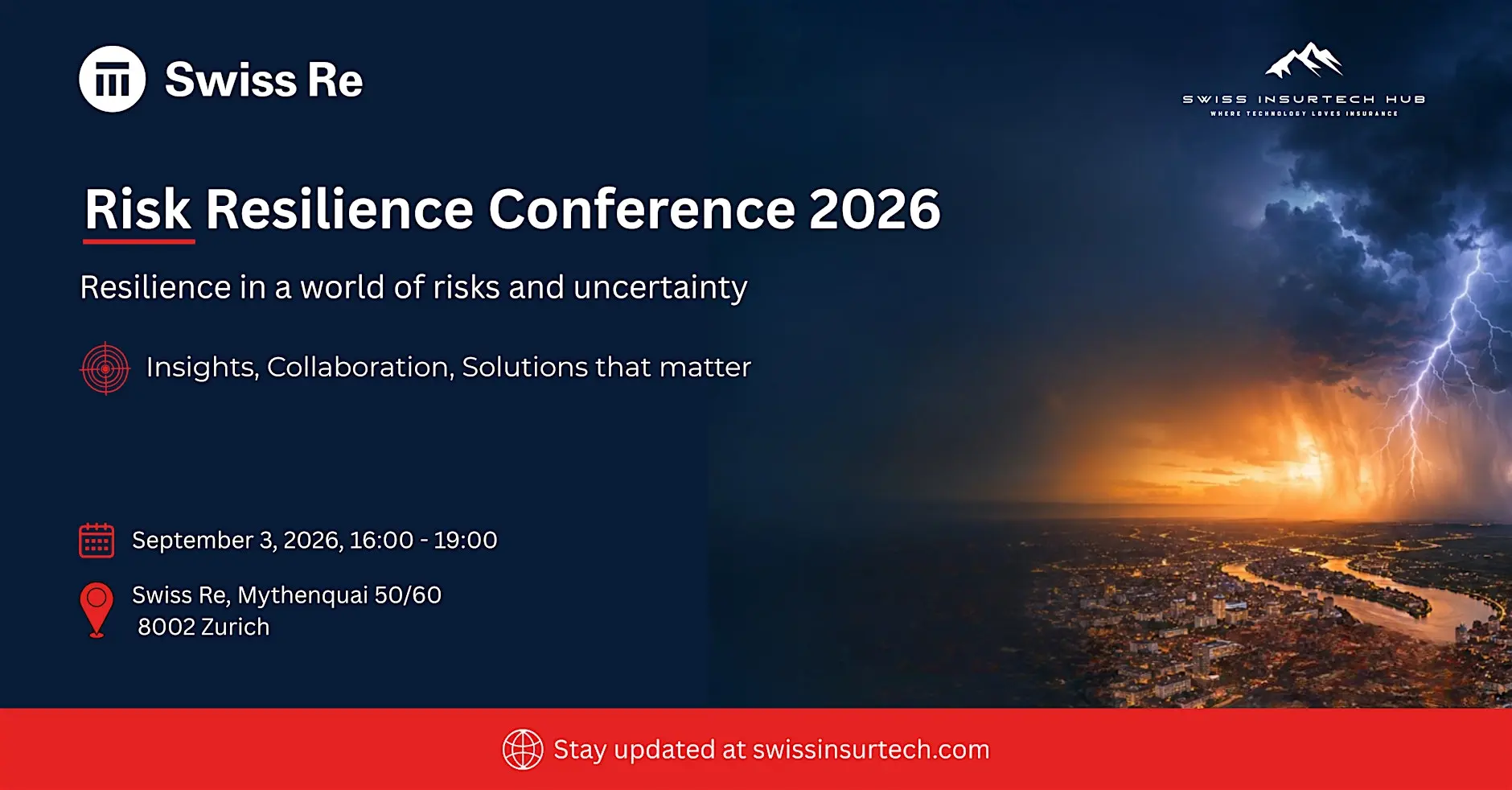
A Risk Resilience Conference will take place on September 3, organized in collaboration with Swiss Re. The event is based on the Swiss Re Sigma Report and focuses on climate risks, catastrophe risks, and the reinsurer’s CatNet toolkit. Between 150 and 200 participants are expected. In addition to a panel discussion and a fireside chat with industry thought leaders, there will be an InsurTech showcase featuring six presentation stations as well as demo pods where discussions can be explored in greater depth. For the Hub, the conference marks the first major event following the summer break.
Five Years of the Swiss InsurTech Summit and Awards
The Swiss InsurTech Summit and Awards is already generating buzz. The event will take place on December 1 at the Google Auditorium in Zurich and marks a milestone this year: the fifth anniversary of the awards. The application period for the InsurTech of the Year Award is now open, and all members of the association are eligible to participate. A jury of insurance experts will evaluate the submissions, and the ten finalists will pitch their ideas live in front of approximately 300 industry representatives on-site, while the event will also be streamed online. Signoretti emphasized that, in addition to the overall winner, there will also be category winners, making participation worthwhile for many companies. The program—featuring particularly high-profile speakers in this anniversary year—will be announced after the summer break.
From a Report to a Dynamic Market Intelligence Platform
A key focus of the meeting was the presentation of a new market intelligence platform developed in close collaboration with AXA. The starting point was the realization that traditional market reports are too static to keep pace with the speed of technological development: What is true today may already be outdated in six months. The result is therefore not a report in the traditional sense, but a continuously updated system consisting of a general market overview—the so-called “Player’s Playbook”—and a detailed InsurTech Trend Radar that maps out partnerships, use cases, and the demonstrable impact of individual InsurTech companies.
The data set is substantial: Starting with a global pool of over 1,000 InsurTechs, the selection was narrowed down to approximately 400 companies relevant to the European market, from which a smaller group was then identified for in-depth analysis. The study covers the entire value chain of the insurance industry, from product design through underwriting, risk management, claims processing, distribution, and policy administration to customer retention, data, and AI.
Daniel Steingruber of AXA Switzerland, who is responsible for open innovation, provided a firsthand account of how the platform is used within the company. The platform has transformed what was once a reactive approach to startup inquiries into a strategic prioritization process. A particularly valuable aspect is that the content is consistently presented in the language of the insurance industry, which significantly facilitates internal dialogue between the innovation department and line of business units. The platform also serves as a kind of heat map of what competitors are doing in the market, which creates a motivating “FOMO” effect internally. What started as a reporting tool has thus evolved into a genuine decision-making tool.
When asked where AXA is currently seeing the most momentum, Daniel cited artificial intelligence in distribution and the modernization of claims processing as the two key areas. In the claims sector in particular, there is enormous potential, coupled with the challenge of not only digitizing existing processes but also fundamentally rethinking them.
A68: Fraud Detection Using a Network of Specialized Agents
A68 was the first new member to introduce itself, represented by co-founder Julian Becker. The company tackles insurance fraud in claims processing, a problem with significant financial implications: In Germany alone, annual losses due to insurance fraud amount to around six billion euros; in the U.S., they total 308 billion dollars, with an estimated one in ten claims being suspicious.
A68 has developed approximately 160 specialized agents that combine traditional machine learning models, forensic methods, and modern language models. An overarching supervisor model aggregates the results and provides an overall assessment to the claims processing team. Among other things, the system checks for plausibility, performs online comparisons, and addresses forensic issues such as AI-generated content or digital manipulation of submitted images. In a case study conducted with partner Insmoo, the solution identified 160 percent more cases of fraud, with approximately 1.9 percent of the claims reviewed actually being fraudulent. At the same time, the processing effort per case fell by about half, as the triage process now focuses more specifically on suspicious cases. Becker cited the long sales cycles in the insurance industry—sometimes lasting more than a year and a half until a policy is issued—as the biggest challenge.
Mavenblue: Efficiency for Actuaries Without AI Hype
Mavenblue, a Dutch InsurTech company founded in 2016, introduced itself as a firm that deliberately positions itself not on the basis of artificial intelligence, but rather on concrete efficiency gains for actuarial and risk management. Andreas Meyer, who represented the company, described two key problem areas as the starting point: pricing and balance sheet management.
When it comes to pricing, Mavenblue relies on a circular model consisting of pricing, rollout, monitoring, and adjustment, which in particular accelerates the implementation of new rates. From the finalized pricing logic, the software generates a so-called “rating artifact”—compilable code in Java, C, or COBOL—that can be integrated directly into existing portfolio management systems without the need for complex IT projects. What used to take up to six months at some German insurers can now be reduced to a matter of hours or days. In the area of balance sheet management, Mavenblue offers a central database for reporting, capital requirements, and stress tests, reducing analysis times from weeks to hours.
Vectoryx: Property Damage Management as a Data Problem
The presentation round concluded with Vectoryx, a German company with operations in Germany, Austria, Switzerland, and the U.S. CEO Alexander Nett explained the company’s approach based on his own experience as a former real estate manager: In the event of a claim, seven different parties typically need to be coordinated—from the owner to the real estate agent to the construction company—which incurs significant overhead costs even before the claim is filed with the insurer.
Vectoryx positions itself as a white-label solution that acts as an interface between all parties involved, answers calls, collects documentation, and ultimately hands the insurer a case ready for a decision, complete with a cost estimate and coverage analysis. According to the company, this approach reduces processing time from months to minutes, resulting in savings of up to $1,000 per claim and costs of $150 per claim processed. The focus is on high-frequency claims in the private and, to some extent, commercial sectors ranging from 2,000 to 15,000 euros, while complex major claims fall outside the target segment.
An ecosystem that continues to grow
The event once again highlighted just how firmly the Swiss InsurTech Hub has established itself as a bridge between established insurers and innovative technology providers. Whether it’s fraud detection, pricing, or claims management, the solutions presented show that the pressure to innovate in the industry remains as strong as ever and is increasingly delivering concrete, measurable results. With its fall program centered around the Resilience Conference and the fifth anniversary of the Summit and Awards, the Hub has already set ambitious goals for the second half of the year.
Binci Heeb
Read also: Swiss InsurTech Hub gets off to a flying start in 2026
Search:
Sponsors: