Since late February 2026 the Strait of Hormuz has been severely disrupted by the U.S.-Israel conflict with Iran. Before the war, approximately 20 million barrels per day of crude and products, about one-fifth of global consumption, flowed through the strait. Flows have remained volatile and well below baseline for months, with refined-product movements particularly constrained. Brent crude has traded above $100 for extended periods, peaking just over $126 in late April and fluctuating around $104 to $105 more recently.
Hormuz is the most visible chokepoint, but it is not the only source of tightness. Several independent stresses have hit at the same time and reinforced one another.
The ongoing war in Ukraine continues to affect Russian refining infrastructure. Ukrainian drone strikes have repeatedly reduced capacity; diesel and product exports have collapsed at times, and Russia has imposed export restrictions to protect domestic supply.
Western sanctions on Russian oil have redirected flows, widened discounts on Urals, and added logistical friction. The practical market outcome is cumulative disruption.
Secondary effects include attacks on alternative routes, low strategic inventories, refining bottlenecks elsewhere, and residual Red Sea issues. Bypass capacity exists but is limited. Saudi Arabia’s East-West pipeline, with capacity around 7 million barrels per day, was recently restored to roughly 5.8 million barrels per day after a September attack. It cannot fully replace the volumes that once moved through Hormuz.
The International Energy Agency has repeatedly revised both supply and demand forecasts downward for 2026. Inventories have been drawn at elevated rates, and high product prices, especially diesel, have already begun to destroy some demand. Crude can be partially rerouted; refined products cannot.
Key Market Indicators (Mid-October 2026)
| Indicator | Approximate Level |
|---|---|
| Hormuz Strait oil flow before the crisis | ~20 million barrels per day |
| Most recent Hormuz Strait throughput (fluctuating) | often 40–70% of the pre-crisis level; products significantly lower |
| Brent | ~$104–105; wartime peak ~$126 |
| Saudi East-West Pipeline | ~7 million barrels/day capacity; most recently ~5.8 million barrels/day |
| War risk premium before the crisis | usually 0.1–0.25% of the hull value |
| War risk premium during the crisis | often 3.5–7.5%; peaks at 7.5–10% |
Marine War Risk
Within 48 hours of the first airstrikes, war premiums increased sharply. The London market’s Joint War Committee classified the Gulf as a conflict zone. Tanker traffic plummeted by more than 80 percent in the early weeks.
In formal clarifications issued in late March 2026, the Lloyd’s Market Association stated that reports suggesting coverage had been cancelled or that insurance unavailability was the reason vessels were not transiting were not accurate. War insurance remains available within the Lloyd’s and London company market for vessels wishing to transit the Strait of Hormuz. Lloyd’s CEO Patrick Tiernan reaffirmed that the market would continue to offer coverage. Liability cover through the International Group of P&I Clubs was largely non-cancellable.
Premiums rose sharply. Pre-crisis rates were typically 0.1 to 0.25 percent of hull value per voyage. During the crisis, market reports commonly cited 3.5 to 7.5 percent, with peaks of 7.5 to 10 percent of hull value for higher-risk vessels. On a large tanker this equates to several million dollars extra per transit. Rates are negotiated case by case and fluctuate with events.
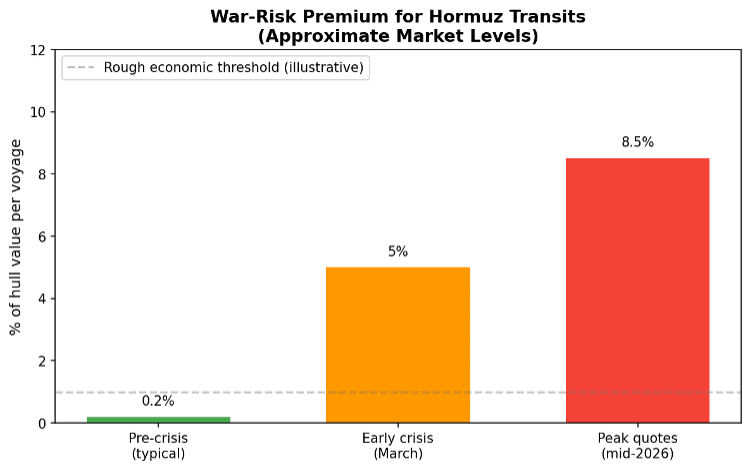
Figure 1: Approximate war risk premiums for Hormuz Strait transits (illustrative market levels).
Most owners and captains deemed the residual physical risk to crew and vessel too high, even when cover was available. Some purchased the expensive policies but still chose not to sail. In June, Lloyd’s launched a consortium led by Chubb with roughly $400 million in capacity, split between hull and P&I and cargo. Marine insurers faced substantial losses. IUMI estimates put them in the range of $1.5 to $2 billion related to the conflict. Lloyd’s reported approximately $1.9 billion market-wide in the first half of 2026 linked to the crisis.
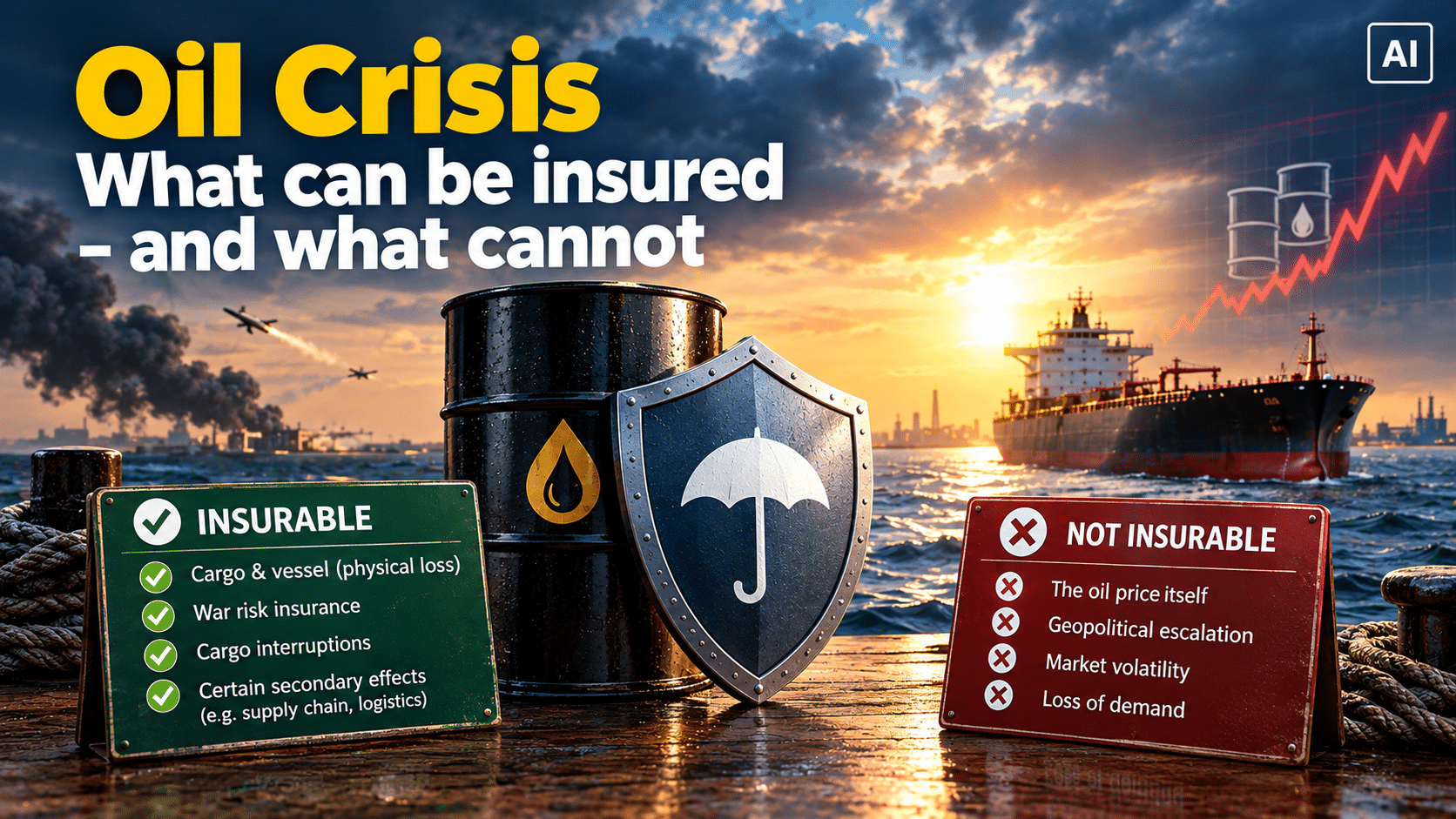
When the probability of attack becomes elevated and persistent, underwriters price the risk close to expected loss or tighten terms and capacity. Cover can remain available at a price while being commercially unattractive for ordinary traffic. Marine War covers the vessel and cargo against physical loss, but not the fact that the oil never arrives.
Illustrative Opportunity Cost
For a Very Large Crude Carrier insured for $150 million, a 7.5 percent war-risk premium adds roughly $11.25 million to the cost of a single transit. At 10 percent the figure rises to $15 million. In normal times the same cover might cost a few hundred thousand dollars. The incremental cost can exceed the freight earned on the voyage, making the transit commercially unviable for many owners even before residual safety considerations are taken into account.
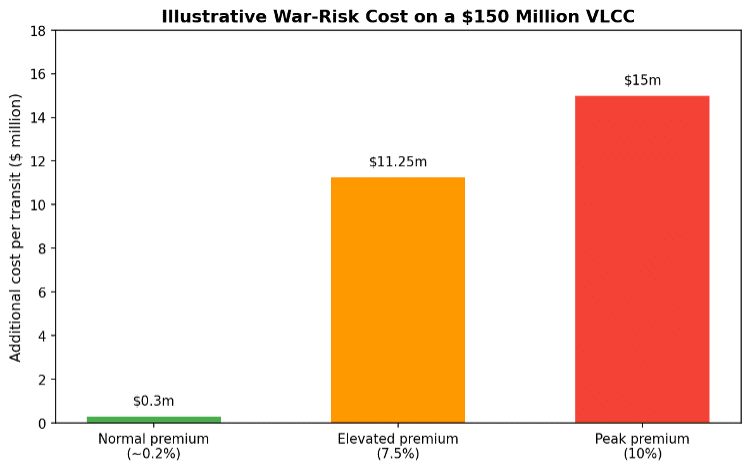
Figure 2: Additional war risk costs per voyage for a $150 million VLCC (illustrative).
Business Interruption Insurance
Anyone counting on their business interruption insurance faces two obstacles. The first is the war exclusion clause, included in most standard policies and capable of covering indirect consequences. The second is more fundamental. Business interruption and contingent business interruption typically require property damage, either to the insured party or to their supplier. Geopolitical disruptions usually do not result in any such damage. If a supplier is unable to deliver because its port is closed, revenue drops without anything having been damaged, and no standard policy applies. No insurance covers increased material and fuel costs.
The main risk for insurers is not so much the frequency of individual attacks as the fact that losses can pile up simultaneously across multiple lines, from property and casualty to marine and aviation to business interruption. An event that affects all of them at once sits outside the normal structure of an insurable risk. Reinsurers have taken precautions; some have set aside hundreds of millions for potential inflationary consequences of the conflict.
What Remains Available
The closest thing to coverage for oil shortages is Trade Disruption Insurance. It compensates for lost gross profit and additional costs if shipments are delayed or fail to arrive due to government measures or port closures, without requiring property damage as a prerequisite. It is offered on the London specialty market and by a handful of specialty insurers, accessible through major brokers. Capacity for the Gulf region is limited, and policies carry sublimits, waiting periods, notice requirements and exclusions.
Political risk insurance is an option for companies with contracts or investments in the region. It protects against financial losses resulting from government intervention or political instability, including war. Many of these policies exclude losses related to sanctions or already restricted jurisdictions. A model clause from the Lloyd’s Market Association illustrates the point: payment of a transit fee for the Strait of Hormuz can result in loss of all-risk coverage, because the payment itself may violate sanctions law.
Price Risk Belongs on the Capital Markets
No insurance policy protects against rising prices. Futures, options and swaps on Brent, WTI, diesel or kerosene have been standard practice for airlines, logistics companies and the chemical industry for decades. SMEs usually lack direct access to these instruments. They are left with fixed-price contracts with suppliers and price-escalation clauses with customers.
The Swiss Mechanism: Pflichtlager
Switzerland has its own mechanism for dealing with physical shortages. The private sector is responsible for the supply of petroleum products, both in normal times and during shortages. Mandatory reserves of gasoline and diesel cover about four and a half months of average demand. Released goods enter the market through the usual channels and at current market prices, without preferential treatment for any particular industry.
September demonstrated how this plays out in practice. The Cressier refinery, which covers a good 30 percent of Switzerland’s demand, shut down due to a technical malfunction, while low water levels in the Rhine hampered transportation. The federal government authorised withdrawals of up to 30,000 cubic metres each of diesel and gasoline, less than three percent of the stockpiles. The trigger was not the war, but a malfunction and a dry summer. Mandatory reserves ensure supply, not price stability.
Timing
Coverage is available for disruptions to a company’s own supply chain, contractual and political disruptions, and transportation risks, each with sublimits, waiting periods and short notice periods. What is not insurable is the possibility that the world as a whole will have less oil and pay more for it. Anyone who wants to hedge against this needs a broker with access to the London specialty market, a treasury department with hedging expertise, and good timing. War-risk coverage is bought before things go up in flames.
Binci Heeb
See also: How the Tables Have Turned
Search:
Sponsors: