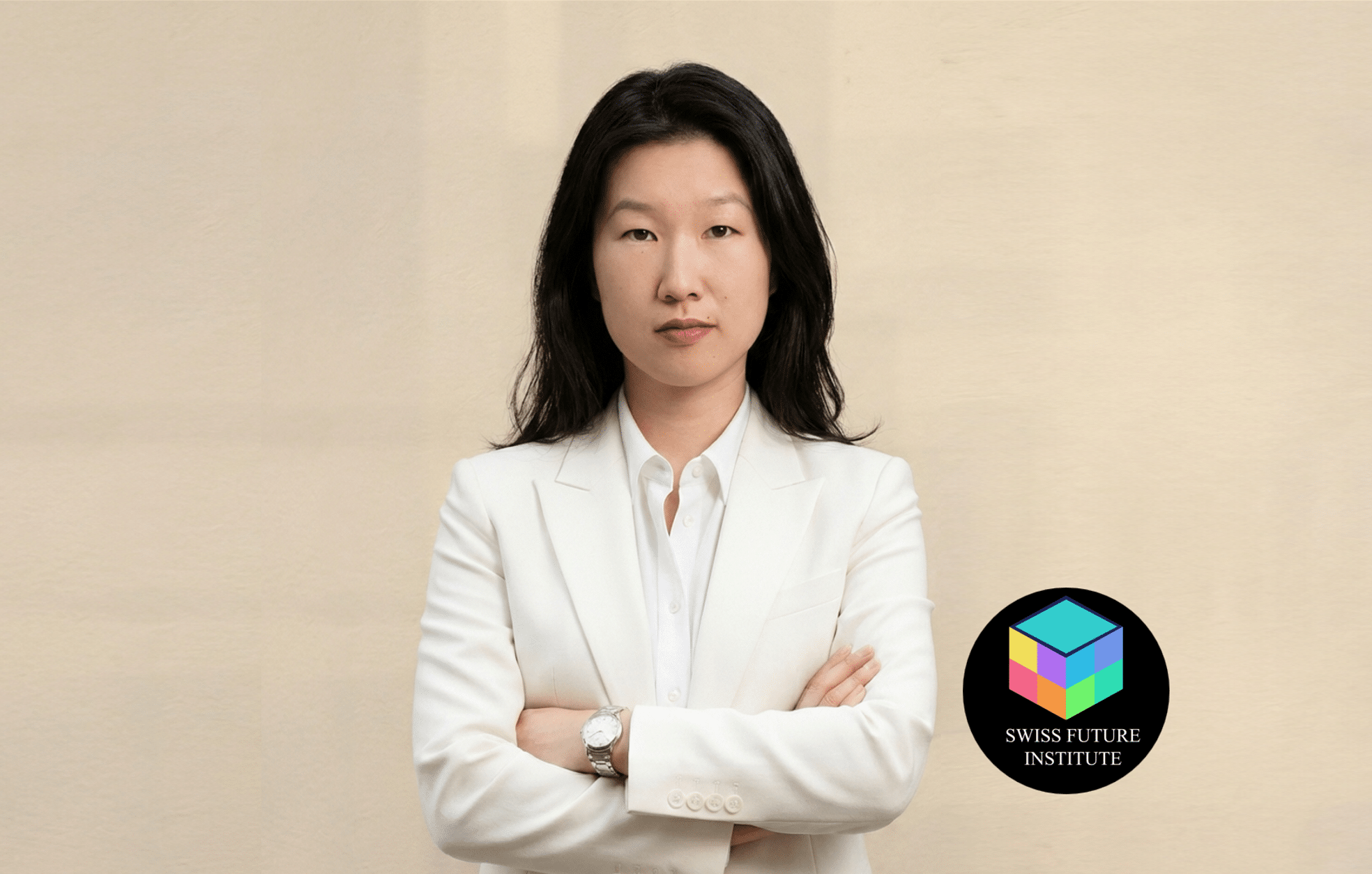
Artificial intelligence is no longer a topic for the future: it is already deciding on pricing, risk selection and competitiveness today. But while algorithms are becoming more precise, one question remains unanswered: Who will take responsibility? Katrin J. Yuan, CEO of the Swiss Future Institute, member of the Board of Directors and Chair of the AI Future Council, calls for more AI expertise on boards of directors and warns against strategic self-deception.
Insurers have always been data companies. But with AI, the playing field is shifting: decisions are automated, models learn independently, margins are created through speed. Katrin J. Yuan operates at the interface of finance, governance and AI. In an interview with thebrokernews, she talks about the loss of control in top management, algorithmic responsibility and why AI is becoming a leadership issue.
Ms. Yuan, have many boards of directors long since lost control of the topic of AI?
Control requires intellectual penetration. In many DACH committees, the delegation paradigm still prevails: AI is pushed to the IT department and dashboards are shown once a quarter. It seems like “AI yes, for the others.” This is a fallacy. Anyone who does not see AI as a substantial issue is steering their company blindly through the biggest economic transformation since industrialization. Like a “blind spot”, they don’t see everything that is possible and miss out on a lot, which in turn raises the question: How long can you afford to drive like this? We often see a dangerous discrepancy between regulatory requirements (compliance) and technological reality. Today, true control means being able to quantify the opportunity costs of doing nothing. Because doing nothing costs.
Is “AI strategy” in corporations often substance or rather PowerPoint rhetoric with a budget?
We are experiencing what appears to be the peak of “AI washing”. Pilot projects are being launched that look like digital petting zoos – nice to look at, but with no impact on core processes. A strategy only deserves this name if it changes the allocation of capital and cuts out old habits. Much of what we see on PowerPoints is defensive: “We also do something with ChatGPT.” Real substance shows up where AI lowers marginal costs and substantially increases customer lifetime value. It is important not to buy the “next best tool” and then look for use cases, but to first ask the fundamental questions at a strategic and cultural level in the company’s understanding. Technology alone does not solve the problems. Anyone who talks about AI must deliver.
Anyone who treats AI as an IT project has not understood the business model. Do you agree?
Unrestricted. IT projects optimize the status quo: AI, on the other hand, calls into question the raison d’être of existing structures. If an AI settles claims in seconds, I don’t need faster software for clerks, I need a new organizational model. Forcing AI into the corset of traditional IT architecture reduces its potential. We need to move away from “tool thinking” towards “platform thinking”. AI is not an add-on, but the new foundation on which the entire business model will be rescaled. Great new opportunities, great freedom comes with great responsibility, as I like to say.
When algorithms decide on premiums, is power shifting from humans to machines?
This is a widespread myth. Power is not shifting to the machine, but is concentrated in the hands of those who define the parameters and objectives of the algorithms. The machine is a highly efficient executor of human intentions or human ignorance. The real shift in power is taking place within the hierarchies: Away from the experienced “gut feeling manager” to the data-competent strategist. Paradoxically, human responsibility increases precisely where the machine takes over.
Does personalized AI pricing endanger the solidarity principle of insurance?
We are heading towards an ethical trilemma. Technically, “segment-of-one” pricing is almost perfectly possible thanks to AI. But if we look at each individual risk in isolation, we destroy the basic idea of insurance as a collective community. The challenge for CEOs in DACH is to create a Smart Solidarity to develop: How do we use data for prevention (which helps everyone) without excluding those who are statistically “more expensive”? Those who rely solely on technical precision here will lose their social license to operate. At the Swiss Future Institute, we look at things from multiple perspectives and through the lens of the future. The topic will become very exciting in the future with regard to geopolitical, technological, regulatory and socio-demographic developments.
Is a lack of AI expertise on the Board of Directors a governance risk today?
Absolutely. It’s comparable to a board of directors in the 90s who couldn’t read a balance sheet. If the supervisory body does not understand the risks of algorithmic bias, data monopolies or technical debt, it is in breach of its duty of care. We don’t need computer scientists on the BoD, but we do need “algorithmic literacy”. Those who cannot scrutinize the black box cannot protect the company from the systemic risks of the future. Today, this is a question of liability and responsibility. As a member of the Board of Directors, I continue to educate myself because I am currently relevant, capable and responsible in my strategic commitment to the company. It is not enough to rest on the laurels of past successes, but also to ensure success in the future. When the parameters of the game change, I change with them as a board member. As a university lecturer and author on AI, I talk about “futures skills” and how human skills will change in the age of the machine.
How many executives underestimate the speed of AI competitive advantage?
The majority still think linearly, while technology is scaling exponentially. In traditional consulting, we have learned that the big eats the small. In the AI era, the same applies: the fast one eats the slow one and the fast one becomes a giant overnight thanks to AI. The tipping point often comes gradually, and once the competitor’s competitive advantage becomes visible on the balance sheet, the lead is usually already unassailable. Some underestimate not only the technology, but also the speed of market consolidation. Standing on the sidelines and watching while the others run the race comes at a cost.
Does management really want full transparency about its own decision-making logic?
This is the crux of the matter. We demand Explainable AI because we are suspicious of algorithms. But are human decisions in middle management really always transparent and logical? AI often reveals how inconsistent and biased human decisions are. Explainability is a double-edged sword: it forces management to be radically intellectually honest, which many shy away from. Anyone who demands transparency from AI must be prepared to make their own privileges and gut feelings measurable, to disclose processes and parameters.
AI discrimination: data problem or ethical failure?
A data problem is a symptom, ethical failure is the cause. Data is merely the historical imprint of our societal mistakes. If a model discriminates, it is because management has ignored the blind spot in its own data history and has not sufficiently tested and corrected it. This is possible in terms of data. Anyone who feeds an AI with dirty data from the past and expects a clean result is acting naively. Ethical leadership today means actively using AI as a tool to correct human biases instead of copying the status quo, automating and scaling up uncontrollably. This is a fundamentally relevant component that needs to be addressed from the outset and not just at the end, when AI is in the company but is not working as expected.
Will the EU AI Act weaken Europe or force it to take structured action?
The question is: Is it an initial, sufficient or over-regulated of the world before the new world emerged? What comes first, innovation or regulation? Ideally, one supports the other without hindering it. Yes, some see the AI Act as a bureaucratic burden. On the other hand, it also offers the opportunity for a Made in Europe quality label. If we manage to integrate ethics and compliance into the design process, we will build systems that customers around the world will trust more than the Wild West models from the USA. Trust is a tough competitive advantage if we see regulation not as a stop sign, but as an infrastructure for high speed. The train should travel quickly and safely without derailing.
Why do so few radically new business models emerge from data pools?
Because most insurers manage their data like an archive and not like a laboratory. Data is used to explain the past (reporting) instead of shaping the future (prediction). In addition, legacy systems and silo structures hinder the creative flow. Radical innovation is created at the interfaces, but the data is stored in separate cellars. We need to stop thinking in terms of products (car, house, life) and start thinking in terms of life events and life phases, which we accompany using data. The customer evolves through the lifecycle and we should go with them and meet them where their lives take place.
Could AI lead to only the most data-rich providers surviving in the long term?
Data wealth alone is no longer a moat if you don’t have a data-to-action pipeline. We are seeing a polarization: on the one side the data giants, who win through volume, and on the other side the agile“specialists”, who win through superior algorithms and niche knowledge. The midfield, companies with a lot of data but slow implementation, is crushed between these poles. The winners are not necessarily those with the most data, but those with the highest learning rate per day. I like to say: it’s not the biggest that survive, but the most adaptive.
Do we need mandatory AI skills profiles for board members?
As an entrepreneur and board member, I advocate a voluntary commitment before the regulator arrives. A board of directors must be able to read an AI impact map for their company. Anyone who accepts a board mandate in the financial industry today without mastering the basics of machine learning and data ethics is basically acting irresponsibly. We don’t need expert boards, we need expert-led boards that are highly digitally literate. And this starts with the Board of Directors.
Will AI replace more jobs or debunk management myths?
Above all, it will replace mediocrity. Wherever people only act as human interfaces between two systems, AI will take over. Much more exciting, however, is the demystification of management: AI debunks the myth of the omniscient leader. In future, true leadership will no longer be defined by knowledge (AI has that), but by the ability to ask the right questions, shape culture and make moral judgments in complex situations, connect the dots and interpret the data. Management will be different, more challenging, not easier. In my book AI Knowledge for Leaders, I write about how the role of leadership, future readiness and understanding will fundamentally change. People will not necessarily become less important, but will take on a different significance.
An inconvenient truth about AI in the insurance industry?
The industry is waiting for the one big bang, but disruption is already quietly taking place every day. The uncomfortable truth is that many insurers are currently using a lot of money and AI to optimize a business model that could be obsolete in ten years thanks to prevention and real-time risk management. We are building more efficient typewriters while the world switches to voice control. I visit Asia, the USA and Europe every year and see the direct comparisons and trends of what is already possible today. There’s still a lot of exciting things to come in the future.
The questions were asked by Binci Heeb.
Note:
The Future Symposium 2026 of the Swiss Future Institute will take place on March 26 and 27, 2026 in Zurich takes place.
Swiss Future Institute AG
Masterclass | Membership | Future Symposium | Consulting
T/WA +41795227613
Email ai@futureinstitute.ch
Follow and Connect
LinkedIn | Instagram | Youtube
Read also: LBC Insurance Radar 9: AI becomes a management task
Search:
Sponsors: