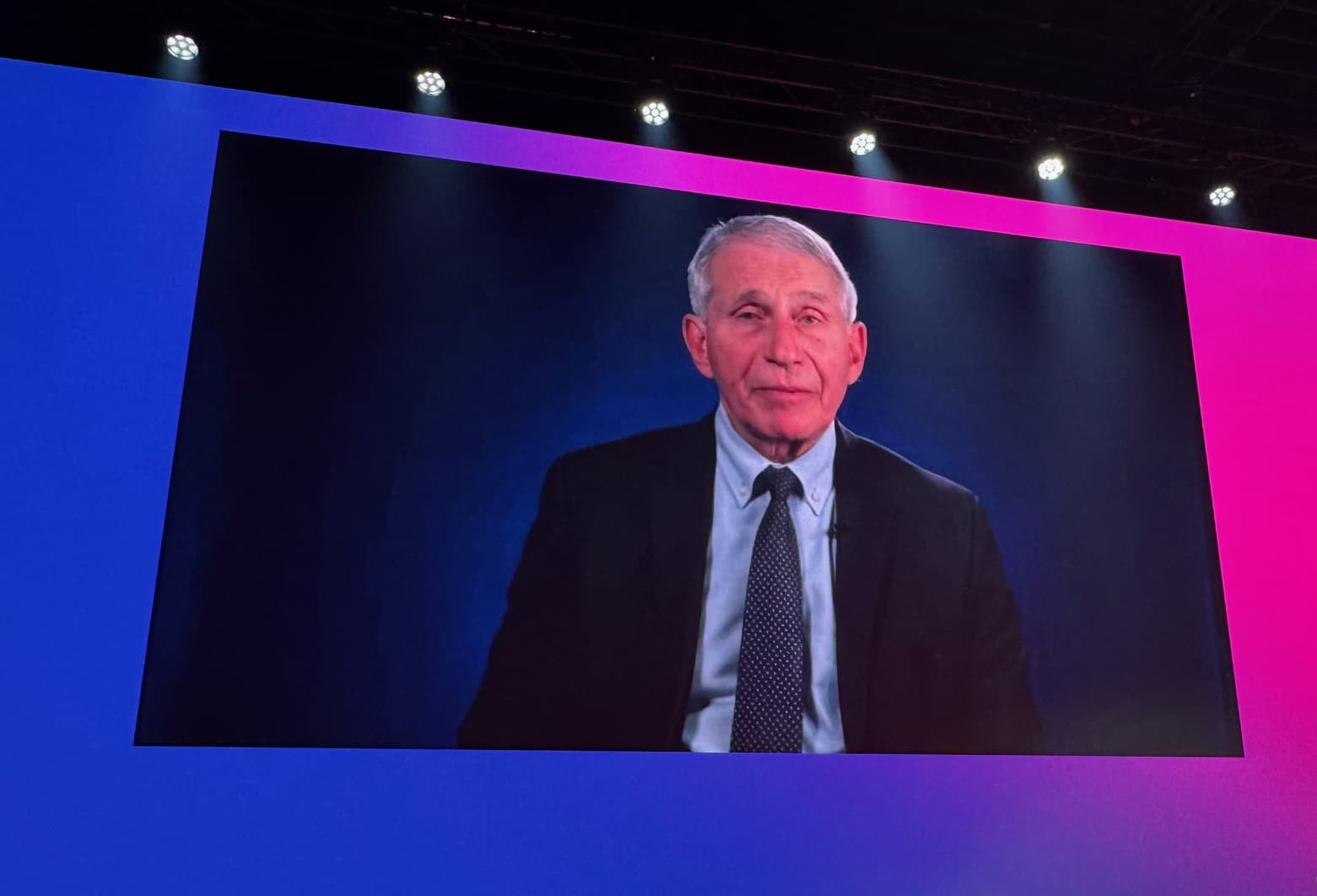
At the Health Tech Global Summit in Basel (3 and 4 March 2026), Dr. Anthony Fauci, the world’s most famous immunologist, joined us from the USA to remind the audience how quickly the unexpected can turn into a global health crisis. His central message: pandemic resilience is not created in a crisis, but through long-term research, resilient institutions and communication that can withstand uncomfortable truths.
The moderator was Rute Fernandez, an internationally experienced life sciences manager. Dr. Anthony Fauci looked back on his 54 years at the US National Institutes of Health (NIH), including 38 years as Director of the National Institute of Allergy and Infectious Diseases. His path has been anything but linear and this is precisely one of his most important lessons: In medicine and healthcare, you always have to expect the unexpected.
HIV/AIDS: The dark years and the lesson of listening
The turning point for Fauci came in the summer of 1981, when the CDC (U.S. Centers for Disease Control and Prevention) reported unusual pneumonia and Kaposi’s sarcoma in previously healthy young men. He spoke of goosebumps and of a career decision against the advice of his mentors: he gave up a successful research program on inflammatory vascular diseases to devote himself entirely to the new, mysterious disease.
He called this phase the dark years of his professional life because almost all the patients died. According to Fauci, it was precisely there that he learned what later became crucial with Ebola and COVID-19: Leadership means mobilizing resources, consistently building scientific programs and viewing the affected community not as a disruptive factor, but as a partner. The AIDS activists were often right with their theatrical and disruptive advocacy. The lesson was: listen before you explain.
PEPFAR: Moral responsibility as a political lever
As an example of what political leadership can achieve in conjunction with science, Fauci described the emergence of PEPFAR (U.S. President’s Emergency Plan for AIDS Relief). After HIV therapies saved lives in rich countries from 1996, sub-Saharan Africa was left behind. In 2002, President George W. Bush commissioned him to examine whether a transformable program was possible.
The result was PEPFAR and was announced in the State of the Union address on January 28, 2003, initially with $15 billion over five years. Today, Fauci said, the program has mobilized over $100 billion in more than 50 countries and saved 25 million lives. In Basel, this retrospective served as an argument that global health is not charity, but creates measurable impact when goals, funding and accountability fit together.
COVID-19 in two pots: science shone, healthcare didn’t always
Fauci chose a clear distinction for COVID-19: in the scientific pot, the performance was spectacular and led from the publication of the virus sequence to vaccination in just eleven months thanks to a public-private partnership. In the healthcare sector, on the other hand, the results in the USA were not optimal. It should have been much better. This is not an abstract finding, but a work assignment: the next pandemic is sure to come, only the timing is uncertain.
Integrity at the center of power: Inconvenient truths are a must
When asked how to advise seven presidents across ideological boundaries, Fauci described his point of orientation as: Science, honesty and integrity, even when it gets uncomfortable. An older colleague had advised him before the first appointment in the White House to tell himself each time that it could be the last time, because you might have to speak a truth that the president doesn’t want to hear. It is precisely this mechanism of not wanting to please that is very dangerous.
Fauci drew the bridge to COVID-19 when he described interventions such as hydroxychloroquine or ivermectin as ineffective and received backlash for this. His point in Basel: credibility does not come from popularity, but from consistency.
NIH and freedom of research: When politics controls science
Fauci was particularly clear on a current topic, the changes in NIH funding and leadership. He spoke of his concern about a development in which scientific leadership is being weakened and replaced by political ideologies. His principle is the opposite: “Science drives policy”, not “policy drives science” (science sets the direction for political decisions, not the other way around). Research that is only permitted if it fits in with administrative priorities threatens creativity and discourages young talent. The consequences are not immediately visible, but will be all the more painful in a few years’ time.
Misinformation as a health risk and a test of democracy
What concerns him most at the moment, said Fauci, is the normalization of untruths: Misinformation and disinformation make it difficult for people to distinguish truth from assertion. This destroys trust in institutions and directly costs lives in the healthcare sector. In Basel, this sounded like a warning to the entire HealthTech and MedTech sector: innovation can only work if societies learn to accept evidence-based decisions again.
Pandemic preparedness: long-term research, global networking, robust systems
His recommendation for governments and organizations was unequivocal: preparation is permanent. The foundations for rapid responses are laid years in advance, such as the discovery of reverse transcriptases, without which HIV diagnostics and therapy target structures would hardly have been conceivable. In addition, a globally networked early warning and response capability is needed because new pathogens do not wait at borders. Those who dismiss pandemics only as a problem of unhealthy populations are ignoring history.
Healthcare means national security
Fauci linked healthcare policy with geopolitics: “An unhealthy country is an unstable country”, he said, quoting Colin Powell – the four-star US Army general was National Security Advisor from 1987 to 1989 – adding that instability opens up spaces for extremism and conflict. He thus explicitly placed the healthcare system in Basel within the logic of resilience, stability and security architecture.
Final message: Less division, more common denominator
At the end, Fauci got personal. His appeal was directed at the more than 1,000 managers present: the world would become healthier, person by person, if we recognized how similar people are to one another. Polarization is the enemy of a good healthcare system. Trust, scientific honesty and a minimum level of social unity are not just accessories, but are the infrastructure on which innovation can unfold its full effect.
Binci Heeb
Read also:
Search:
Sponsors: