Switzerland is aging, and with it, the logic behind life insurance. What was once purely a wealth-building product must now evolve into a tool for the systematic, lifelong use of savings. At the same time, the VAG, AVO, SST, and the European POG regulations are tightening documentation requirements, with the paradoxical result that these very protective mechanisms can hinder the very customers they are actually meant to protect. Thomas Schubert explains why demographic change is not a compliance burden, but rather the industry’s greatest market opportunity in decades.
Imagine a wine cellar that has been stocked according to the same formula for forty years. Always the same barrels, the same aging period, the same time of year for sales. It works wonderfully—as long as the clientele remains thirty-somethings who love to drink.
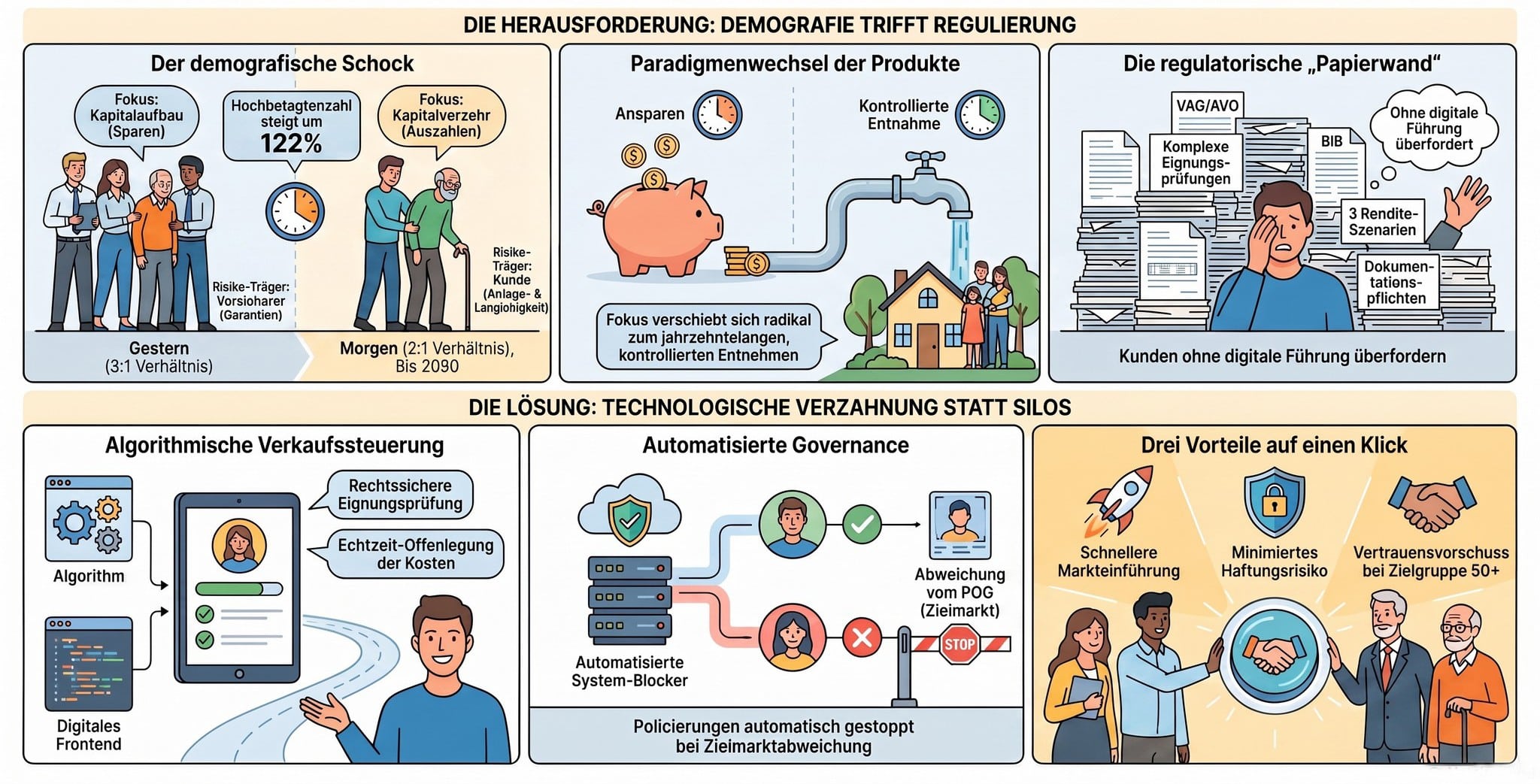
Demographics now come into play. Switzerland has an average of 1.29 children per woman. Life expectancy is rising to 85.9 years for women and 82.4 for men. The ratio of working-age people to retirees will shift from three to one to two to one by mid-century. The number of very elderly people will grow by 122 percent by 2050.
So your wine cellar is filling up with significantly more barrels that need to age for significantly longer. And the sales model is shifting radically from “filling barrels” to “carefully drawing from barrels over decades.”
That is precisely what this gradual unraveling is all about, and that is exactly where the real story of this column begins.
The Product Perspective: From Saving to Paying Off
Your traditional life insurance policy was designed to build up capital. You pay in premiums, earn interest, and receive a payout at the end. It’s a model that was never intended for the phase of gradual drawdown—the planned, lifelong use of the accumulated capital.
The longevity risk further complicates the calculation: If the insured age group lives longer on average than projected in the mortality tables, this causes pension obligations to rise unexpectedly.
Under the Swiss Solvency Test (SST), any long-term interest rate or annuity guarantee is subject to steep equity capital requirements. As a result, insurers are moving away from traditional guarantees and focusing on unit-linked products, in which the investment risk is passed on to the customer.
This only becomes feasible with “life-cycling”: As you age, this investment strategy automatically shifts your portfolio from stocks to safer investments. It sounds simple, but it becomes highly complex from a regulatory standpoint once you factor in long-term care options, assistance services, and flexible payout plans.
The Governance Lens: VAG and AVO Have Rewritten the Rules of the Game
As of January 1, 2024, the completely revised Insurance Supervision Act has been in effect, with a new category at its core: “qualified life insurance” (Insurance Supervision Act, Art. 39a). Any product that involves a risk of loss during the savings process falls under this category. In other words, this includes almost every modern unit-linked policy.
Three consequences that directly affect day-to-day sales operations:
First: This is mandatory prior to the conclusion of the contract; it must clearly state the cost, risk, and return profiles, and, in accordance with AVO Art. 129k, must be reviewed regularly and updated in the event of material changes.
Second: FINMA found that over 90 percent of the “adverse scenarios” reviewed were far too optimistic. In some cases, they assumed a 3.5 percent return, even though risk-free investments were yielding negative returns. Since FINMA Circular 2024/02, three scenarios have been required, with the adverse scenario mandatorily set below the SNB’s risk-free yield curve.
Third: The suitability assessment under VAG Art. 39j has effectively been expanded by AVO Art. 129m to a full suitability assessment. Financial capacity, risk tolerance, investment objectives. All three must be documented and reviewed before you are permitted to recommend a product. If the assessment is negative, you must explicitly advise against the transaction. And all documentation must be available upon customer request within ten business days.
The European Perspective: POG and Value for Money
The rules in Switzerland are even stricter than those in the EU. Product Oversight and Governance (POG) under IDD Article 25 requires that every product have a defined target market and a defined negative target market. This means you must not only know who a product benefits, but also explicitly document who it would harm.
The “value for money” doctrine goes even further: The European Insurance and Occupational Pensions Authority (EIOPA) compares products based on cost ratios and returns on investment. Any product that stands out as an outlier is automatically placed under regulatory scrutiny.
The Customer’s Perspective: When Protection Becomes an Obstacle
And now for the ironic twist in this story: All these protective measures can actually hold back the very people they are meant to protect.
According to studies, 32 percent of the Swiss population has significant gaps in their basic financial knowledge. A 68-year-old client who, out of a need for security, lets his money sit idle in a savings account—and is losing purchasing power in real terms—might want to switch to a life-cycling product. This would be the most economically sensible choice to mitigate his longevity risk. However, if he cannot assess the volatility of the funds, the financial advisor is legally prohibited from recommending the product—even if it were the best solution.
Added to this is the flood of information: BIB, brokerage fee disclosures, three scenario calculations, and ESG inquiries. Many customers abandon the process before they can even make an informed decision.
The Bridge: Four Pairs of Glasses, One System
Product development sees the risk of obsolescence. Governance sees the documentation requirement. The European level sees the target market and the cost ratio. The customer sees a wall of paper.
The Bridge: Those who integrate these four levels technologically, rather than working through them as four separate checklists, can solve with a single measure what others would have to tackle four times over.
Specifically, this means: a sales front end that uses algorithms to guide the consultation process. Dynamic questionnaires for suitability assessments. A “system blocker” that automatically halts policy issuance if the customer profile deviates from the defined target market. BIB and brokerage fee disclosures generated in real time and archived in an audit-proof manner. FINMA’s ten-day deadline is thus no longer a source of stress, but just a click away.
At the product level, this means that the “Product Approval Process” automatically checks whether the cost structure remains fair compared to the market. If the environment changes—for example, due to a shift in interest rates or a surge in inflation—the system automatically triggers a product review. And in the ORSA process (Own Risk and Solvency Assessment), the results of demographic stress tests feed directly back into product development, rather than getting lost in a report that no one reads before the next meeting.
The Point That Counts
Anyone who treats VAG, AVO, SST, and POG as a burden is just shuffling paperwork. Those who view them as an integrated system gain three things at once: faster time-to-market, reduced liability risk, and a head start in building trust with precisely the customer group that will hold the lion’s share of pension assets over the next 25 years.
Demographic change is not a governance or compliance issue. It is the greatest market opportunity the life insurance industry has had in decades—provided that governance and compliance keep pace with it rather than lagging behind, and that a SILO-FREE environment can develop.
Which of your products would pass an unannounced product review today?
TURNING REGULATION INTO VALUE!
Thomas Schubert
Mr. #DeedsCountMore
See also: D&O Insurance for SMEs: Those Who Are Liable Usually Don’t Know It
Search:
Sponsors: