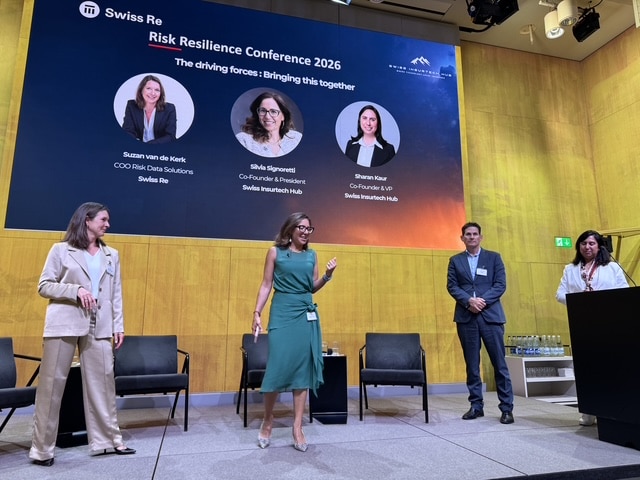
On September 3, 2026, the Swiss InsurTech Hub, in collaboration with Swiss Re, hosted a conference at the company’s Zurich headquarters, the title of which could almost be read as an understatement: “Building Resilience.” What followed was a journey lasting several hours through flood models, polycrises, IoT sensors, and the question of why insurers are chronically too slow despite having capital, data, and technology. In the end, one sentence stuck with everyone—one that is likely to affect the entire industry: There is an action gap, and it is not getting any smaller.
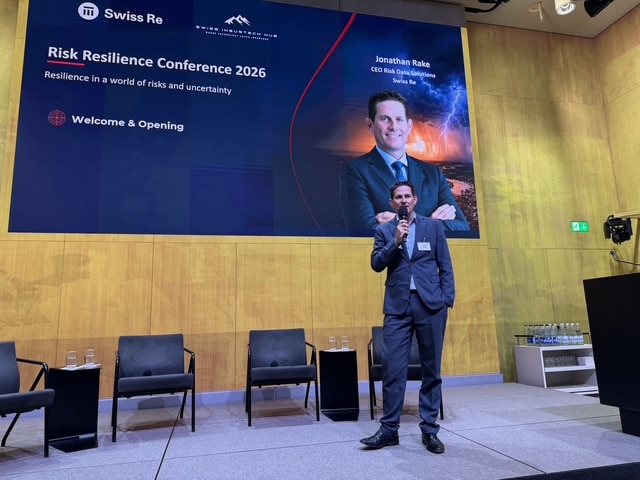
To his credit, Jonathan Rake, CEO of Swiss Re Risk & Data Solutions, began his opening remarks not with a slide number but with a location: Glarus, 70 kilometers southeast of Zurich. In 1861, two-thirds of the city burned down there within a few hours—about 600 houses belonging to what was then a thriving textile industry. No single insurer could bear the loss alone. It was a systemic market failure from which Swiss Re emerged two years later, in 1863. Resilience, as Drake pointed out, was not a marketing gimmick, but the founding principle.
He distilled his opening remarks into three points. First: Historically, there has been too little investment in resilience—a shortcoming that is currently changing. He cited a figure from the Asian Development Bank from his time in Singapore: Of every ten dollars spent, only one went toward prevention, while nine went toward damage mitigation afterward. Second: There is “no better time for collaboration”—driven by advances in data and technology, but also by customers who no longer simply buy a product but want to actively help shape it. Third, and this is the very core of his presentation: the journey from “insights” to “decision intelligence.” A data insight that reaches the underwriter two days too late is worthless. His reference to the “black-box paradox” was particularly interesting: the more precise data becomes, the less transparent it often is as to where it comes from and why it was originally collected—thereby creating a systemic risk within the risk business itself.
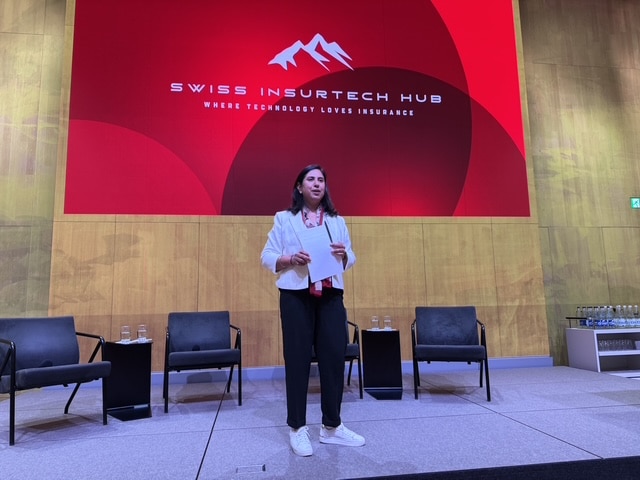
The bill: $220 billion, half of which is insured
This was followed by a keynote address that presented some figures worth noting. Global economic losses from natural disasters totaled $220 billion in 2025, of which about $100 billion—just under 50 percent—was insured. The good news: This insurance coverage rate has never been higher. The bad news: It was still only 50 percent, and in emerging markets, it’s often below 5 percent. Also noteworthy: The insured losses in 2025 did not stem primarily from classic peak risks such as U.S. hurricanes, but rather from flash floods, flooding, and wildfires—hazards that traditionally were not the major cost drivers.
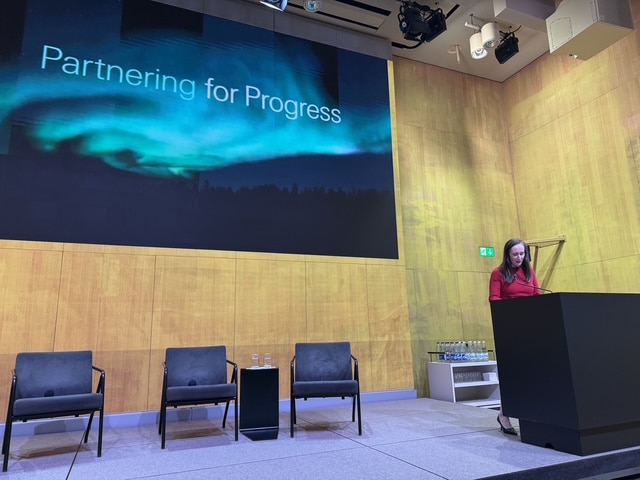
Switzerland itself served as an example: 40 days of heat exceeding 30 degrees in Zurich this summer, compared to a ten-year average of 10. Following the dry summer, the federal government announced 17.5 million Swiss francs for forest adaptation—a preventive measure—as well as 54 million in interest-free loans for farmers who were unable to sell their harvest as expected, a classic example of post-event financing. It is precisely this imbalance, the speaker said, that must be reversed. As a positive example, she cited a city in the southwestern U.S. that took out parametric extreme heat insurance, which triggers during unusually long heat waves without nighttime cooling and finances cooling measures, embedded directly in the city’s budget. A second example was the first deal to embed a natural catastrophe (Nat-Cat) risk transfer into a loan, in collaboration with the Inter-American Development Bank for the government of Belize. This approach is scalable because governments and companies already work with loans. You just have to channel resilience into the places where the money is already flowing.
Multiple Crises and the Question of Who Actually Benefits
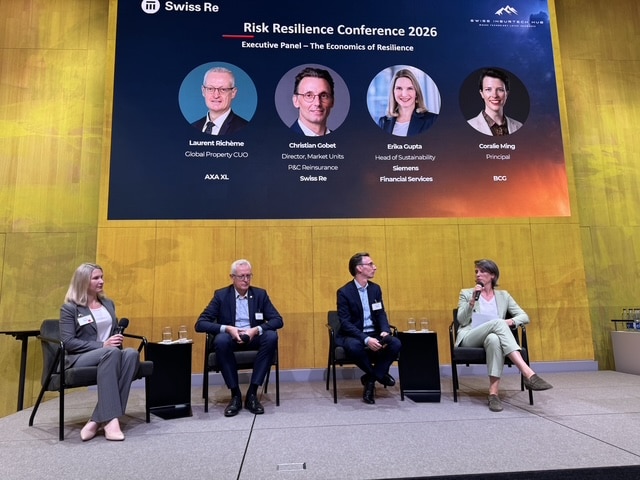
In the subsequent panel discussion featuring Erika Gupta (Siemens Financial Services), Laurent Richème (AXA XL), and Christian Gobet (Swiss Re)—moderated by Coralie Ming (BCG)—one term stood out: “polycrisis.” Geopolitical tensions, cyber risks, climate change, and water scarcity are no longer isolated issues, but are intertwined and reinforce one another. Rechelle illustrated this using the example of the start of the war in Ukraine: supply chain disruptions, an energy crisis, inflation, potential shortages of agricultural goods, and—in his personal assessment—an increase in cyberattacks from Russia—all triggered by a single event.
The real point of the panel, however, was structural: Those who make investments in resilience are often not the same parties who benefit from them. A building owner invests in storm protection, but the economic benefits—fewer injuries, less government emergency aid—are realized elsewhere. Erika Gupta cited the example of a house on the Florida coast that was the only one left standing after a hurricane because it had been built well above the required building code standards. Economically, this investment could hardly be justified by the insurance premium alone. The actual benefit (no evacuation, no government-funded reconstruction) does not appear in any damage calculation. This is precisely where, according to the consensus, new business cases are needed—ones that highlight not only the reduction in premiums but also the overall economic benefits. The “Fortified Roof” programin Alabama was cited as a concrete example, in which the state directly provides grants for storm-resistant roofs.
Richème also made a remarkably candid statement about market realities: In a soft market with ample capacity, it is hardly worthwhile for insurers to differentiate between resilient and less resilient customers. Only in a hard market is resilience tangibly rewarded. A statement that contradicts many a sustainability brochure.
Flood models for the entire planet
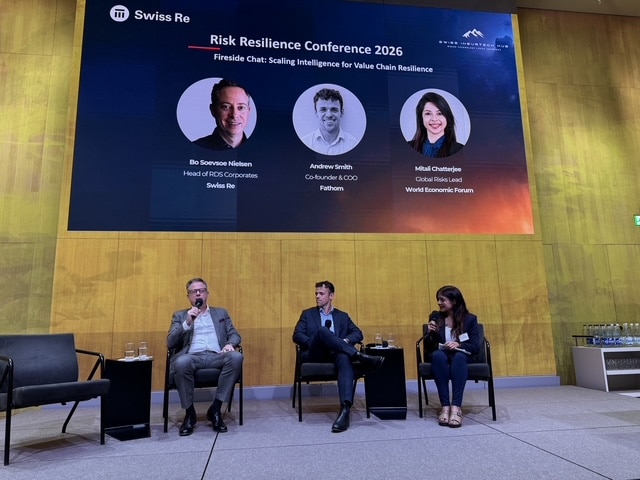
In the fireside chat that followed, Bo Soevsoe Nielsen (RDS Corporates Swiss Re) and Andrew Smith from Fathom—the flood modeling company that is now part of Swiss Re—joined moderator Mitali Chatterjee. Smith, a self-proclaimed “One-trick pony“With a very clever twist,” he described the impetus behind his company’s founding: the 2011 floods in Thailand, an “unmodeled loss.” They simply hadn’t seen it coming, even though it would have been visible on their own screen as an industrial area underwater. Fathom builds physics-based models that—unlike generative AI, which Smith smugly referred to as “elaborate plagiarism”—can also simulate events that have never occurred before, worldwide and for any location.
Nielsen, for his part, soberly described the biggest blind spot of large corporations: the failure to acknowledge that they have blind spots at all. Reputational risks at individual locations, for example, could escalate into “stranded assets” if customers or suppliers pull out, turning what was originally a reputational problem into a balance sheet issue. Both agreed that visualizations—rather than abstract risk scores—are particularly effective: when you show corporate leadership what happens to a specific, critical facility, people in the room take notice.
Five Insurtech Companies, One Common Denominator
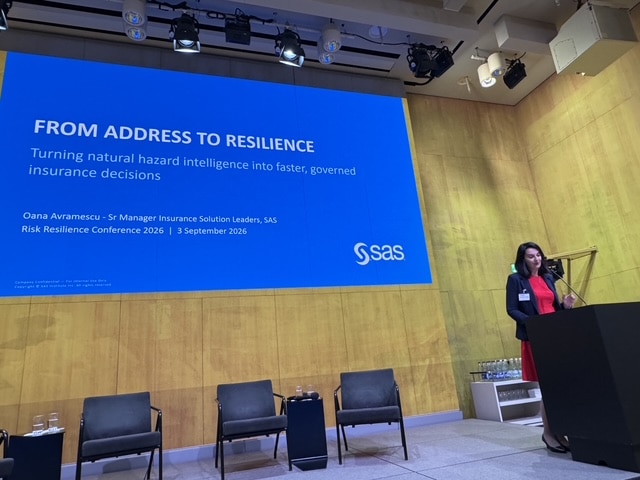
The afternoon was then dedicated to five InsurTechs, which presented their solutions in eight-minute intervals. Sas demonstrated how Swiss Re CatNet data is directly incorporated into underwriting decisions, from product configuration to automated client reporting. Previsico addressed a little-known gap: About 70 percent of all flood damage in the U.S. occurs outside FEMA’s official flood zones, due to rain-induced or near-water flooding for which there are no government warning systems. A case study involving the construction of a high-speed rail bridge in the United Kingdom illustrated the difference: Thanks to an early sensor warning, a construction site was evacuated in time, turning a potential loss of millions into zero damage.
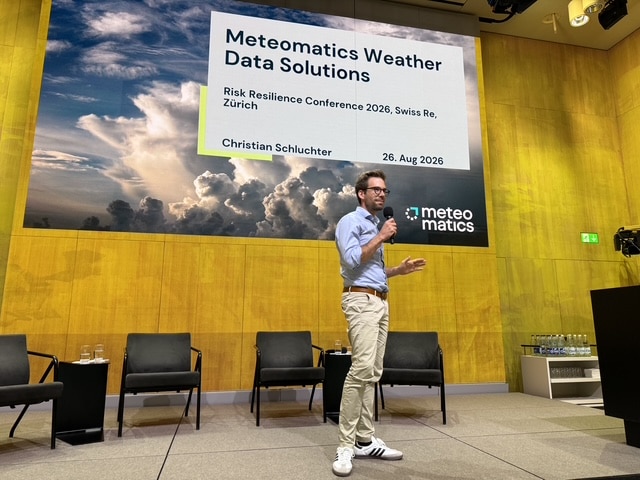
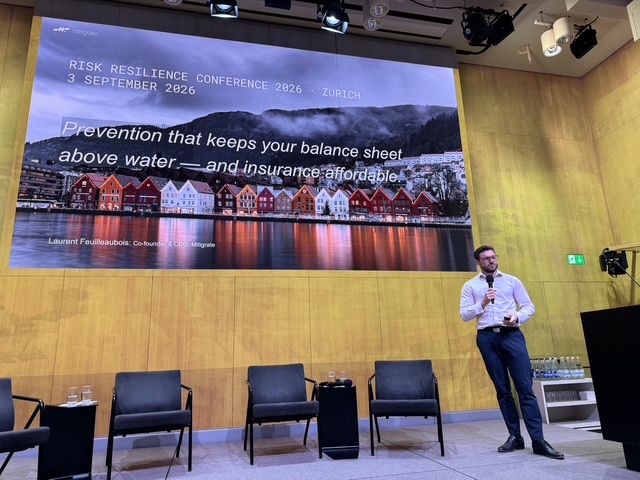
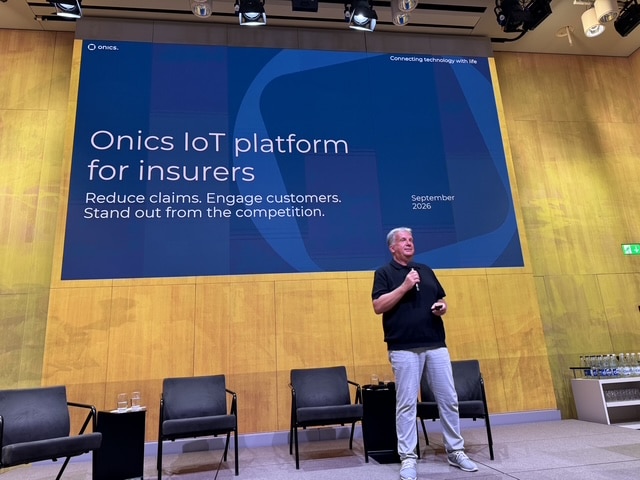
Mitigrate Using the 2007 Gloucester flood as an example, he calculated how much investment could be saved by protecting the right buildings instead of the wrong ones: For the 12 percent of buildings with the highest preventable damage, 50 percent of the total damage could be prevented. For the wrong It takes 88 percent of the same investment to achieve the same effect—a difference of 300 million pounds. Onics A company from Scandinavia presented an IoT platform that uses sensors to detect water damage early on and offers insurers a white-label app for proactive customer communication, with the goal of improving the notoriously poor combined ratio in property insurance. Meteomatics Finally, a study from St. Gallen showed how weather simulations at a resolution of one kilometer (compared to eight kilometers in standard global models) can reduce damage verification costs by 50 percent.
The Action Gap
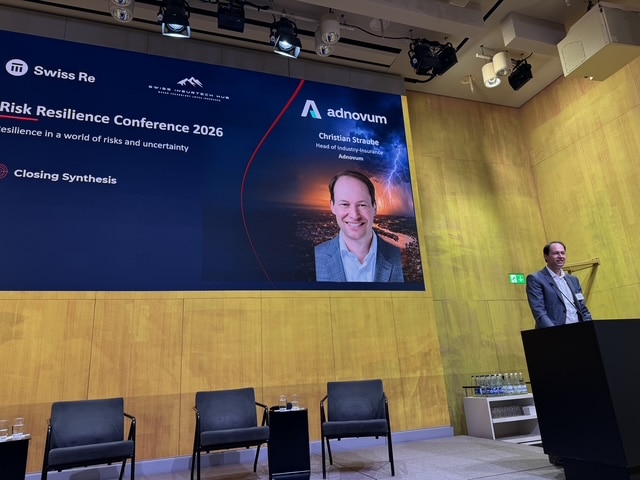
Finally, Dr. Christian Straube delivered the most analytically incisive presentation (Adnovum) in his synthesis. His thesis: The insurance industry was invented to manage uncertainty, but that is no longer enough because a new factor has entered the equation: speed. The world is changing faster than insurers can react, creating an “action gap.” His examples struck a chord: shadow AI in companies because governance processes are too slow; quantum computing, which clients like Roche and Mercedes-Benz have long been using in their supply chains, while insurers almost exclusively classify the topic as a cryptography risk; and autonomous vehicles, for which there is no “driver’s age” factor in actuarial models.
His solution to the “Action Gap” rests on three pillars: first, a radical focus on the user—people don’t think in terms of policies and claims, but in terms of life situations (no car, but an important appointment tomorrow—why not a shuttle bus instead of filing a claim?). Second, technology as a means to an end rather than an end in itself: No restaurant advertises that it uses “very good knives,” and insurers shouldn’t advertise AI, but rather the results it delivers. And third, standardization for integration: Systems that understand each other before building ecosystems. A nice aside: Machine learning only identifies patterns in the data it’s fed. If medical protocols have historically been developed primarily based on male bodies, the model is of little use for prescribing medication to a woman. This is a warning worth keeping in mind for any discussion of AI in the insurance industry.
A conclusion that should be taken seriously
What stood out that afternoon was not so much the sheer number of data points: flood models, IoT sensors, weather simulations at a kilometer resolution—but rather the consistency of a single message: Resilience is not a product to be sold, but an ecosystem to be built together, and data alone solves nothing if the decision comes too late. There are 165 years between Glarus 1861 and the Action Gap 2026. The question of whether an industry is acting quickly enough is clearly not one that can be answered with even more models.
Binci Heeb
See also: Swiss InsurTech Hub Looks Back on an Eventful First Half of the Year
Search:
Sponsors: