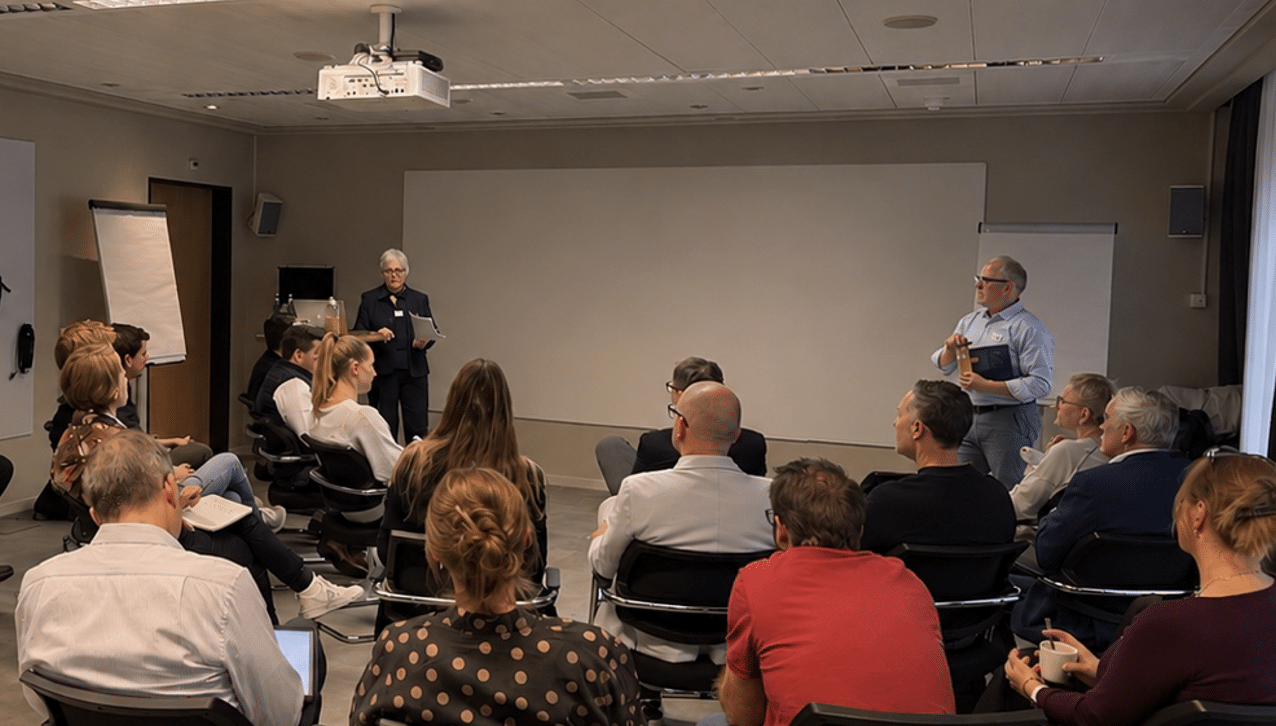
Analyses in hours instead of weeks, typo-free texts, slides that look like they came from a design studio: Artificial intelligence is changing not only the world of clients, but the very nature of consulting itself. At a networking event hosted by La Bella Consulting, consultants, lawyers, insurance experts, and technologists discussed what would remain of the profession if knowledge were suddenly available to everyone. The answer was both more unsettling and more reassuring than expected.
For a long time, consulting thrived on a simple exchange: knowledge for an hourly rate. It is precisely this model that is now under pressure. What once set experts apart is now available to clients with just a few clicks. Host Stephanie Rielle La Bella summed it up right at the start: For years, the consulting industry has guided clients through new strategies, structures, and forms of collaboration. Now, the consulting industry itself is in the midst of a transformation. Its role is shifting—away from being a purveyor of answers and toward becoming a co-creator, a guide, and a trusted anchor. And it’s essential to clarify how to handle confidentiality, data protection, and quality responsibly.
The book *AI-Native Consulting: A Compass in the Age of Algorithms* by Stephan Weber, Daniel Ehmann, and Stefan Schmautz served as the guiding principle. Their thesis: AI is not simply another tool for consulting; it changes the very nature of the field. Weber himself sums it up in one sentence: “The more intelligent machines become, the more important human judgment becomes.”
For the afternoon session, the host posed three questions: Where does AI already add real value in your own work today, and where does it not yet? What services do customers still need people to provide? And what could we offer collectively as a network that we couldn’t offer on our own? The focus shouldn’t be on tools, but on experiences: what has worked, what has gone wrong, and what we’ve learned from it.
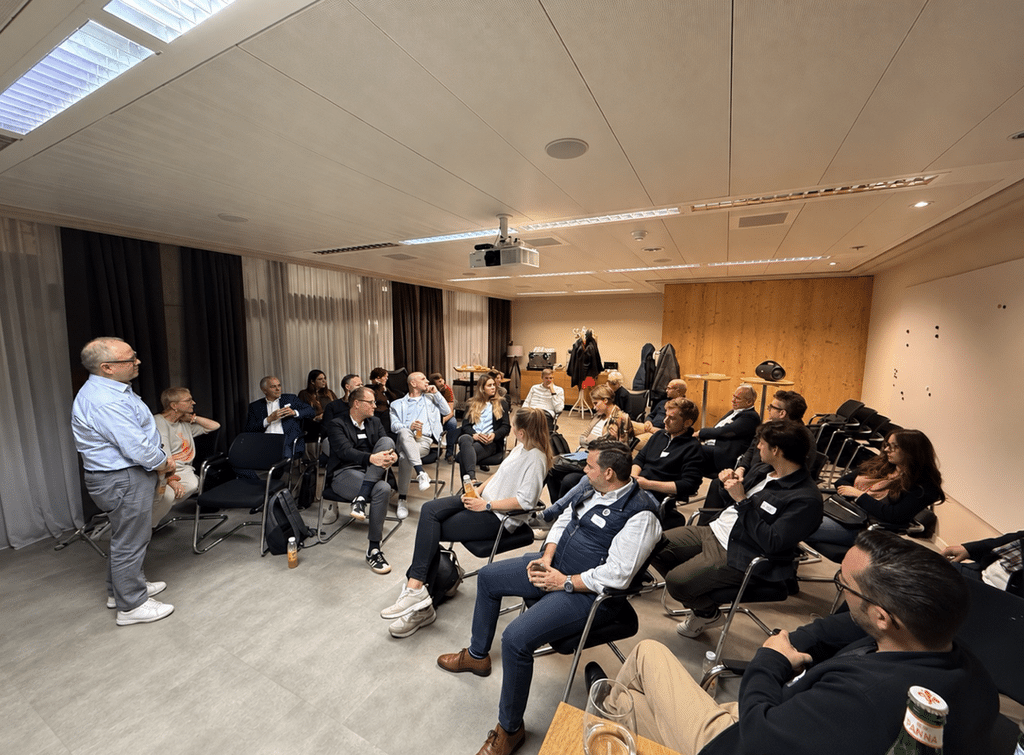
The introductory round of introductions alone demonstrated just how broad the topic has become. Personality assessments, cultural analysis, employee surveys, forensic legal consulting, insurance sales, machine learning, travel assistance, brain research, brokerage software, international underwriting. A room full of different colors, like a Rubik’s Cube. And everyone is grappling with the same question.
AI automates workflows, not roles
Christian Woese, founder of Limbi GmbH—which supports B2B go-to-market teams in their AI transformation—provided the initial impetus. He immediately debunked a popular image circulating on social media: AI agents neatly arranged in organizational charts with bosses and sub-agents. That, he said, is not productive. AI does not replace roles, but rather workflows—either entirely or in part.
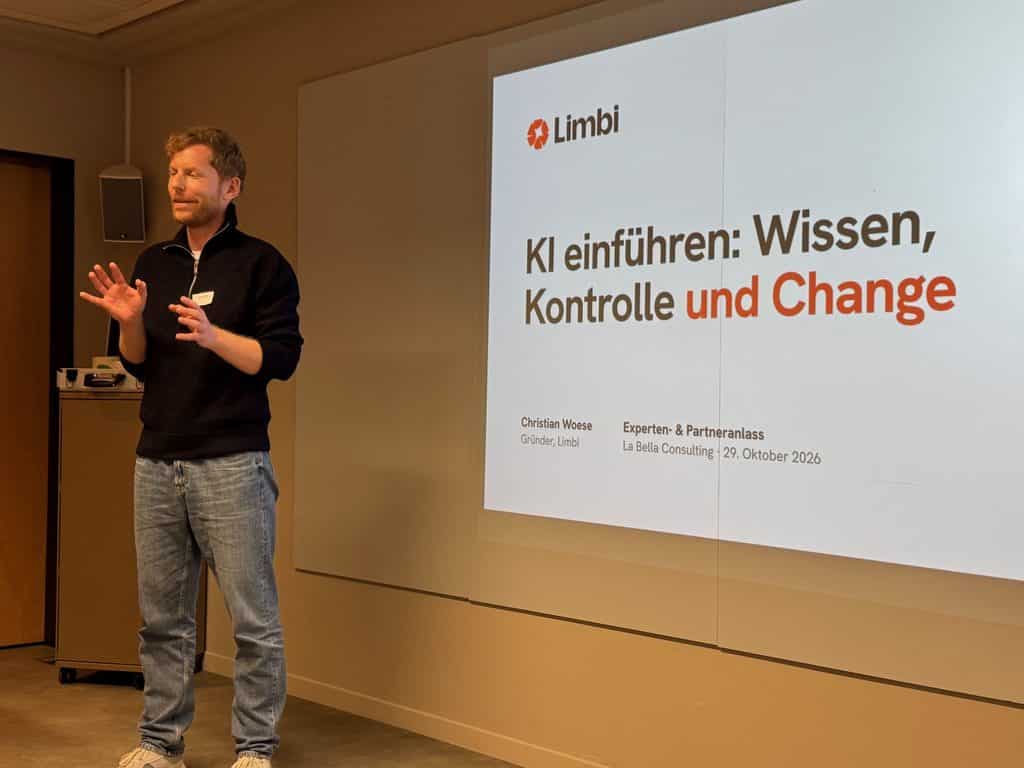
That’s why every project begins with three questions. What knowledge does a workflow actually need? Which systems need to be integrated? And where are the risks—in situations where a machine makes judgments instead of a human? He calls the answer to the first question the “Context Layer”: a central location where static knowledge—such as customer profiles, brand voice, or product information—converges with dynamic data, such as conversation transcripts. It’s not built for humans, but rather designed so that a language model can quickly navigate it.
From his perspective, the issue of access remains unresolved above all. When confidential and non-sensitive topics are intermingled in a meeting transcript, current technology can hardly distinguish clearly who is allowed to see what. And when it comes to liability, the rule is: whoever allows an AI architecture to communicate externally is liable for it. This makes it all the more important to precisely define where human oversight is required in the process. When it comes to change management, he advises a modest approach: small, motivated teams; early successes; and internal champions rather than a top-down mandate to adopt AI.
From Analytics Consultant to Implementation Consultant
The second presentation was given by Loris Niederberger, co-founder of Moodtalk. The company conducts AI-moderated interviews that combine quantitative surveys with qualitative discussions. Anyone who answers “meetings” when asked about areas for improvement is asked to clarify: Which meetings, and why? This creates depth across a broad spectrum—in all languages, on any device, even for cleaning staff without a laptop or login credentials.
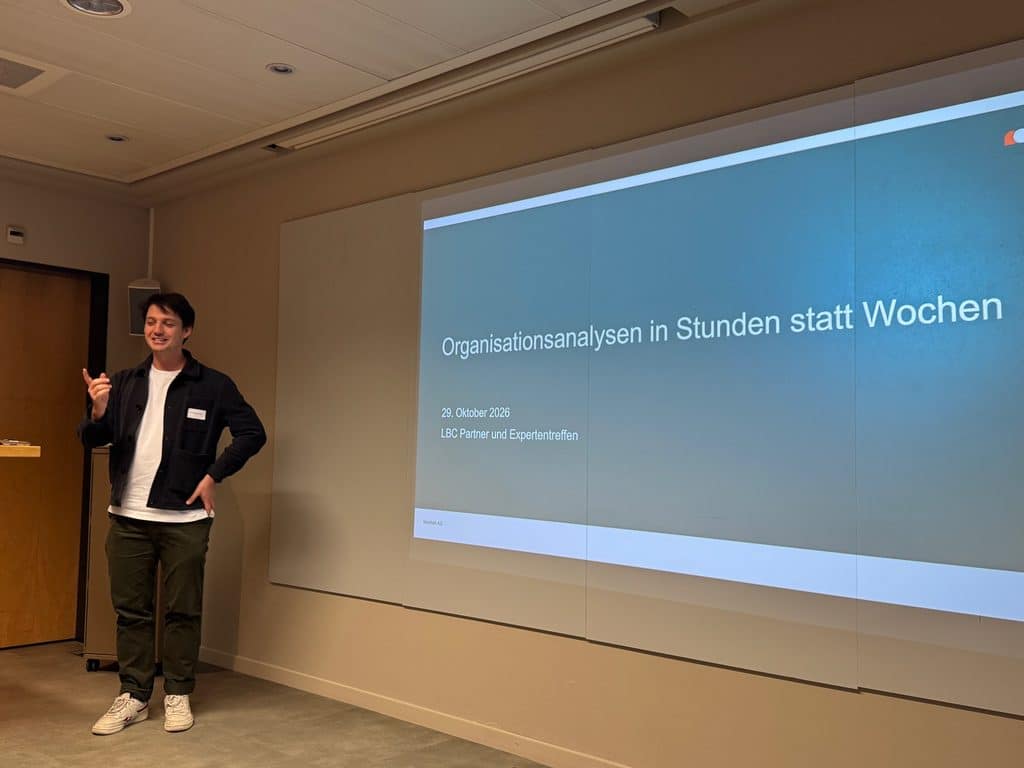
His thesis on the future of consulting was particularly noteworthy. He argued that the role of consultants is no longer to simply deliver an analysis, but rather to guide organizations in building a system that continuously integrates insights. Many companies only realize during a survey audit how many departments are sending out surveys in parallel, using seven different tools and with unclear data protection practices. The host confirmed this effect from real-world experience: Discussions about methodology are no longer necessary; no one asks anymore how a particular result was arrived at. Instead, the conversation immediately turns to root causes and next steps. The analytical consultant is transforming into an implementation consultant.
But here, too, a clear line was drawn. While managers want guidance on which topics to bring up at the next team meeting—and some even asked if the system could just facilitate the meetings itself—the answer was a resounding no. It doesn’t work without people.
The Perfectly Worded Threat
The ensuing discussion highlighted the downside of democratization. A provider of travel assistance reported a sharp increase in legally sound threats, the vast majority of which turned out to be unfounded. Nevertheless, they cannot be ignored. A cantonal administration reported a roughly 30 percent increase in objections, many of which are 30 to 100 pages long. An underwriting expert confirmed that insurance complaints have also grown significantly in length, which in turn necessitates the use of AI on the recipient’s end. Machines write; machines summarize.
It was also pointed out that this has a democratic aspect. Access to the legal system has been expensive up to now. Legal experts in the field of forensic law have observed that AI offers enormous benefits when dealing with voluminous case files: Who said what and when, and could they have known that at the time?
Why We Believe the Machine
A psychologist offered what was perhaps the most honest explanation of the evening: We believe AI because we want to believe it. The answers are good enough to save us effort. That, precisely, is where the dependence lies. A young student described how, at some point, she stopped checking the simple answers—focusing only on the complex ones—and how that’s exactly where the errors crept in.
A consultant with extensive experience in the insurance industry described a pattern he’d observed in project work: AI produces a surprisingly good initial draft—perhaps 70 to 80 percent complete. But the process of arriving at a result you can put your name on is then a truly intensive one. A presentation that seemed convincing at a quick glance turned out to be illogical upon closer examination. His concern: Clients at the management level might underestimate the value of precision and completeness for a while, until the consequences become apparent. Regarding the insurance business, an underwriting specialist dryly added: If the data isn’t clean, there’s no point in using AI at all. And this groundwork is still far from complete in the industry, both in Switzerland and across Europe.
The Question of Price
That leaves the money. If an analysis takes only hours instead of weeks, how is it billed? Customers expect lower prices, while infrastructure and token costs are rising. One provider reported that software margins, which used to be comfortable, are now negative in some cases. An IT project manager made a realistic assessment: he saves about half his time, especially on design. Content, the overarching theme, and storytelling remain manual work. This doesn’t make him any cheaper, but it does make him better.
The most convincing answer came from organizational development. No transformation has ever been achieved more quickly simply because someone knew the solution earlier. The customer sets the pace, not the analysis. What people pay for isn’t a beautifully worded text, but relief when making difficult decisions, support when things get tough, and the actual resolution itself. As a result, certain services become less expensive, while others become significantly more valuable. The crucial question is: Where do I deliver unique added value?
Who else is studying?
Finally, the discussion turned to society as a whole. If AI takes over the work of assistants and junior consultants, and only experienced professionals review its results, where will tomorrow’s experienced professionals come from? And what price do we pay—in electricity, computing power, and water—for the speed we gain? There were no definitive answers that evening. But there were the right questions—and in an age of ready-made answers, that’s no small thing.
Binci Heeb
See also: riskAware Continues to Grow: New Platform, New Customers, and Strong Partnerships
Search:
Sponsors: