A week on from Black Friday, the market held another sale, in the wrong order. A one-day relief rally on the Democratic sweep, then the worst rout since the spring as the identical result became a reason to sell. The giants finally cracked, the rotation that had sheltered everyone gave way, and record leverage did the rest. Friday brought the hangover, and with it the reminder that this is no longer a market that needs a reason so much as a spark.
Last week this column was called Black Friday, after the fire sale the market held on the last day of October. This week it is called Black Thursday, which is a problem of sequence, because is supposed to Black Thursday come first. The original, the twenty-fourth of October 1929, was the opening day of the Great Crash, three sessions before Black Monday and the ruin that followed. Our version has arrived in reverse: Friday first, Thursday second, eight days apart. When a market begins holding its black days out of order, it is worth noticing. It means the calendar has stopped organising events and the mood has taken over. It also means the place is loaded, and looking for an excuse. The street is empty. Somewhere a guitar begins.
The folklore of that first Black Thursday still includes the image of ruined men leaping from skyscrapers. The picture is mostly false. John Kenneth Galbraith later showed that the suicide rate in the weeks after the crash was no higher, and in places lower, than it had been while the market was still rising; the handful of jumps that did occur were isolated and not the epidemic the papers invented. We have been spared that particular theatre this time. The money, however, has already left the building. Every financial crisis is different in its costume. In the end it is just about money: who borrowed it, who has to give it back, and who still believes the next buyer will arrive before the music stops.

And the mood this week was a rollercoaster, in the most literal sense. On Tuesday the country voted. By Wednesday morning the result was plain: the Democrats had swept both chambers of Congress, taking the House and the Senate and ending unified Republican control for the last two years of the term. The President said he would accept the result, which removed the one outcome markets truly feared, a contested vote, and the relief was enormous. The S&P 500 rose more than one and a half per cent, its second-best day following any midterm since 1982; the Dow had its best post-election session in forty-four years. The reasoning was the oldest on Wall Street. A divided government can pass very little, and a government that can do nothing can do nothing foolish. Gridlock, in the market’s theology, is a blessing. It was also, in the language of the trading floor, a clean pump: the news was known, the positioning was light, and the machines and the leveraged funds did the rest. For a few hours the resistance that had sat overhead for days simply melted, and the breakout the bulls had been promising finally arrived. The music lifted. It lasted one session.
The same news, read the other way
Then came Thursday, and the identical fact, the Democratic sweep, became the reason to sell everything. Overnight the market decided that a Congress hostile to the administration would mean tighter rules on artificial intelligence, slower approvals for the data centres the whole boom is built on, and a harder road for the capital-spending complex that has carried the index for three years. Nothing new had happened. No company had reported, no rule had been written, no data centre had been refused. The market simply changed its mind about a result it had celebrated twenty-four hours earlier. On Wednesday the sweep was gridlock and salvation. On Thursday it was regulation and ruin. The news was fixed. Only the mood had moved, which is the whole lesson of the week: a price is not a fact about a company, it is a vote on a feeling, and the feeling can reverse between the closing bell and the opening one. The powder was already stacked. The election interpretation was merely the match. In a market this leveraged, you do not need a large spark. You need only the smallest change in the story the machines are telling themselves. The guitar stops. Then the shooting starts.
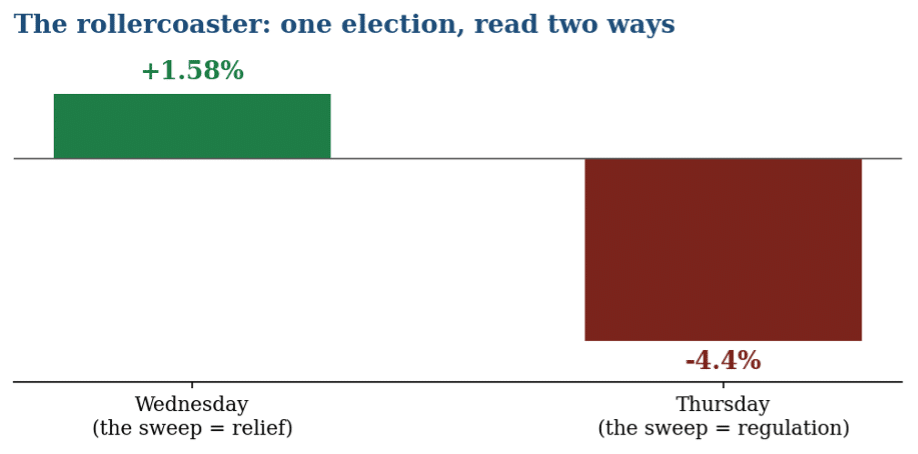
Daily price movements of the S&P 500. Wednesday was the second-best day following midterm elections since 1982; Thursday was the worst day since April. The election results didn’t change overnight. But the interpretation did.
The Thursday fall was the real event. The S&P 500 lost more than four per cent, its worst session since the tariff panic of last spring. The Nasdaq dropped five and a half and slid into a correction, more than a tenth below its October record. The Dow shed eighteen hundred points. Chip stocks had their worst day since 2020, the semiconductor index down more than eleven per cent in a session, with Nvidia alone off nine. Somewhere between two and three trillion dollars of value left the market in an afternoon. By Friday the hangover was plain. The strong jobs report, a hundred and sixty-five thousand new posts against expectations nearer sixty-five, and unemployment back to four point one, would in another season have been celebrated. Here it was read as one more reason the Federal Reserve need not hurry with the cuts everyone is leaning on. The bounce that appeared in the morning was sold by the close. Pump on Wednesday, dump on Thursday, and another round of the same game on Friday. We are back in the Far West. The street is quiet again, but the dust has not settled. The ones who feel safest are usually the ones who have not yet noticed that the saloon is full of men who sell the same story twice in two days.
The day the rotation gave way
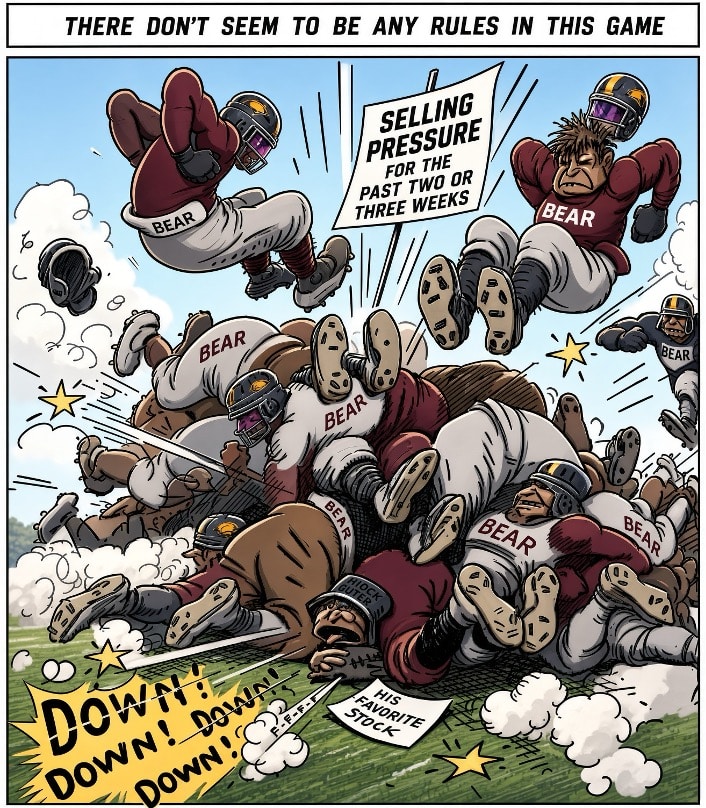
Here is the detail that matters most, because this column promised to watch for it. For weeks the selling had been orderly. The giants fell and the money rotated, out of the glamorous and into the dull, so that the equal-weighted index, which treats the smallest company like the largest, kept rising even as the headline indices wobbled. That rotation was the market’s shock absorber, and last week I wrote that the day to fear was the day it gave way, the day the dull stocks were sold alongside the glamorous ones. On Thursday they were. All eleven sectors closed lower. The equal-weight fell too, by nearly three per cent, less than the giants but red for the first time in this whole descent. It was not yet a full capitulation; the dull still fell less than the glittering. But it was the first day the entire house went down together, and the shelter that had protected the patient investor quietly stopped working. When the shock absorber fails, the next stop is usually a longer one. The wide street has no cover left.
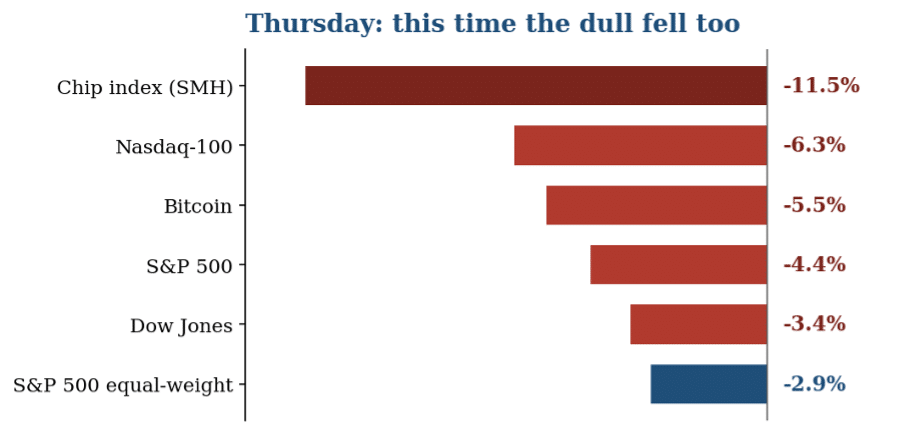
Market Performance, November 5, 2026. Even the equally weighted index—which had served as a safe haven last month—finally gave way. All eleven sectors closed in the red.
And then the leverage
What turned a sharp fall into a stampede was the thing this column has described all autumn as the planet on steroids: borrowed money. Leverage in the market sits at a record, and in the weeks before the vote investors had done the most dangerous thing of all, they had bought the dip with still more of it. Leveraged exchange-traded funds, the instruments that promise two or three times the daily move of an index, took in some fifteen billion dollars in October alone, their largest monthly inflow in at least two years. That is a great deal of fuel stacked against the walls on the assumption that the only direction is up. When Thursday came, the fuel did what fuel does. The funds that had amplified the rise amplified the fall, margin calls forced selling that forced more selling, and several large institutions are believed to have been liquidated outright in the course of the session. The fear gauge, the VIX, which measures how much turbulence the market expects and which on Black Friday had barely cleared its throat, this time leapt by almost seventy per cent in a single day, from under seventeen to above twenty-eight, its biggest jump since the tariff panic of last spring. The doomsday machine this column kept describing is not a metaphor. It is margin, and it is automatic, and on Thursday it ran.
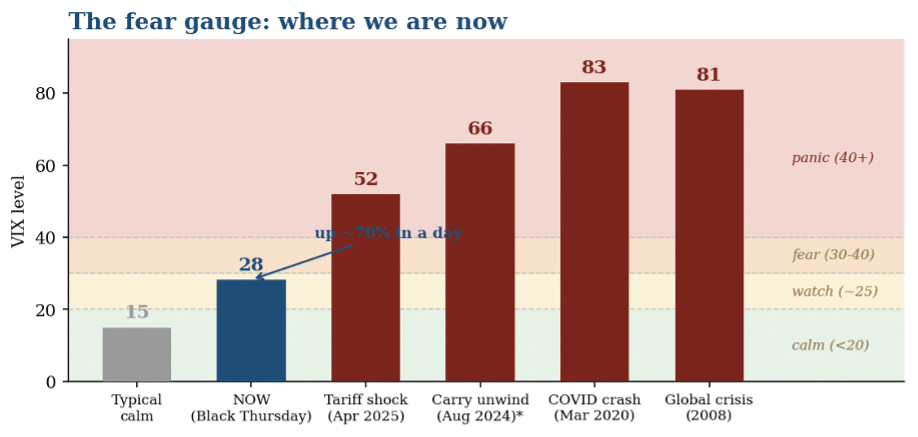
The VIX, Wall Street’s fear index, compared to periods of calm and compared to actual crises. 28 is elevated, but not catastrophic. August 2024 marks an intraday high; other readings are roughly at this level.
So should we reach for the parachutes? Not quite yet. On the scale that actually matters, twenty-eight is a long way from calm and a long way from catastrophe. It sits above the line where traders begin to watch and below the forty that signals real panic, and it is nowhere near the fifties, sixties and eighties the genuine crises reached. The honest reading is the uncomfortable middle one: the gauge has woken up, the air has turned thin, and this is the altitude at which you check the straps and keep the parachute on your back. It is not yet the altitude at which you pull the cord.
The same machines that buy the dip with leverage are the ones that sell the rip. That is the treachery. Volatility is not merely the price of admission; it is the cover under which the games are played. In a quiet market the games are harder to hide. In a market that swings four per cent in a session they become the main business. The music swells, then cuts to silence.
Gordon Gekko, in the film that still supplies the trading floor with its favourite sermon, told a room of shareholders that greed, for lack of a better word, is good. The line is usually shortened and the hedge removed, which is how most dangerous ideas travel. Greed has been very good for the people who sold the leveraged funds and the people who bought the dips on borrowed money. It has been less good for the institutions that were liquidated on Thursday and for anyone who mistook Wednesday’s relief for a lasting breakout. Greed clarifies, the character said. This week it clarified who still had cash and who only had a story.
The barometer: who has bled
It is worth stepping back from the single session to the whole descent, because the day-to-day noise hides how far the usual suspects have actually fallen. Measured from their 2026 peaks, most of the damage done in the past three weeks, the picture is plain, and it has a shape. The deeper a company sits in the machinery of the build-out, the more it has lost. The neocloud that rents out borrowed computing power, CoreWeave, is down about two-thirds. Oracle, which took on a mountain of debt to join the race, is down a half. The memory-makers and chip designers, Micron, Broadcom and AMD, have lost a third to two-fifths. Nvidia itself, the one name in the whole complex that actually prints the cash, is down a more modest fifth, and the software firms that merely use the technology, like Palantir, have barely been grazed. The rule is consistent and it is worth remembering: the market is punishing the spenders in strict proportion to how much they spent. This is a barometer worth keeping week by week, because it reads the pressure of the whole system rather than the weather of one afternoon.
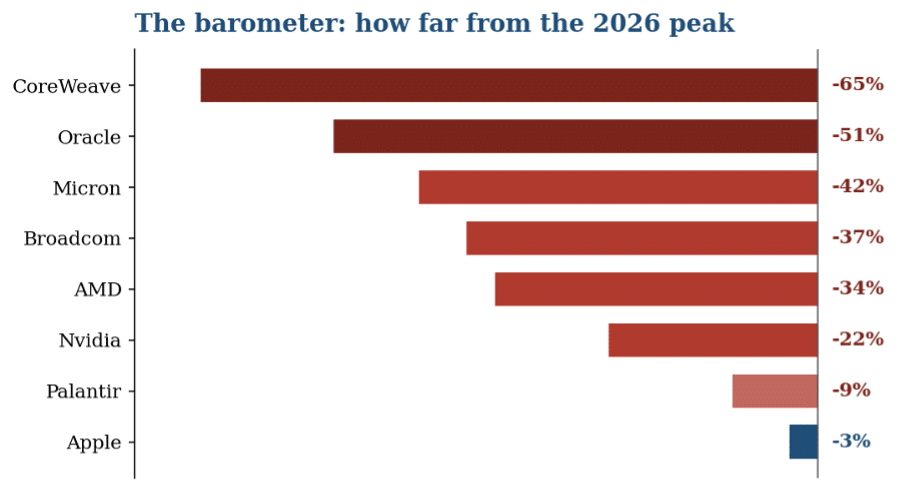
Approximate price declines from the 2026 highs, as of November 6, 2026. CoreWeave and Oracle are measured against their 52-week highs. Only Apple is just a hair’s breadth away from a record high.
And then there is the company at the other end of the barometer, the one that touched an all-time high in the very week the rest bled. Apple, by the unkind but not entirely unfair verdict of its critics, has not produced a genuinely new idea since the man who built it died, fifteen years ago now: no new category, no revolution, a patient annual procession of slightly larger telephones and slightly thinner laptops. It declined to spend two hundred billion dollars building data centres. It rented what computing it needed and invented, by the standard of this feverish age, nothing at all. And on the worst week the artificial-intelligence trade has suffered since the pandemic, Apple reached a record and stood briefly as the most valuable company on earth, above five trillion dollars. There is a lesson in that, and it flatters nobody. The market, when it is finally frightened, does not pay for innovation. It pays for cash, and for the discipline not to set it on fire. The firm that did nothing is worth more than the firms that tried to do everything, for the simple reason that the firm that did nothing still has its money. In a town this quiet after the shooting, cash is the only thing that does not make a sound when you walk. The ones who spent the money are still explaining why the spending was different this time.
When good news is the problem
Then, on Friday, the economy committed the one offence this market cannot forgive. It turned out to be healthy. The October employment report showed a hundred and sixty-five thousand new jobs, against expectations nearer sixty-five, and unemployment slipping back to four point one per cent. In any sane arrangement that is good news, and for the country it is. But a market addicted to the promise of cheaper money reads a strong economy as a threat, because a strong economy is one the Federal Reserve need not rescue, and the cut in interest rates that everyone is leaning on recedes a little further with every healthy number. So the week ended as it had lurched along: not because anything was wrong with the economy, which is fine, but because the problem was never the economy. The problem is the price, and the borrowed money piled on top of the price. The morning bounce was the last pump of the week; by the close it had been dumped. Anyone who bought the Friday open because the jobs number “wasn’t that bad” discovered, by the bell, that the number was exactly as bad as the positioning required it to be. The dust settles. The music does not start again.
The unknowns, and the carry
There is more stacked under the floorboards than leverage alone. The largest of the hidden timbers is the Japanese carry trade, the great invisible plumbing of the last decade. The idea is simple and its scale is not: for years, money has been borrowed in Japan, where it costs almost nothing, converted into dollars and other currencies, and used to buy anything that yields more, from American technology shares to government bonds. You pocket the difference, and while the yen stays weak and cheap you can do it with enormous leverage. It is the single largest borrowed bet in the world, and it is no longer the free ride it was. Every time the Bank of Japan edges rates higher or the yen strengthens, the unwind that has been threatened for years becomes a little less theoretical, because then the borrowers must buy yen back to repay their loans, which means selling the assets they bought, all at once, into a falling market.
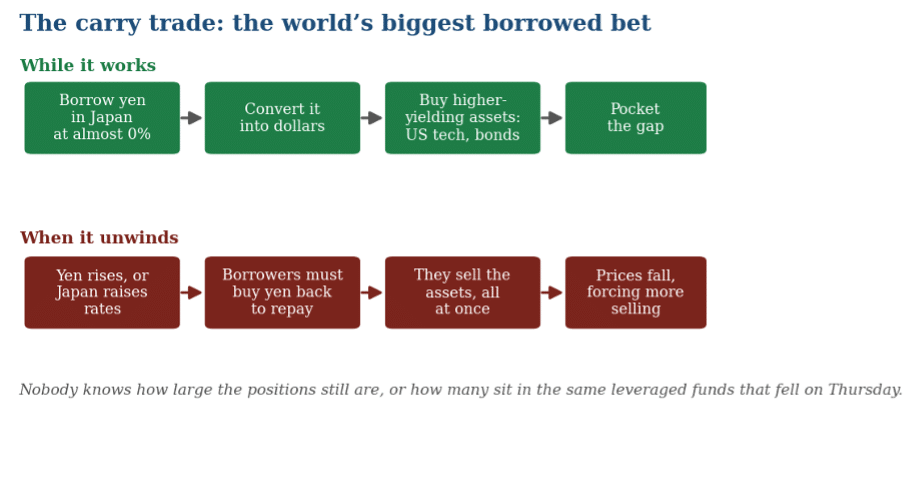
Here’s how the carry trade works—and how it collapses. The danger is that no one knows how large the positions still are or how many of them are held in the same leveraged funds that crashed on Thursday.
No one knows the size of the positions that still depend on it, or how many of them sit in the same leveraged funds that just took the hit on Thursday. Add the concentration in a handful of names, the private credit that has never been tested in a real drawdown, the data-centre build-out that assumes both power and permission will be available, and the simple fact that so much of the recent advance was bought with borrowed money on the assumption that volatility would stay low. The list of unknowns is long. The market only needed one of them to be read the wrong way for an afternoon. That is the nature of a powder keg: it does not require a large spark. It requires only that the people standing next to it have already decided the spark will not come today. Somewhere out on the plain, something is still moving.
The reassurance, and the catch
By the weekend the soothing notes were already circulating, and they are not wrong, exactly. A correction, they say, is normal and even healthy; volatility is the toll the long-term investor pays; the year after a midterm the S&P 500 has risen more than seventeen per cent on average since 1950. All of that is true, and this column has no quarrel with patience, which is the one reliable edge an ordinary saver has. But notice the word healthy, which is what the industry always calls a fall while it is still falling, and ask whether a market that needs record leverage, a seventy-per-cent spike in fear and the forced liquidation of large institutions in order to stay aloft is quite the picture of rude health being described. The averages are real. They are also backward-looking comfort, and they say nothing whatever about the particular week in which you happen to need them, or about how much further a thing carried this high on borrowed money can fall before the averages reassert. Nor do they describe the games that get played in the noise. A market that can reverse its reading of the identical election result in twenty-four hours is not a market whose next move will be decided by the historical average. The tune they are whistling is an old one. It does not match the landscape.
And then, over the weekend
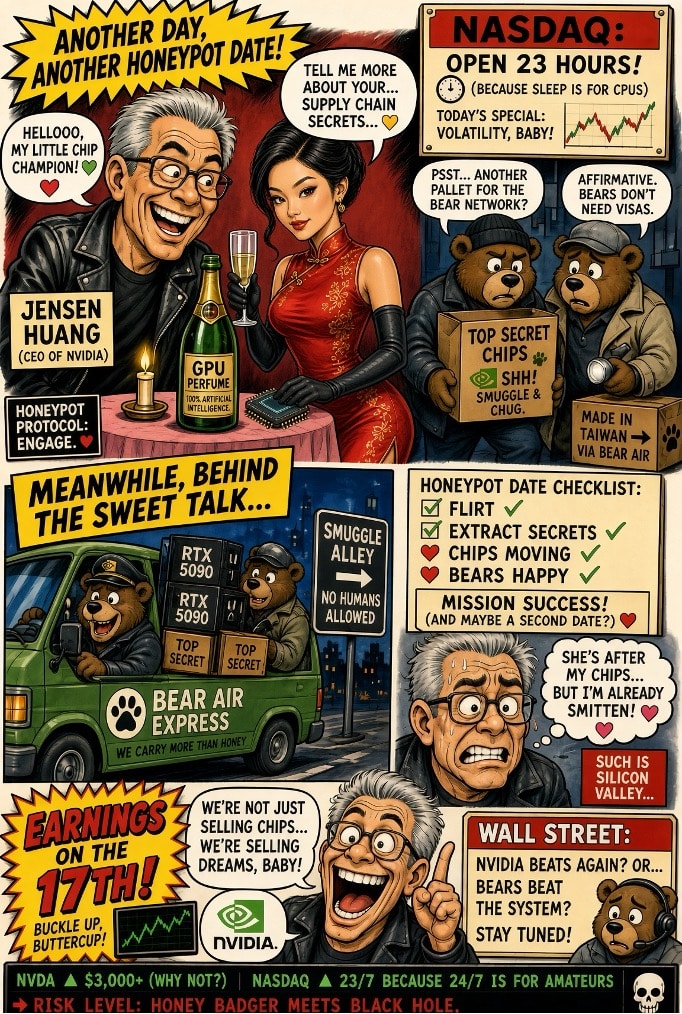
The week was not finished with us. Over the weekend it delivered a plot a Bond screenwriter would reject for being too on the nose. It emerged, and the man himself has now admitted it, that the chief executive of Nvidia, the most important company in the entire artificial-intelligence story, had conducted a romantic relationship with a woman American intelligence believes to be a Chinese agent, recruited, they allege, in a classic honeypot operation to gather information on precisely the chips the whole world is fighting over. The woman is a senior executive at a Singapore data-centre firm that, around the same period, began buying Nvidia’s most advanced processors by the billion, and which has since been linked to the smuggling of some two billion dollars of them into China. Nvidia’s board has opened an independent investigation and insists it has no reason to believe any secret was compromised. Perhaps none was. But consider the timing. The single most load-bearing stock in the market, the one name on which the whole index now leans, reports its earnings on the seventeenth, and it does so with its founder under investigation over an affair with a suspected spy and a chip-smuggling ring hanging off the edge of the story. Had a novelist put the espionage and the make-or-break print in the same fortnight, you would have told him it was too much. The market spent the week insisting the real danger was a shift in mood. It has just been reminded that the real dangers are usually the ones nobody modelled, and that they tend to arrive wearing a disguise.
And one last item, almost too fitting to invent. From early December the Nasdaq will stay open for trading nearly around the clock, twenty-three hours a day, five days a week, a day session and a night session parted by a single hour to sweep the floor. The casino, in other words, is extending its hours. The music this column keeps describing need never stop now; the open bar will run through the night; and the sleepless, leveraged, screen-lit crowd that turned one election result inside out between a Wednesday and a Thursday will soon be able to do the same thing at three in the morning. Whether a market that cannot keep its head in daylight will keep it any better at four a.m. is a question nobody at the exchange seems eager to ask. Plenty of white nights ahead, for everyone.
Eric Lefebvre
See also: Black Friday
Search:
Sponsors: