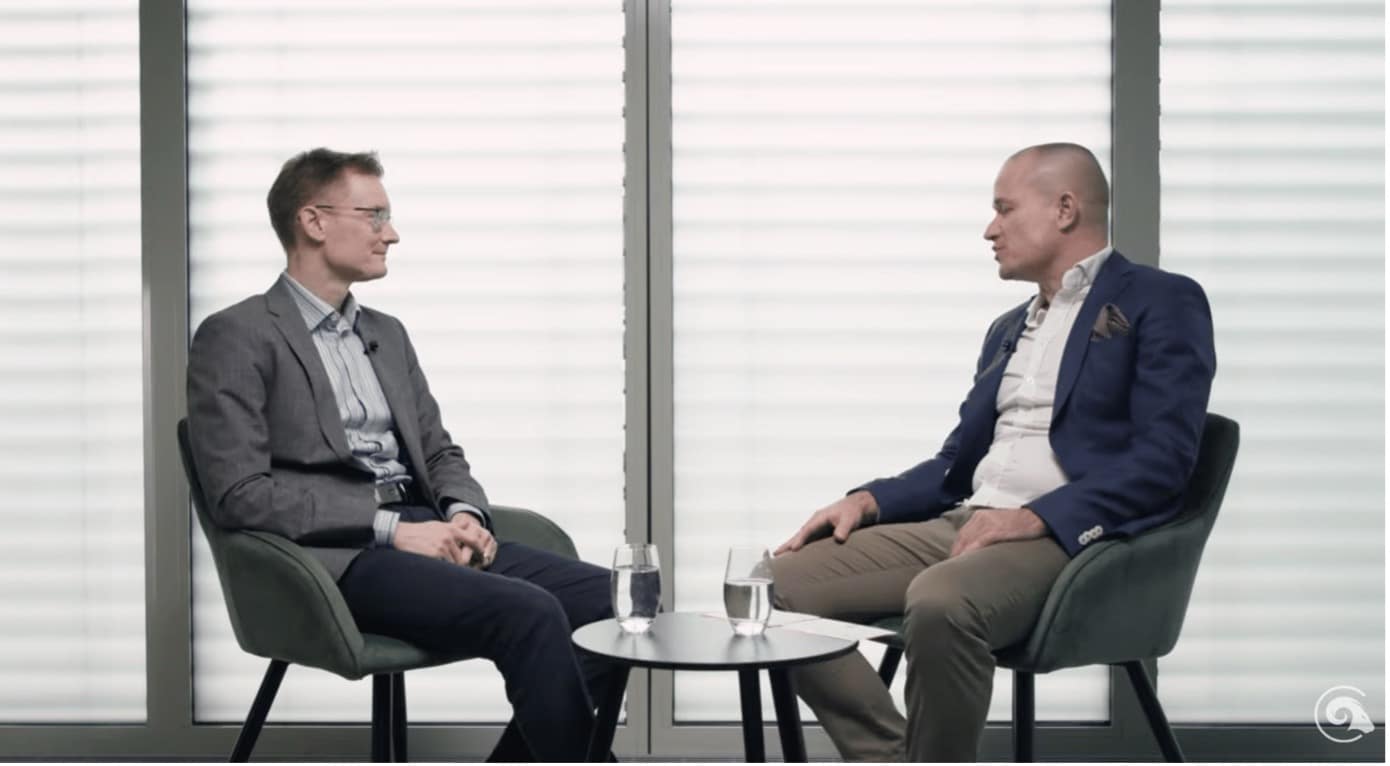
In a video interview with Jakob Barandun, physicist and entrepreneur Dr. Christian Spindler explains why artificial intelligence only works if companies are digitally mature and why curiosity, frustration tolerance and human judgement will remain crucial in the future.
Thebrokernews is now showing video interviews (in English) from our partner Capricorn Connect. The host of the interviews, Jakob Barandun, wants to maximize the visibility of interesting and exciting CEOs from different industries, increase their brand awareness tenfold and help them win high-value customers faster through personal conversations. The first guest we are featuring today is doing climate resilience analysis for optimal adaptation planning and regulatory compliance.
Dr. Christian Spindler, the founder and CEO of Sustainaccount AG, wanted to be an astronaut as a child. Like many boys, he says looking back. Then came the glasses and with them the realization that the path into space was perhaps not quite so obvious after all. What remained was his fascination for the natural sciences. For him, physics became the discipline with which the world can be fundamentally understood, including biological, chemical and technical processes.
This curiosity initially led him into research and later into industry. After completing his studies and doctorate, Schindler worked at ABB in Baden, at a time when what is now known as data science was still referred to as numerical mathematics or research. He later switched to consulting, including at PwC. There he learned that digitalization is not simply a project that you complete, but a technical, organizational and cultural process.
Digitalization is also a social task
One of the most important insights from his career: technology alone is not enough. Companies can introduce new systems, collect data and automate processes. But the decisive factor is whether people are prepared to embrace them. Digitalization changes working methods, responsibilities and decision-making logic. It therefore requires not only technical understanding, but also social intelligence.
For Spindler, this social dimension is not a contradiction to natural science. Research, he says, is also ultimately driven by human curiosity. Even basic research has a social component because it arises from the need to understand the world better.
From consulting to your own company
The step into self-employment arose from the desire to not only analyze a specific problem, but to solve it permanently. Consulting reaches its limits where standardizable software solutions are required. With Sustainaccount, Spindler develops AI-supported applications for climate and risk issues, especially for investors, real estate portfolios, companies and project developers.
The focus is on the question of how climate change affects economic processes, buildings, supply chains and value creation. Sustainaccount analyzes vulnerabilities and supports companies in developing structural, procedural or contractual adaptation measures. It is therefore not about abstract sustainability rhetoric, but about concrete resilience: how can a company, a portfolio or a building stock become more sustainable?
Climate risks are moving from a side issue to the norm
In the beginning, it was not easy to explain the market. Spindler remembers discussions with the cocoa industry. Even then, it was foreseeable that climatic conditions in certain growing regions would change, which could put supply chains under pressure. The reactions ranged from interest to skepticism: the warehouses were still full, it was said.
Today, the topic of supply chain risk is much more present. Companies are asking more systematically which regions raw materials come from, how stable these regions are and what risks arise from climate, regulation or geopolitical developments. What used to seem like a specialist topic is increasingly becoming part of professional risk management.
AI needs clean data and digital maturity
When it comes to artificial intelligence, Spindler remains sober. AI is above all a tool. It unfolds its benefits where data is available, accessible and of sufficient quality. Companies that want to benefit from AI therefore need a certain level of digital maturity. Without structured data, clean processes and clear interfaces, AI often remains piecemeal.
One example: Anyone who evaluates customs documents or delivery bills manually can automate certain steps with AI. However, a consistently digitalized process in which relevant information is transferred directly via interfaces is even better. This does not necessarily require artificial intelligence, but above all a good data model.
Precision is crucial, especially for legally or financially sensitive applications. Generative AI is well suited to situations where suggestions, texts or variants are helpful and the result does not have to be one hundred percent deterministic. For tax, customs or compliance issues, on the other hand, a robust digital process architecture may be more important than a probabilistic model.
Where people are still crucial
Spindler does not see AI as a simple replacement for humans. Rather, human skills will become more important where creativity, judgment and ingenuity are required. He uses the English term “ingenuity”, the ability to find new solutions, recognize connections and deal with uncertainty.
He also relies on a combination of technical tests and personal interviews in recruiting. Technical skills can be tested with tasks and assessments. But collaboration, trust and fit are created through direct interaction. AI can help with the pre-selection process, but there are risks involved, such as distortions in historical data. Ultimately, recruitment remains a human decision.
What children should learn today
As the father of two children, Spindler is also thinking about the future of the job market. He does not want to give them a specific career path. The world is changing too fast for that. Curiosity, a willingness to learn and a natural approach to technology are more important.
In his family, exchanging information via AI is already part of everyday life. His daughter uses language models when learning French, for example. For Spindler, this is not a substitute for education, but an opportunity to actively introduce children to new tools. Only those who understand what AI can do and where its limits lie will later be able to assess its manipulative or problematic aspects.
Entrepreneurship requires frustration tolerance
In Spindler’s experience, anyone starting a business needs three qualities: the ability to live with uncertainty, a high tolerance for frustration and confidence in their own abilities. The first idea rarely works immediately. The first communication with the market often doesn’t hit the nail on the head. It is crucial to learn from this and continue working.
This is linked to a basic entrepreneurial attitude: not everything can be planned, but a lot can be learned. Anyone who solves a relevant problem, understands the market and communicates their solution clearly has a chance. Particularly in the context of AI, climate risks and digital transformation, the following therefore applies: technology is important. But it only becomes effective when people classify it correctly, use it and develop it further.
Binci Heeb
Listen and read also: More Europe, now
Search:
Sponsors: