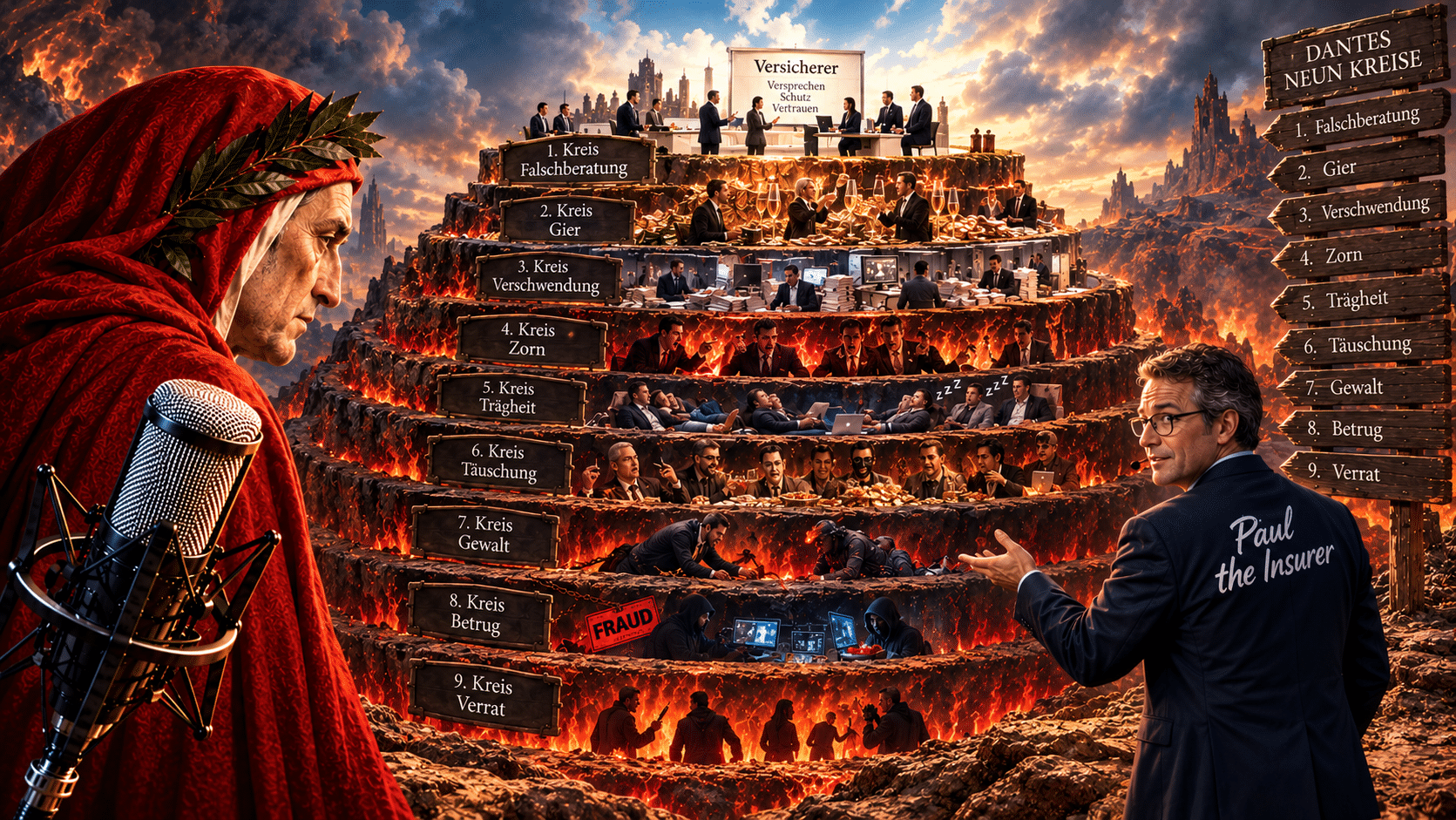
What would Dante Alighieri see if he were to descend into Hell again today and pass by the insurance industry along the way? In today’s episode of “Paul the Insurer,” Paul uses “The Divine Comedy” as a guide to sort the sins and virtues of modern insurers circle by circle. It’s playful, but also quite serious.
The idea is as simple as it is effective. Dante divided Hell into nine circles, and he assigned each sin its own, often cruelly fitting punishment. If you apply this framework to an industry that thrives on promises, it quickly becomes clear just how far it can fall. Those who sell protection are judged by that protection, not by their advertising.
Second circle: The overmarketers
In Dante’s work, the Lustful wander restlessly in an eternal storm. Paul sends there those insurance agents who seduce customers with unrealistic promises: claims paid in seconds, no follow-up questions, everything handled thanks to the magic of AI. The endless pursuit of attention through garish campaigns, misleading claims, and emotional manipulation fits this stormy place surprisingly well. Those who do nothing but seduce will never find peace.
Fourth circle: Those obsessed with profit
Here, both the stingy and the wasteful pay the price. They roll heavy weights toward each other, collide, and start all over again. Paul sees here insurers who focus exclusively on profit margins, deny legitimate claims to protect their profits, or lobby against public reforms of insurance coverage. There is a certain logic to the punishment: Those who have endlessly struggled over premiums and benefits in life now continue to roll just as endlessly, and just as futilely.
Fifth circle: The bureaucrats of indifference
In the swamp of the Styx, the angry ones fight, while the disheartened sink beneath the surface. Paul reserves this place for insurers who, out of laziness or indifference, keep claimants trapped in endless forms, on-hold loops, and digital dead ends. The punishment is as obvious as it is malicious: submitting perpetually incomplete forms while standing in a line that never gets any shorter. Anyone who has ever heard a hold-line tune start over for the third time can guess that Dante isn’t exaggerating here.
Eighth circle: The deceivers
Malebolge, the ten pits of deceit, is the obvious home of the black sheep: bogus insurers, fraudulent schemes, and corrupt claims adjusters. Dante has flatterers wallowing in filth there, false advisors engulfed in flames, and seducers flogged by demons. For those who have betrayed the trust of an industry built on promises, this hardly seems like an exaggeration.
Ninth circle: The traitors of trust
In Dante’s work, the deepest circle is reserved not for murderers, but for traitors, those who have betrayed their benefactors, families, or country. Paul suspects this refers to insurers who deny essential benefits in times of disaster or manipulate policyholders in their most vulnerable moments. They are frozen in ice, their hearts sealed forever. It is remarkable that Dante chose cold rather than fire as the harshest punishment: in the end, it is not greed that is the worst, but the absence of all compassion.
The rise of the virtuous insurers
But Dante was no cynic. He believed in purification. There are insurers who protect the vulnerable, make coverage understandable, and serve the common good. They do not end up in hell, but on Mount Purgatory, where they slowly ascend, guided by humility, a spirit of service, and purpose. The path is more arduous, but it leads upward. Especially in an industry that likes to define itself by efficiency and automation, this is a gentle reminder that trust cannot be scaled, it must be earned.
A divine comedy of risk
Dante’s work is as much a moral allegory as it is a myth. If he were to judge today’s insurers, Paul says, he would do so not by their balance sheets, but by their ethics. To sell protection and then fail to provide it would, in his view, be a moral failure. To serve with clarity, justice, and compassion, on the other hand, would mean ascending, perhaps even all the way to Paradise.
The question remains: in which category would you place your own company? An honest answer says more about a company than any sustainability report.
Binci Heeb
Paul the Insurer has additional content that might interest you, such as a series of interviews with insurance industry executives.
See also: Benjamin Franklin, America’s First Underwriter
Search:
Sponsors: