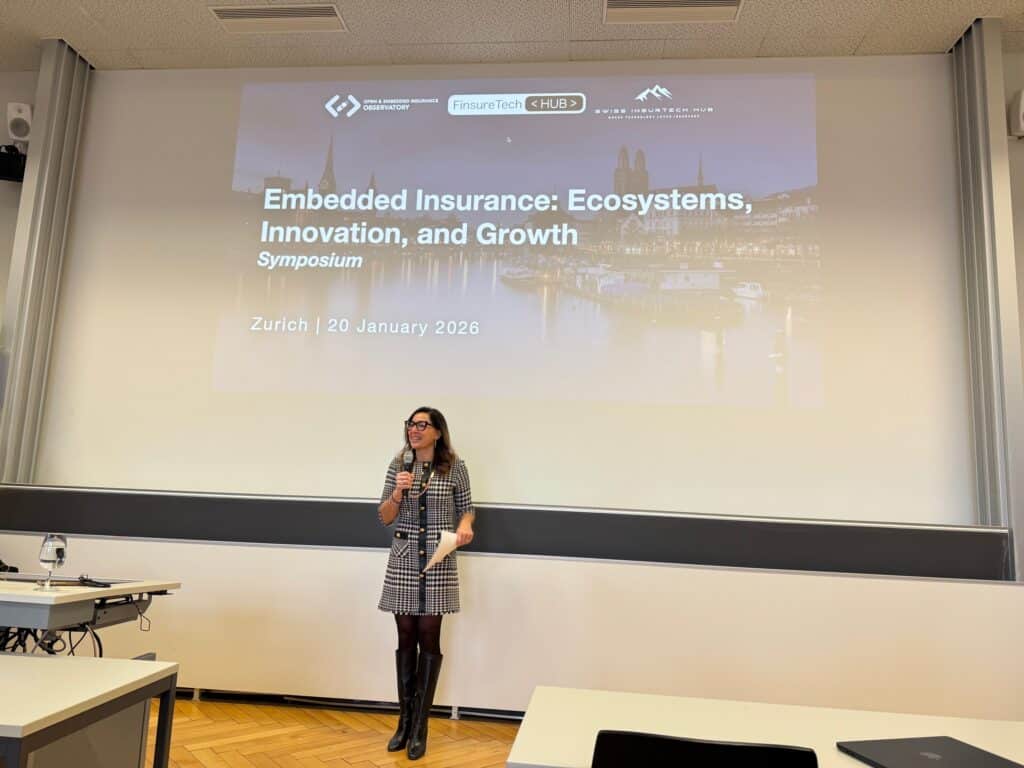
Insurance is no longer sought after, because it appears where it is needed. At the ETH Zurich, Swiss InsurTech Hub and Insurance Observatory symposium on “Embedded Insurance”, it became clear just how much the industry’s business model is changing: It is moving away from being a stand-alone product and becoming an invisible component of everyday digital processes.
When experts from insurance companies, the platform economy and insurtechs met in the main building of ETH Zurich on January 20, 2026, the tenor quickly became clear: the traditional insurance model is under pressure. At the opening of the symposium on “Embedded Insurance”, Silvia Signoretti, President of the Swiss InsurTech Hub, spoke openly about how the traditional model is increasingly becoming “nonsense” for many consumers. Insurance is no longer actively sought out, but should appear where it is needed, namely at the moment of purchase, as smoothly as possible and without additional effort. Embedded insurance represents precisely this shift.
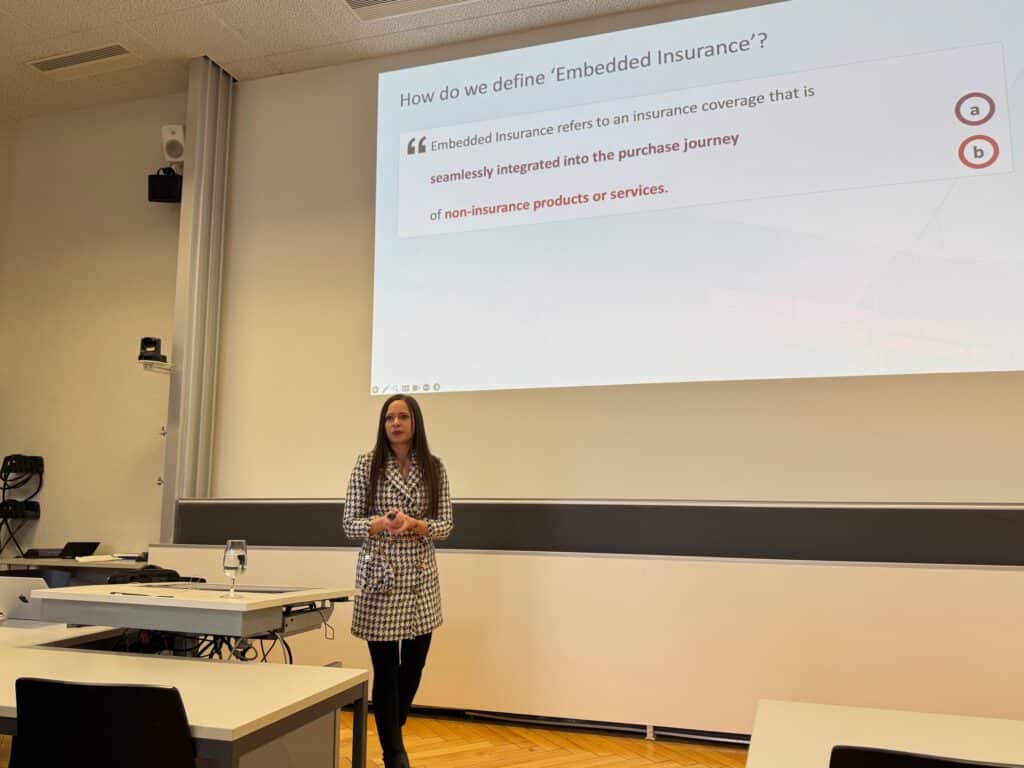
In essence, “embedded insurance” means that insurance cover is integrated directly into the purchasing process of a non-insurance-related product or service. Pia Bodner, CEO of Allianz Partners Switzerland, suggested in her keynote speech that a common definition should be agreed upon first. For her, embedded insurance consists of two elements: an insurance solution and its seamless integration into a third-party customer journey. This results in different forms, from “soft embedded”, in which customers actively consent, to “invisible embedded”, in which the insurance cover is automatically part of the offer and is no longer perceived as a separate step.
Why the market is exploding
The figures that were mentioned several times during the day show that this model is growing rapidly. The global market for embedded insurance was around 150 billion dollars in 2024 and is expected to grow to 700 to 900 billion by 2030. The annual growth rates are significantly higher than those of traditional insurance lines. The main drivers are digital platforms that have direct access to customers, have access to data and have built up a high level of trust. For many consumers today, it is more obvious to trust a banking app, a travel platform or a mobile phone provider than an insurer that they only contact once a year.

Examples from practice
Several practical examples showed what “embedded insurance” can look like in practice. In Switzerland, Allianz Partners is integrating travel and mobility insurance directly into credit card and banking apps, among other things. Customers can see their insurance policies where they are on the move every day anyway. Claims can be reported directly from the banking app, without media discontinuity. At the same time, new additional services are being created, such as automatic notifications in the event of flight delays or access to lounges in the event of travel problems. Insurance thus becomes part of a more comprehensive service ecosystem.
Even more radical is the Ledgertech model, which has introduced pay-as-you-go travel insurance. The customer takes out a basic policy once a year. However, she is only billed for the days she is actually abroad. The system uses the mobile phone provider to recognize when someone is travelling. The insurance starts automatically when they travel and ends when they return. According to Ledgertech, the completion rate is around 35 percent. That is many times higher than what traditional online insurance offers achieve. The reason: the insurance adapts to usage behavior, not the other way around.
The extent to which embedded insurance can change processes can also be seen in claims management. Insurtech Insurteam works with platforms in the travel sector and communicates with policyholders via WhatsApp instead of separate apps. Customers are automatically recognized because their data comes from the booking system. In the event of a claim, all they have to do is send a photo of the claim form or answer a few questions. In many cases, claims are settled within minutes. This means lower costs for insurers and a much better experience for customers.
Benefits and open questions
The benefits of embedded insurance are spread across several levels. For insurers, it opens up a rapidly growing market with access to new customer groups who would otherwise hardly have actively taken out a policy. For platforms, insurance is a differentiating feature and often also an additional revenue driver. Studies cited at the symposium show that the likelihood of buying a product online increases significantly if suitable insurance cover is integrated. For consumers, the main advantage is convenience: the insurance is there exactly when it is needed and clearly relates to a specific situation.
At the same time, many questions remain unanswered. Who owns the customer data when the platform and insurer work together? How transparent must an offer be so that customers don’t feel they are being “pushed in”? And how does regulation, particularly in Switzerland, react to models in which insurance becomes practically invisible?
A fundamental change
The symposium at ETH Zurich made it clear that “embedded insurance” is more than just a short-term trend. It is an expression of a fundamental change: insurance is moving away from the idea of a stand-alone product and becoming part of everyday digital processes. For many people, it is not becoming more important, but more natural. And this is probably where its greatest success lies.
Binci Heeb
You can read the second part about the symposium at ETH Zurich on January 26, 2026.
Read also: Embedded insurance: from hype to strategy
Search:
Sponsors: