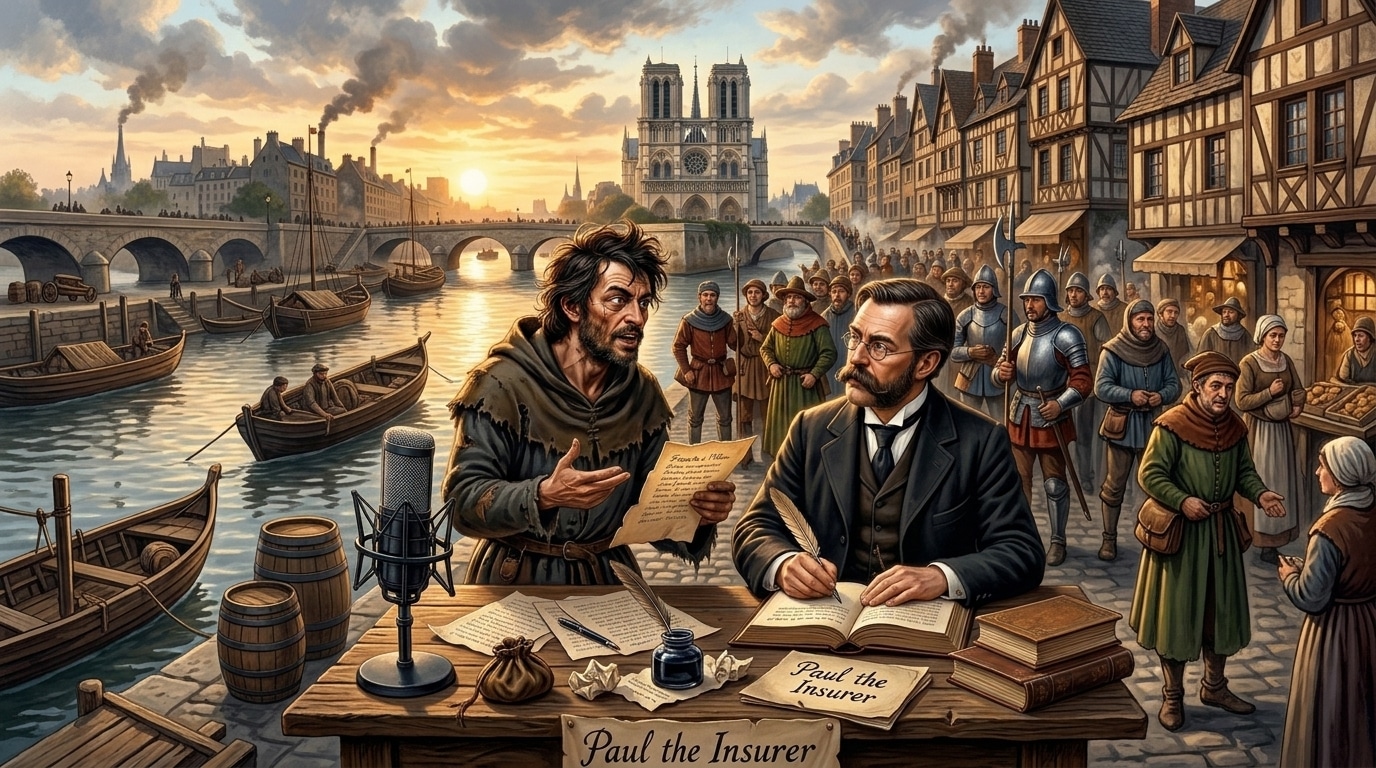
In the new episode of “Paul the Insurer,” an unusual guest takes the stage: François Villon, a 15th-century thief, scholar, and poet. How would France’s most rebellious poet view the insurance industry? Certainly not with reverence, but rather with biting irony, street smarts, and that melancholy known only to those who have stood on the margins themselves.
Villon wrote candidly about poverty, injustice, death, and fleeting happiness. He knew the prisons and taverns of Paris better from the inside than he did the lecture halls of the Sorbonne. Anyone who transports him today into the world of insurance policies, premiums, and claims forms is held up to a mirror that does not flatter, but does not merely condemn either.
Ballads of the outcasts
Villon knew what it meant to be poor and marginalized. His attention, therefore, would not turn first to those with insurance, but to those left out: the homeless, undocumented people, and those in precarious employment. In a rhyming lament, he would ask who insures the drinkers in winter, the undocumented widows, the street musicians with broken teeth. An uncomfortable question for an industry that likes to talk about solidarity but calculates based on risk categories.
On bonuses and fines
The insurance premium would likely have reminded Villon of medieval indulgences: a payment made in the hope of salvation, with no guarantee of divine grace or the mercy of the claims department. He would ask aloud whether the price of protection is fair or merely another tax levied on fear.
The latin of judges and insurance adjusters
Villon despised institutions that hide their harshness behind formality. He would have had a field day with insurance policies: the fine print, the exclusions, the cold tone of the rejection letters—those legal prayers used to excuse inaction. His verses might go something like this: In April they took my money with a smile, / but when the storm came, no one was there to help.
The ballad of the broker
To Villon, brokers would be the modern-day jugglers: charming and shrewd, sellers of dreams, dancing between several masters. He would respect their diligence while at the same time questioning their loyalty. And he would likely write a mocking ballad about the one who promised too much and vanished while the client wept. Anyone who works in brokerage may feel this applies to them, both as a compliment and as a warning.
On death and the underwriter
No one understood death quite like Villon. The fact that modern society attempts to quantify mortality and capture the value of a human life in tables and graphs would have both astonished and provoked his scorn: They calculate when I will die, / yet do not know when, how, or why it lasts. Awe and sarcasm, closely intertwined, as in all his work.
A thief’s prayer for honest protection
For all his biting wit, Villon had a deep longing for justice. He would therefore conclude not with a condemnation, but with a plea: for insurance that protects without requiring one to beg for it; for policies that are written in clear language; for a system that does not forget the poor man, the fugitive, and the repentant fool.
Villon among the actuaries
You wouldn’t find Villon in a corporate boardroom, but rather in a tavern, where he reads rejection letters aloud, half laughing, half crying. He would remind the industry, in verse and in jest, that behind every claim there is a human being, disheveled and mortal, who hopes not for profit, but for compassion. Perhaps he would write, in rhyme, the truest insurance policy of all. For an industry that has to earn people’s trust anew every day, that’s not a bad idea.
You can listen to the full episode of “Villon on Insurance” on “Paul the Insurer,” the podcast that reveals the real world of insurance: beyond the myths, beyond the paperwork.
Binci Heeb
Listen to and read: Marx, Engels, and the Police
Search:
Sponsors: