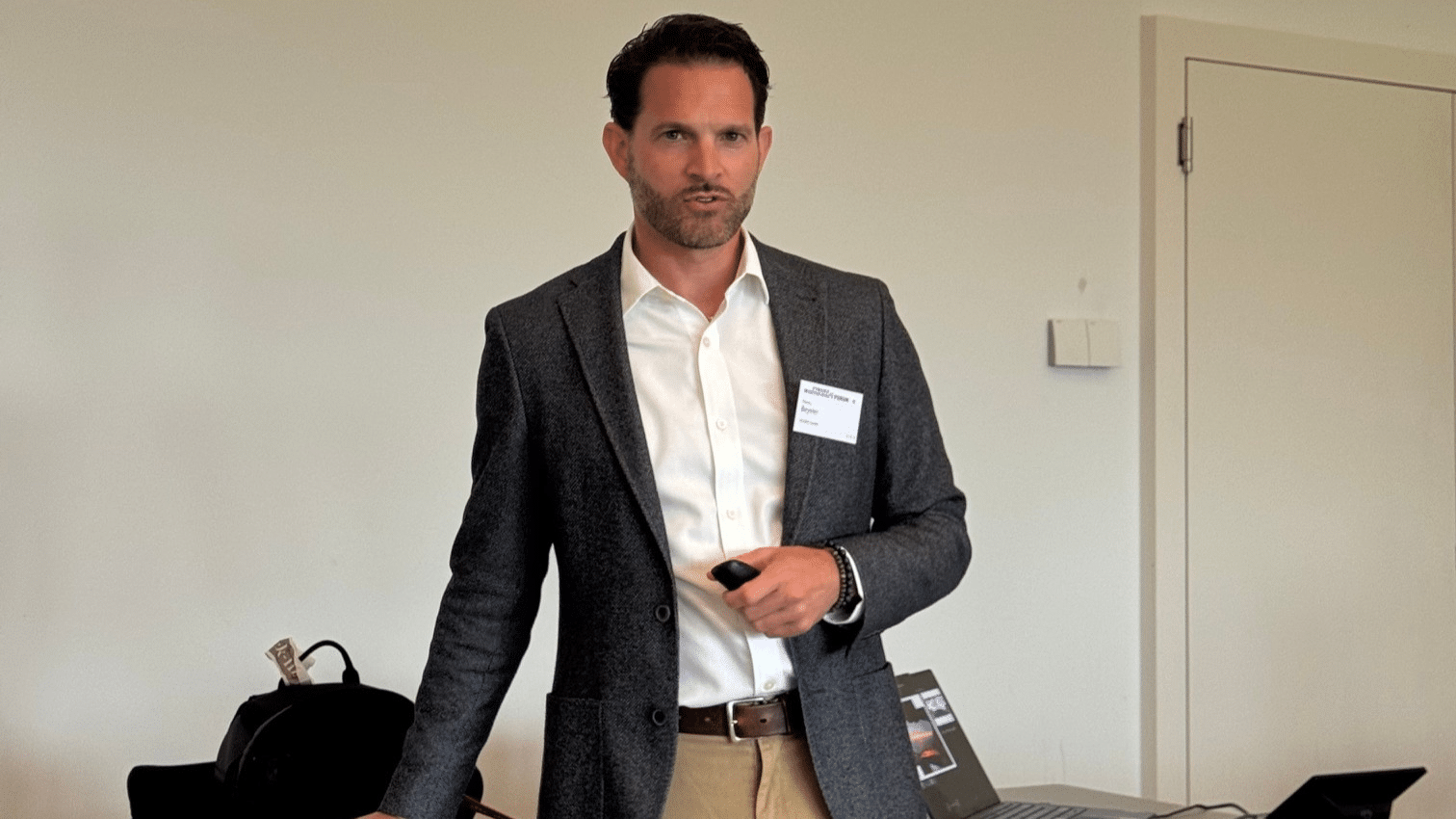
When the blizzard comes, it’s not perfection that counts, but judgment. At the Finanz und Wirtschaft Insurance Broker Forum 2026 in Rüschlikon, Swiss captain and leadership coach Thierry Beyeler drew an unusual parallel: making good decisions under pressure doesn’t require fear of regulation, but the right tools.
Beyeler took his audience on an imaginary transatlantic flight to Montreal, where it is minus five degrees and a blizzard is on its way. In this scenario, he unfolded his core theses on stress, regulation and decision-making quality, all topics that are just as virulent in broking as they are in the cockpit.
His starting point: stress is not bad per se. The so-called Yerkes-Dodson curve, which Beyelerer referred to as the “Totzen curve”, shows that as stress levels rise, so does performance. Only when the pressure exceeds a critical level does performance collapse. “If you know yourself, you know where you stand on this curve and can take countermeasures,” says Beyeler.
The three Cs: Competence, Confidence, Control Emotions
Beyeler propagated three key factors as a practical counter-model to stress failure:
Competence
It forms the basis. Without sound knowledge of your own situation – be it the system architecture of an aircraft or the cover of a policy – there is no basis for action. Preparation, training and education are not optional, but essential.
Confidence
Understood as well-founded self-confidence, not overconfidence, is the second factor. Beyeler referred to the legendary emergency landing pilot Chesley Sullenberger, who ditched an Airbus on the Hudson River in 2009: “He believed that it would turn out well. That is no coincidence.”
Control Emotions
Finally, control over your own emotions requires you to know them first. Beyeler’s recipe: breathe, pause, then act. The automated pattern is “Realize – Reflect – React”. Crucially, people tend to act immediately. This is often counterproductive on a plane or in a consultation.
The dog in the cargo hold: good airmanship in practice
The pilot used a vivid example to illustrate the tension between regulation and entrepreneurial pragmatism. A dog has to be transported in the cargo hold. If it is loaded incorrectly, it is in danger of freezing to death at zero degrees. Correct relocation costs half an hour and all the connecting flights of thirty passengers.
What to do? “I have to stand in front of someone at the end and have an answer,” said Beyeler. “In front of the customer, in front of my boss, in front of a judge.” This imperative of “good airmanship” refers to the ability to make defensible decisions under time pressure, with incomplete information and with high consequences. Not perfect ones. Justifiable ones.
Translated for brokers: Anyone who advises clients faces similar trade-offs every day. Regulatory compliance is not an end in itself, but neither is it an obstacle that can be ignored as soon as it becomes inconvenient.
Nokia, Boeing, Credit Suisse: Case studies of failure
Beyeler did not shy away from naming prominent negative examples. Nokia lost 90 percent of its market value within six years. Boeing built airplanes with inadequate systems and a lack of training in order to cut costs and paid for it with 346 deaths and massive reputational damage. Credit Suisse, where Beyeler led global management training for two years, failed due to “Failure to act on known information” and “ineffective risk management”, among other things.
What all three cases have in common is a dysfunctional approach to stress, change and regulation. Beyeler’s message to the brokerage industry was unmistakable: a culture of error, preparation and admitting your own limitations are not weaknesses, they are conditions for survival.
Debriefing as a learning principle
Finally, he pleaded for an element of pilot culture that is often missing in the corporate world: systematic debriefing after every assignment. “Even if everything went really well, we ask ourselves: Why did it go so well? Learn from the positive.” This attitude, based on positive psychology, protects against negativity bias, which tempts people to give mistakes more weight than successes.
This was a fitting conclusion for a forum dedicated to the topic of “Strengthened for the future”: strength does not come from avoiding pressure, but from dealing with it confidently.
Binci Heeb
See also: Insurance Broker Forum 2026: The Road Ahead Is Rocky
Search:
Sponsors: