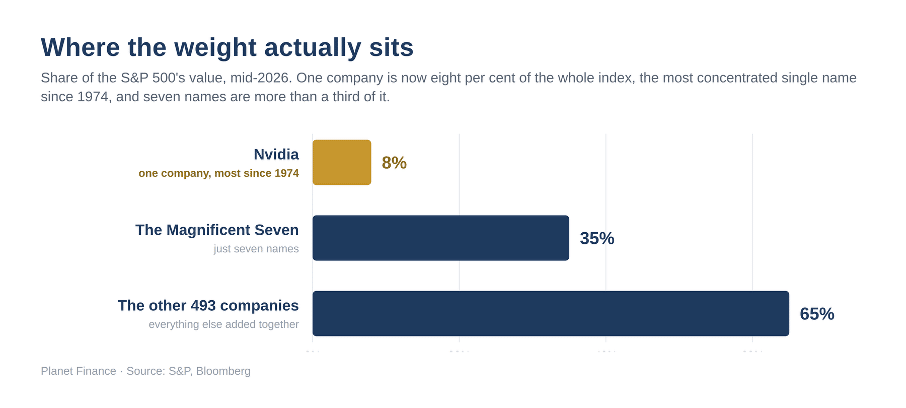
A single company now accounts for eight percent of the S&P 500, and the sentiment of the entire market can be turned upside down by a single statement from the Fed. This is what a market looks like when it has quietly removed every additional support, rests its entire weight on just a few points, and then calls the result “strength.”
An engineer will tell you that the difference between a structure that stands and one that collapses rarely lies in the quality of the materials. It depends on how the load is distributed. A cathedral supports its roof with many columns, so that no single one ever has to bear the entire weight; a poorly constructed building rests entirely on a single column and stands there beautifully—until the moment that column gives way. By this measure, the U.S. stock market has been quietly transformed over a period of about three years into a structure of the second kind. This week, it showed us exactly how few points are now supporting the roof, and then decided, with a sort of nervous jubilation, that this was reassuring. On “Planet Finance,” the most dangerous statement isn’t that “this time it’s different.” It’s that “it has held up so far.”
The stock that drives the market
Let’s start with the figure that should worry a cautious investor more than any inflation rate. A single company, Nvidia, now accounts for nearly 8 percent of the entire S&P 500—the largest share any single company has ever held since 1974. If we broaden our perspective just a little, seven companies—the ones the market calls “great”—together make up more than a third of the index. This means that the remaining 492 companies—the banks, railroad companies, pharmaceutical manufacturers, and retailers, in other words, the broader economy itself—together account for barely two-thirds of the index. When you buy into the U.S. market today, you’re not really buying America. You’re buying a small group of technology companies and, on top of that, a rounding error. It’s also worth noting that the same company is weighted quite differently depending on which index you’re tracking: nearly 8 percent of the S&P 500, nearly one-tenth of the technology-focused Nasdaq, and—since the venerable Dow is weighted more by stock price than by company size—barely more than a footnote in it. That’s precisely why the Dow was the only index to remain calm this week, while the others rose and fell depending on the fate of a single chip.
Nvidia reported its earnings this week, and at first glance, they were a triumph. $96 billion in revenue in three months, compared with an expected $92 billion; a data center business that grew by more than 100 percent year-over-year; and a CFO who forecast 70 percent growth over the next two years, while Wall Street had expected 40 percent. The stock rose by nearly nine percent. Two details, however, are more significant than the headline. The first is a small act of honesty that has become so rare as to be remarkable: The company voluntarily announced—even before anyone asked—that its profit margin would fall from 75 percent to 71 percent because it was facing pressure on memory prices. A management team that shares bad news on its own initiative and unsolicited says a lot about its own self-confidence. The second detail is hidden in the filings. About 85 percent of Nvidia’s revenue comes from just six customers, and about two-fifths of that from just two of them, who are not named and are referred to in the documents as Customer A and Customer B.
If you follow this thread to the end, you’ll end up in a place that’s truly unsettling.
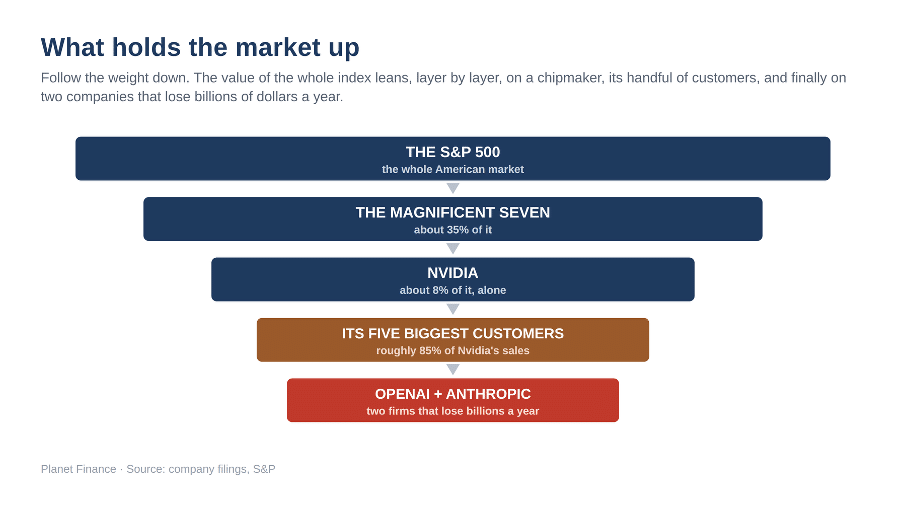
The chip manufacturer sells its devices to a small group of hyperscalers—the giant cloud companies. A large portion of what these hyperscalers now earn from artificial intelligence can, in turn, be attributed primarily to two names: OpenAI and Anthropic. Both are remarkable companies. Both also lose billions of dollars annually and stay afloat by raising fresh capital. So the flow of money in the world’s richest market moves, layer by layer, from the index through the “Seven” to that one chip manufacturer, to its five major customers, and finally ends up at two companies that aren’t yet making any money. Steve Eisman, who was right about the last crisis but is holding back on predicting the next one, has summed up the situation clearly: Nearly half of U.S. economic growth this year comes from spending on AI equipment, and if either of these two companies were to fail tomorrow, the economy would slide into a recession and the market would collapse. This is not a prophecy. It is a description of where the weight lies. And Nvidia, as I wrote two weeks ago, has begun lending money to its customers to buy its chips; a $500 billion financing facility announced this week—even before it was signed—only tightens the noose further. A market this concentrated isn’t strong because it’s rising. It’s fragile because it’s tight.
The number that no one read until it was read aloud
If the first pillar is a company, then the second is a statement, and the deeper lesson of this week had nothing to do with Nvidia at all. It was about what’s currently driving prices. On Wednesday, the Federal Reserve’s preferred inflation indicator was reported at 3.7 percent—meaning it remains above target, as it has for 65 consecutive months. The market took a look at it and shrugged; the yield on 10-year Treasury bonds moved by a single basis point; no one reacted. Then, on Friday, the new Federal Reserve chairman, Kevin Warsh, stood up in Jackson Hole, read that exact figure aloud, and explained that the summer data hadn’t convinced him that inflation was truly on the retreat. Nothing had changed. The figure was 48 hours old and had been public knowledge the entire time. Yet during the twenty minutes his speech lasted, the market’s probability of a rate hike in September rose from about one-third to well over half.
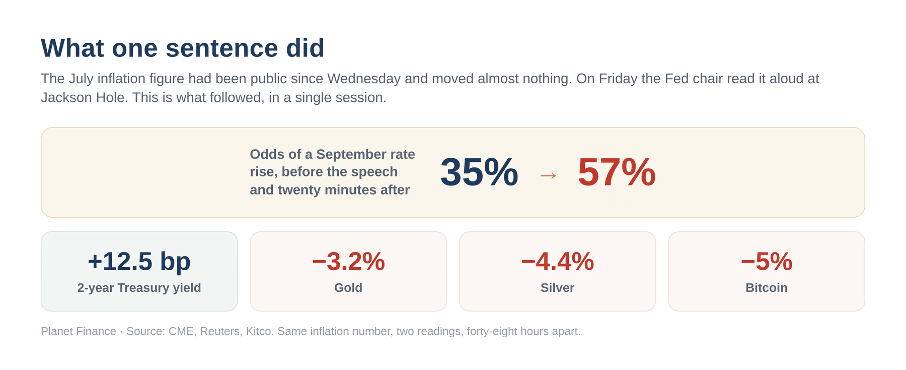
Consider the impact of that statement. Yields on two-year bonds skyrocketed, the dollar climbed, and the assets that had risen throughout August in the hope of cheap money were removed from portfolios and punished. Gold fell by more than three percent in a single trading day, silver by more than four percent, and Bitcoin—which just a few hours earlier had been flirting with new all-time highs above eighty thousand dollars—was sold off massively. An entire week of crypto euphoria was wiped out—not by a fact, but by the interpretation of a fact. That is the crucial point, because it reflects the actual state of the market. The market no longer trades on the world itself, but on commentary about the world. Wednesday’s inflation figure was a piece of information, and no one reacted to it. The identical figure on Friday, delivered by the right man on the right stage, was an order, and everyone obeyed. A market that waits to be told what to make of facts it already knows is not a price-discovery mechanism. It is a gathering.
One detail of this sell-off is worth a closer look, as it corrects a convenient turn of phrase and clarifies an argument I made a week ago. When newspapers write that a price drop has caused value to “vanish,” they’re only half right. The tens of billions of dollars in Bitcoin value that vanished from screens on Friday were not transferred to anyone; market capitalization is a metric, not a vault, and it simply ceases to exist when the price does. What actually changed hands was smaller and far more real. Nearly half a billion dollars in leveraged bets, most of them “bullish“… were liquidated within a single trading day. This means that actual cash flowed from the pockets of the latecomers and those who had borrowed money into the pockets of the patient investors and the house. This is precisely the mechanism I described in my last column, which is now running in the opposite direction. The squeeze that drove short sellers to buy at any price as the market rose has reversed and is now driving the lagging retail investors—those who bought at the peak with borrowed money—to sell at any price as the market falls. “Pump and dump” were never two separate events. They are one and the same engine, and this week it has changed direction.
The floor still won’t budge
And yet, amid all this compliance, there was one thing that flatly refused to listen, and it is the most important thing in the room. Warsh delivered the most hawkish speech a Federal Reserve chairman has given in years. The short end of the bond market believed him immediately. But the long end—the 30-year bonds, the part of the market that lends money far into the future—didn’t budge at all. It neither rose out of fear of tighter monetary policy nor fell out of confidence in it. It simply shrugged.
Regular readers will know that this is a topic I keep coming back to, because it is the foundation of everything and quietly repeats the same message over and over. When a central banker promises to fight inflation and long-term bonds don’t react, it’s not because they’re asleep. It’s because long-term bonds are worried about a different problem—one that no speech can address. It’s watching the line at the credit window, and that line has now tripled: a government with a $2 trillion deficit on top of debt that has just surpassed $40 trillion; the old, persistent costs of war financing; and the newcomer that’s changing the equation—the roughly five trillion dollars needed to build data centers, which the expansion of artificial intelligence must finance through borrowing. The short end deals with what Warsh controls. The long end has already priced in what he is not pricing in. This gap between the interest rate the Fed can set and the interest rate the world will demand to hold American debt for thirty years is the slow story behind all the fast ones. This gap widened again this week while everyone was watching a chipmaker.
All filed under “Good News”
There is one pattern that connects these two pillars, and once you recognize it, you can’t stop seeing it. This week, almost every piece of bad news was tacitly shifted into the “good news” column and left there. Warsh’s threat of higher interest rates should actually be poison for stocks; instead, it was interpreted as proof that he had regained his credibility, meaning inflation would be curbed and investors should therefore buy. Nvidia’s admission that its margins would decline should have been a warning; instead, it was interpreted as proof that demand was simply too insatiable to be satisfied, and the stock rose. That is not denial. Denial would be to pretend that the price of wheat hadn’t risen by more than fifty percent this year, and no one does that. It’s more subtle—and far more effective. It is reinterpretation: You don’t argue with the unpleasant number; you categorize it under a heading where it appears as a strength. Once you do that, it’s analysis. If you do that for five consecutive trading days with every unpleasant fact, it’s something else: a market that has decided in advance what everything means.
Being right is not the same as surviving
It’s worth taking a moment to reflect on the difference between being right and staying solvent, because the market has just taught us a costly lesson in that regard—one whose unfolding we’ve been following on these pages. The young manager behind the “Situational Awareness“At first glance, he had clearly foreseen the future. He was long in companies developing artificial intelligence and short in software companies that he believed would ultimately be displaced by this technology. By the middle of this year, the fund had posted a gain of about four hundred fifty percent, and for a brief time, he appeared to be the most far-sighted investor of his generation. Then, over the course of four weeks in July, the tide turned.
His publicly traded holdings lost more than two-thirds of their value, the fund gave up a good forty percent of its assets under management, and a company that had reached a value of forty-five billion dollars was liquidated within a few days, with its positions sold off in a hurry to Citadel. Regulators are now sifting through the wreckage and have reportedly subpoenaed the Wall Street banks that had provided him with a lifeline. Here’s the part you should remember: He might well have been right. In five years, the companies he bought could outperform the ones he sold. He simply didn’t survive long enough to reap the benefits.
The mistake wasn’t in the thesis itself. The mistake was that the thesis was a single trade masquerading as a diversified portfolio—and this trap has been set in every era when something truly new emerged. The clearest example is still the one that many readers have witnessed firsthand. In 2000, the belief that the Internet would reshape the world was not wrong; it was glorious and absolutely correct. And it nearly ruined almost everyone who acted on it. The Internet did indeed change everything, just as promised, but the companies that survived to prove it were only a handful—the Amazons and the Googles—while the vast majority of the plausible ones, the “pets,” the “sock puppets,” and the “grocery delivery trucks” simply vanished. Knowing the right destination was worth nothing to the traveler whose loans or entry price didn’t allow him to survive the journey there. The same trap has ensnared everyone who saw the railroad, the car, or the smartphone coming and decided to own the entire idea all at once—with the bank’s money—before the world was ready to embrace it. Conviction and ruin, it turns out, are closely related.
It’s also important to keep in mind how rare true disruptions are and how inconspicuously they usually occur. The individual components of the mobile internet had been around for years until Apple brought them together in 2007 into a single device that an ordinary person could hold in their hand—and this one product opened the door to much of what we now collectively refer to as the digital economy. That’s what true disruption looks like, and it’s rare. For every iPhone, there are a hundred companies, and there’s no shortage of well-paid consultants who applied the term “digital transformation” to everything they were already doing, charged hefty fees for this rebranding, and in the process didn’t invent a single new thing. The difference between the two is rarely apparent from the outside, and that is precisely the problem. It only becomes visible when you’re willing to lift the hood—something most people and almost all consultants would rather not do, since the surface tells a simpler story and pays just as well.
This week provided us with a small, almost comical example of this. Salesforce, a large and thoroughly reputable software company, announced its earnings, and its stock soared by nearly 23 percent—the best single-day gain in the company’s history. But if you take a closer look under the hood, it turns out that the engine runs on something other than software. More than forty percent of earnings per share and nearly the entire margin by which the company exceeded expectations came not from the sale of additional products, but from a valuation adjustment on an investment in Anthropic, whose private valuation has skyrocketed. No new customers, not a single dollar in revenue—just an accounting entry. The masses believed the headline; almost no one read the footnote. And note the silent cycle at work here: Anthropic, one of the two loss-making companies that form the foundation of the entire structure, is now—solely through the rise in its private valuation—boosting the reported profits of the publicly traded companies situated above it. The machine has begun to admire its own reflection and to label that reflection as growth.
That is what the industry means by “risk management” behind all the jargon, and it is the least glamorous yet most valuable discipline in the entire business. Diversification doesn’t mean owning forty different things; it means owning things that won’t all crash on the same day—which is far rarer than it sounds—and that’s exactly what the man who held AI on both sides of his portfolio was missing. Position sizing means refusing to let a single conviction—no matter how sound it may be—grow so large that it ruins you at an early stage. And leverage is the multiplier that turns an unpleasant price decline into a permanent one, because, as the old saying goes, the market can remain irrational longer than you can remain solvent. The bitter irony of the “Situational Awareness” fund is that it wasn’t destroyed by being wrong, but by being right—with no margin for being too early. And the index itself is teaching exactly the same lesson this week from the opposite perspective. A portfolio that has quietly become a single trade—whether it belongs to a hedge fund or the entire S&P 500—is not made safe simply by its size. It is concentrated, and concentration is simply a bet that nothing will go wrong in that one place on which everything now depends.
The only drawback
So let’s sum up the week in a single image. The value of the entire U.S. market now rests on a single chip manufacturer; this chip manufacturer relies on five customers; these customers rely on two companies that aren’t yet turning a profit; and the mood of the entire structure can be thrown into turmoil by a single man reading out a number on a Friday afternoon. Meanwhile, the long-term bond—the only honest witness in this building—silently refuses to give credence to the speech, for it looks past the chip manufacturer and the CEO to the ever-lengthening line at the loan window. None of this means the roof will collapse next week. Concentrated markets can rise for a long time, and the people who run these companies are among the most capable ever to hold these positions; this is not a bubble created by charlatans. But concentration is not the same as security, however much it may resemble it as long as the curve continues to rise. It is the opposite. It is the steady removal of every superfluous pillar until the entire load rests on just a few, and the tacit agreement among all involved not to ask what will happen if one of them shifts. Engineers have a term for a structure built this way—without redundancy and without leeway—where the failure of one part causes the rest to collapse. They call it a “single point of failure,” and they don’t mean it as a compliment. For the rest of us, the lesson is the same as always: When the entire market has quietly and imperceptibly become a single transaction, the most valuable thing one can possess is that which is not included in it.
Eric Lefebvre
See also: Margin Call
Search:
Sponsors: