A margin call is the moment a lender stops believing in your collateral and demands cash you can raise only by selling whatever the market will still take. This summer the asset being quietly doubted is not a rotten corner of credit. It is the government bond itself. When the floor is what cracks, the call goes out to the whole room at once, and this week you could already hear the telephones.
Every financial crisis is, underneath the noise, the same event. In 2007 the collateral that failed was a tower of mortgages, a rotten corner of the credit market that the wider world was assured could be contained. What makes this summer the more unsettling is that the asset now being marked down is not a corner of anything. It is the government bond itself: the risk-free floor beneath which nothing was ever supposed to fall, the paper on which every other price and every leveraged book on earth is finally posted. There is no safe room to flee to, because the call, when it comes, goes out to everybody at once.
And the people who issue that paper have spent the week giving the room every reason to doubt it. A country cannot fight inflation and finance it at the same time. On the day American debt crossed forty trillion dollars, the Treasury announced it would double the rate at which it buys back its own long-dated bonds, and word emerged that the Federal Reserve is quietly enlarging its purchases too. In plain words, the men paid to guard the dollar have gone back to printing it, and they have chosen to do so at the precise moment a second wave of inflation is gathering in the one place no central banker can reach: the physical world of oil, gas and grain. On Planet Finance the price of money is the force that stands in for gravity. This week the men who mind that force were caught, openly, with their thumbs on the scale.
Paying the card with another card
Start with the number, because it deserves a moment. Forty trillion dollars is roughly a hundred and sixteen thousand dollars of debt for every American alive, newborns included, and it has quadrupled since 2008, the year the whole commentariat agreed the figure was a national scandal. It is two trillion larger than it was on the first of January, which works out, if you care to do the division, at something close to a hundred thousand dollars borrowed every second, weekends and holidays included.
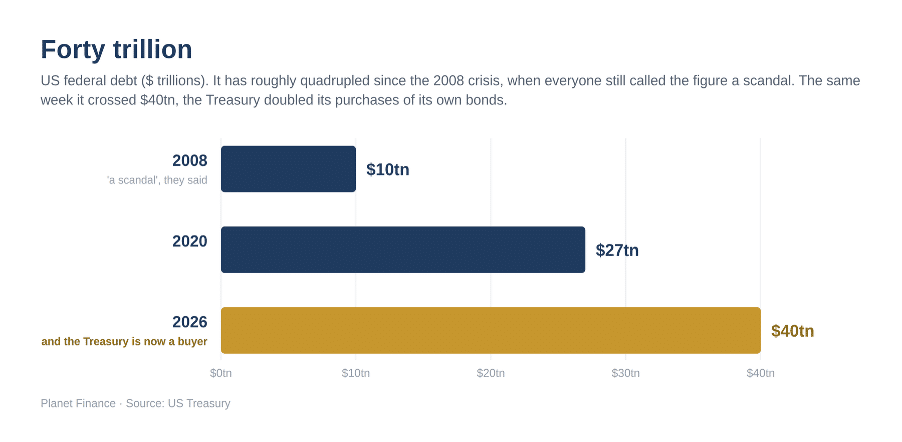
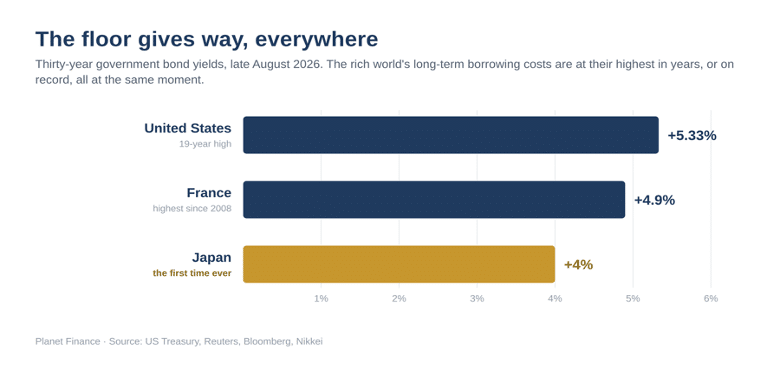
The Treasury’s response to a bond market plainly unnerved by all this was not to borrow less, which is unthinkable, but to become a buyer of its own paper, lifting its repurchases of ten- to thirty-year bonds from two billion dollars an operation to at least four. A bond manager put it better than I could, so I will borrow his line: it is like taking a slimming drug while eating four thousand calories a day. You lose weight on the chart and gain it in the mirror, and you are the one administering the treatment. It bought about a day of calm. By the next session the ten-year yield was back near 4.65 per cent and the thirty-year at 5.3, a whisker from its highest in nineteen years.
And this is not an American difficulty alone, which is the part that should hold your attention. France now pays close to five per cent to borrow for thirty years, its dearest since 2008; Japan’s thirty-year has climbed above four per cent for the first time in the entire history of Japanese debt; and in Europe the conversation has turned, improbably, back to rate rises. The whole developed world is borrowing more expensively, at the same moment, for the same reasons: too much deficit, too much oil, and a mountain of new bonds still to be sold to pay for, among other things, the artificial-intelligence data centres of last week’s column. When the firefighters start lighting fires of their own, the sensible thing is to notice the smoke.
The only honest price
If you want to know what the market truly makes of all this, do not read the statements; read the one price the authorities cannot manufacture. As the Treasury turned buyer and the dollar sagged, gold erased an entire summer’s slump in a matter of days and vaulted back above four thousand five hundred dollars an ounce, and the commentary attached to it did not trouble with euphemism. The word in every headline was debasement.
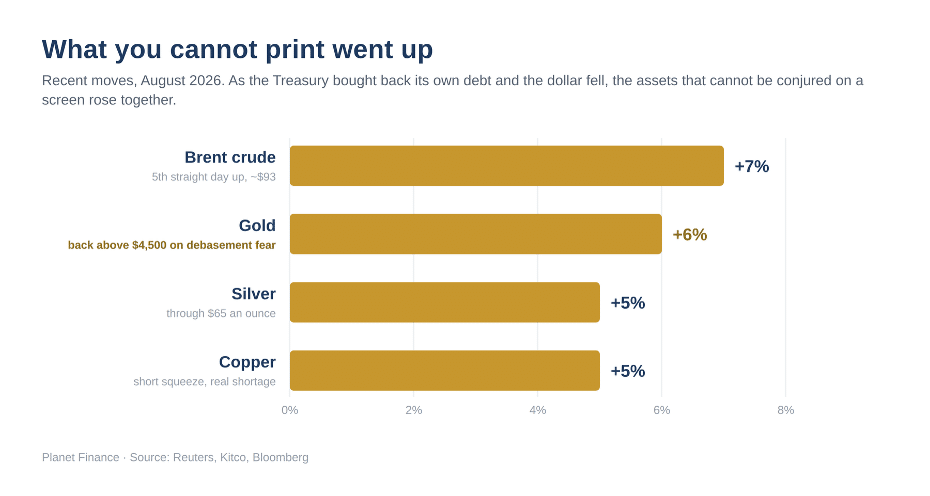
Silver went with it, through sixty-five dollars an ounce; copper, where a real shortage met a crowd of short sellers, was squeezed so hard that traders found themselves paying a premium merely to keep their bearish bets alive, the reverse of the natural order of things. Gold is the least exciting asset in the world. It yields nothing, does nothing, promises nothing. It rises for one reason only, that people have begun to distrust the paper alternative, and it does not rise like this while a government is printing by the back door. Gold at these levels is not a rally. It is a verdict, and it was handed down while the officials were still congratulating themselves on a single day of lower yields.
The second wave is in the weather
Now to the wave itself, which almost no one on a trading floor is watching, because it does not come from the places they know how to model. This inflation is not being written in a spreadsheet of wages; it is being written in the sky, the soil and the pipeline. Brent has risen for a fifth straight day to around ninety-three dollars, up seven per cent on the week, the Strait of Hormuz still contested and American petrol, remarkably, more expensive this late in the summer than at any point since records began in 2000. Europe is told it is insulated and is nothing of the kind. Its natural gas price has roughly doubled and pushed back above the levels that caused open panic two years ago, while its storage tanks sit at their lowest for the time of year on record. A continent that imports its energy, walking into the cold with the emptiest cupboards in living memory, is not a bystander to an energy shock. It is the second act of one.
A strong El Niño is returning with it. The popular version of that story is ruined harvests everywhere; the useful version is narrower. Heat and drought across Asia and the tropics lift rice, palm oil, coffee, cocoa and sugar, the soft commodities a European shopper meets as a chocolate bar, a jar of coffee and a bag of sugar even if rain in the southern cone of Latin America spares some soy and maize. The net is not in doubt. The tropical food complex rises, Asian food inflation rises, and the risk to the world’s grocery bill runs firmly to the upside, exactly as the monetary authorities lose the will to resist it. Europe imports its coffee, its wheat and its gas. That is not insulation. That is exposure with better manners.
The war that would not detonate
There is a deeper reason the oil price belongs in a column about the dollar. When Iran throttled the Strait of Hormuz, every model forecast the same thing: two hundred dollar crude, a global recession. It never arrived. Brent spent the crisis near a hundred dollars, painful but survivable, and the reason is genuinely new. China simply declined to buy. For years it had been filling vast tanks with cheap, sanctioned Russian and Iranian crude that Western buyers would not touch, and paying for it not in dollars but in its own currency, the yuan. So when prices spiked it drew on those reserves and left the rest of the world to squabble over the shortfall, proving in the process something that will outlast the war: that oil can be bought and sold, at scale, entirely outside the dollar.
This is why the debasement is more dangerous than it looks. The petrodollar, the arrangement struck in the 1970s that made every barrel a source of demand for American money, and thus a pillar beneath American debt, is being quietly routed around through Chinese payment rails built for exactly that purpose. The dollar is not dead. It is still close to sixty per cent of the world’s reserves against the yuan’s two, and no one parks ten billion dollars in Chinese bonds as easily as in American ones. But for the first time in half a century there is a working alternative to being paid in dollars for oil, and a Treasury printing those dollars has chosen a poor moment to remind the world why it might one day want one. Gold at four and a half thousand dollars is simply the market saying that arithmetic out loud.
The consumer, and the machine
Two stories from the same week show where the pressure finally lands, and how little give is left when it does. Begin with the American household, which is starting to crack. The clearest signal came from Walmart, and Walmart is worth listening to precisely because it sells nothing aspirational; it is where the median family buys what it cannot do without, which makes its tills a more honest census of the country than any confidence survey. The shares fell more than nine per cent, their worst day in about three years, and not on a weak quarter but on the texture of one: customers trading down to the cheaper label and the smaller packet, and a management that, asked to account for it, pointed at the price of fuel. Every dollar a war-inflated pump lifts out of a wage packet is a dollar that never reaches the checkout. The bleaker confirmation came from a retailer of car parts, which lost almost a quarter of its value in a single session. Ask what it means when people stop buying the components to keep alive the car they depend on to reach work. That is not economising. It is a household that has run out of road.
The second story is not a sideshow. It is the picture of how a margin call actually travels before anyone names it. A call does not begin with a press conference on the Treasury steps. It begins as forced trading that looks, for a day or two, like conviction, buying that had to happen, selling that had to happen, prices that moved because someone else’s book was on fire. That machine ran in plain sight this week, and it will be the same machine that transmits a doubt about government bonds into everything else the moment the collateral is marked down.
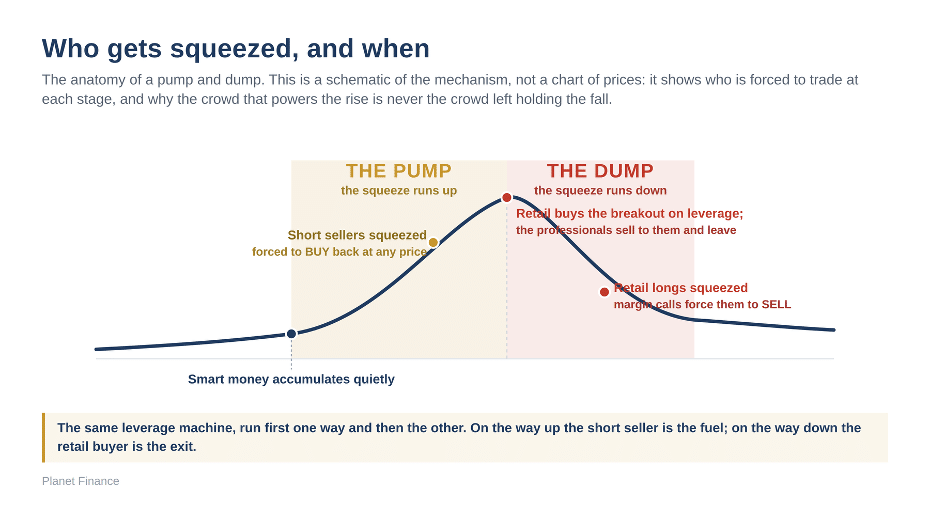
Moderna, a maker of vaccines, doubled in a single Wednesday session on a genuinely historic result, the first late-stage trial to show a cancer vaccine working. A doubling sounds like a triumph, but the sheer violence of it gave the game away. The shares leapt not because a crowd of investors had calmly reappraised the company overnight, but because another crowd had borrowed heavily to bet against it, and good news is a death sentence for a crowded short. To close those bets they had to buy the stock back at any price, and to raise the money for that buying they had to sell something else that instant. No one in a hurry sells the holdings nobody wants; they sell the ones that move, the liquid and fashionable positions in chips and artificial intelligence. And so, on a day when not one fact about the semiconductor business had changed, the chip shares fell, tipped over by a cancer result at the far end of the market. Thursday then ran the lesson in reverse. Moderna itself fell more than twenty per cent, the worst session in its history, the day after the best news of its life, because by then other books were bleeding and a manager told to find cash by the close does not sell his losers, which cannot be sold, but his one liquid winner. It was bought on the Wednesday because it had to be bought, and sold on the Thursday because something else had to be sold. When the best news of the year and a one-fifth collapse are the same event, forty-eight hours apart, you are not watching a market weigh a company. You are watching a line of dominoes fall in the dark.
The same machine then announced itself in the one corner that spent the week in triumph. Bitcoin broke above seventy-two thousand dollars while its believers proclaimed vindication. Here too the price was moving for reasons that had nothing to do with a sudden conversion. A crowd had shorted Bitcoin heavily; a burst of friendly noise from Washington, a proposed law the tape treated as a starting gun, blew those shorts up in a matter of hours, something like three billion dollars of them, more than a billion inside a single sixty-minute stretch. That is not a debate about digital gold. That is a squeeze. Now follow the money, because this is where the casino reaches into everything else. A trader forced to buy back Bitcoin at a loss of that size has to find the cash somewhere, and he finds it by selling whatever he holds that is liquid and in profit. The margin clerk who squeezes him in crypto is, in effect, reaching through him into the equity market. Some of the chips and the biotech winners dumped this week were sold for no better reason than to plug a hole blown open in a bitcoin book.
Call that what it is. It is a pump: forced buying dressed as belief, financed by forced selling somewhere no one is looking. And a pump has only one sequel. The identical leverage that has driven the pessimists to buy at any price will, the moment the mood turns, drive the optimists to sell at any price. The optimists at these levels are overwhelmingly the retail latecomers, who bought the breakout on borrowed money at the very moment the professionals who lit it were leaving the room. That is the dump, and the one who arrives last is always cast as the exit through which the clever money departs. It is a single machine, run first forwards and then in reverse, and both directions end in the same two words. You do not need a conspiracy to get this result. You need only a crowded book, a spark, and a room that still pretends the collateral underneath it is beyond question. This week supplied all three. A doubt about Treasuries will not stay in Treasuries. It will travel exactly this way.
What cannot be printed
So, gather the week onto one page. A government that has stopped fighting inflation and started financing it, printing into the teeth of a price wave it no longer controls. An inflation rising this time from the pump, the pipeline and the harvest rather than from the wage packet. A reserve currency being quietly engineered around. A consumer who has run out of road. And a market that is no longer weighing companies so much as recycling other people’s emergencies, one squeeze away from an accident, which is another way of saying one margin call away from discovering what the collateral was really worth.
Next week the chairman of the Federal Reserve rises at Jackson Hole and will be asked to explain how he means to drag inflation down to two per cent while his own Treasury prints, oil climbs, and the weather turns against the world’s food. Watch what he does with the contradiction, not the adjectives. If he pretends the buybacks are technical and the inflation is transitory, the bond market will keep marking the floor. If he admits the trade-off, he will have named the call. I do not envy him the speech. For the rest of us the lesson is older and plainer than anything he will offer. When the people paid to guard a currency begin, quietly, to debase it, you want to hold the things they cannot conjure on a screen and the things no one can do without: what must be eaten, what must be heated, what must be burned, and the one asset that can never receive a margin call, because no one issued it and no one can print it, the metal that has outlived every paper currency ever fashioned, for the simple reason that no treasury has ever found a way to run it off a machine.
Eric Lefebvre
See also: The Perpetual Motion Machine
Search:
Sponsors: