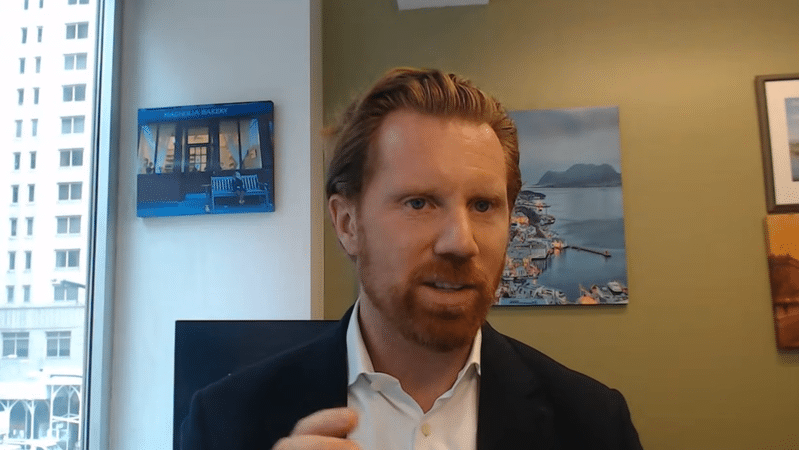
Karl Andersen no longer wants to sell solar power to the grid for a few rappen; instead, he wants to convert it directly into computing power. With his company Lektra, the American entrepreneur is focusing on small, decentralized data centers rather than hyperscalers. In a podcast conversation with Jakob Barandun of CapricornConnect, he explains why electricity, not chips, is the bottleneck of the AI era, why data centers are becoming a security risk, and what entrepreneurs can learn from a good hot dog stand.
The idea for Lektra originated in Norway. Andersen was managing a private-equity fund there and observed how quickly the country was becoming electrified and how much strain this was putting on the power grid. At the same time, he was frustrated by an imbalance that every solar panel owner is familiar with: Solar power can now be generated for about three U.S. cents per kilowatt-hour, but if you don’t use it yourself, you have to sell it back to the grid. And there, a monopolist sets the price.
For the financier, this calculation didn’t add up. So he looked for another buyer who would pay more. First, it was charging stations; then, with the rise of generative AI, the real insight emerged: Anyone who operates a small data center alongside a solar power system and connects it to a decentralized cloud via the Internet is no longer selling electricity, but rather computing power. According to Andersen, operators in his model earn between two and ten dollars per hour, instead of six cents per kilowatt-hour when feeding electricity into the grid.
Lektra refers to this as “Edge Scale” rather than “Hyperscale”: data centers with a power capacity of 20 megawatts or less. The company has filed patents covering decentralized power for operating graphics and other processor cards. Andersen feels vindicated by the Nvidia GTC conference, where it was openly acknowledged that the power supply, not the chips, is now the limiting factor.
Two customer groups, one cycle
The business is divided into two parts. Lektra Energy partners with solar and battery providers such as Sunrun and EG4, which have access to hundreds of thousands of locations. Andersen draws the comparison himself: AWS operates around 30 sites worldwide, EG4 alone 150,000, and Sunrun around one million. These “Energy Hosts” receive 80 percent of the revenue. On the other hand, there is Lektra Cloud, built by the former architect of IBM’s AI cloud, which sells computing power to developers.
Andersen cites the U.S. as the leading growth market, where wait times for new data center capacity are two years and the first moratoriums on large data centers are being discussed. Europe follows closely behind: There are significantly more households with solar panels here than in America, and CO₂ pricing plays into the hands of a provider with a completely emission-free cloud. In the long term, he is targeting countries with weak power grids, such as those in Latin America or South Asia, where hyperscale data centers are simply not feasible. Behind this lies a geopolitical question: Who will be the first to build the AI infrastructure there, Western providers or Chinese ones?
Data centers as vulnerable targets
Andersen is particularly clear on the topic of security. He points to attacks in the Middle East, which, according to him, specifically targeted large data centers, and to the Russian attacks on the Ukrainian power grid. His point: Anyone who relies on massive data centers connected to an already fragile grid is concentrating critical infrastructure at a few, easily identifiable points. AI, Andersen notes dryly, won’t take over the world if its data centers are bombed. Small, distributed facilities, on the other hand, can be built inconspicuously, camouflaged, or even used as decoys.
He also sees a case for resilience from a business perspective. Many companies, especially in Europe, are hesitant about AI because they don’t want to entrust their data to the major cloud providers. That’s why Lektra is partnering with Dell to build on-premises solutions featuring solar power and battery storage, on which open-source language models run locally. The data stays in-house. For risk managers, this is a familiar pattern: concentration risks associated with a small number of providers, dependence on critical infrastructure, and issues of data sovereignty. The only thing new is that the answer might lie right on their own rooftops.
Why the grid is stumbling
Andersen explains the technical problem using an analogy. A hyperscale data center’s load can jump from 20 to 80 percent within seconds, as if New York were occasionally turning all its lights on and off at the same time. The grid must maintain a stable frequency during such fluctuations. Renewable energy sources provide electricity, but they lack the inertia needed to cushion such fluctuations. The result is overloads and even power outages, even though, mathematically speaking, capacity would still be available. It’s as if you were trying to drive Ferraris on horse trails.
Politically, Lektra straddles the two camps. In the U.S., the issue of climate change has largely disappeared from the debate since the change in administration, but rising electricity prices in regions with many data centers, water shortages, and local opposition are playing into the hands of decentralized solutions. Andersen, on the other hand, does not see small modular nuclear reactors as a quick fix: The industry isn’t ready yet, and there simply isn’t enough skilled labor to maintain such facilities.
Entrepreneurship without heroics
If you ask Andersen about the challenges of entrepreneurship, you won’t get any motivational rhetoric. Failure isn’t good, it’s grueling, every single time. You can recognize true entrepreneurs just like you recognize good comedians: they do it because they can’t help themselves. Andersen himself delivered newspapers as a child and later founded a broker-dealer, a hedge fund, and a reinsurance company, not all of which were successful. Success depends not only on the idea, but also on timing, the team, and coincidences that no one can control. Anyone who has three out of five factors on their side can count themselves lucky.
Companies aren’t things, but processes that need to be constantly fine-tuned. And the most important thing is empathy for the customer. That may sound trite, but it’s simply true. Andersen illustrates this with an example from his adopted home of New York: A hot dog stand can be terrible or fantastic, same product, same street corner. The difference lies solely in whether someone loves their craft and takes the customer seriously. Even a four-star hotel with warm service beats a five-star hotel with indifferent staff. Anyone who thinks this way doesn’t have to worry about coming across as cool. It just happens naturally.
Energy as an investment
When asked about a superpower, Andersen doesn’t want a time machine, he wants speed: the ability to convince people more quickly to rethink energy. He considers the common AI narrative, that jobs will disappear first, followed by humanity, to be bad PR. His alternative vision is AI that runs in-house, under one’s own control, on the farm just as much as in a small business. The company’s motto is “Powering Intelligence.” His personal motto is even simpler: energy as an asset.
It remains to be seen whether this model will catch on on a large scale. In any case, the question Andersen raises remains an uncomfortable one: Why are we expanding the most critical infrastructure of our time in the very places where it is most vulnerable?
Binci Heeb
Listen, watch, and read more: When Machines Learn Faster Than Humans
Search:
Sponsors: