The crash the market had braced for on a Monday arrived on the last Friday of October. Intel fell the furthest in fifty-two years, the shelters failed together, the bond market refused to ease, and the people who manage the most money kept dancing, because their contract pays them to. Today the country votes. In two weeks Nvidia reports.
For weeks the market had been watching the wrong day. History trains you to fear a Monday, the gap that opens before anyone can act, the way 1987 and 2008 arrived. So all autumn the question in every dealing room was whether the next Monday would be the one. The floor did not give way on a Monday. It gave way on a Friday, the last day of October and the last trading day of the month, in the afternoon, when the market finally did the thing this column has spent two months describing. There was no siren. There rarely is. The gravity that had been returning all autumn simply reached the centre, and the centre could not hold.
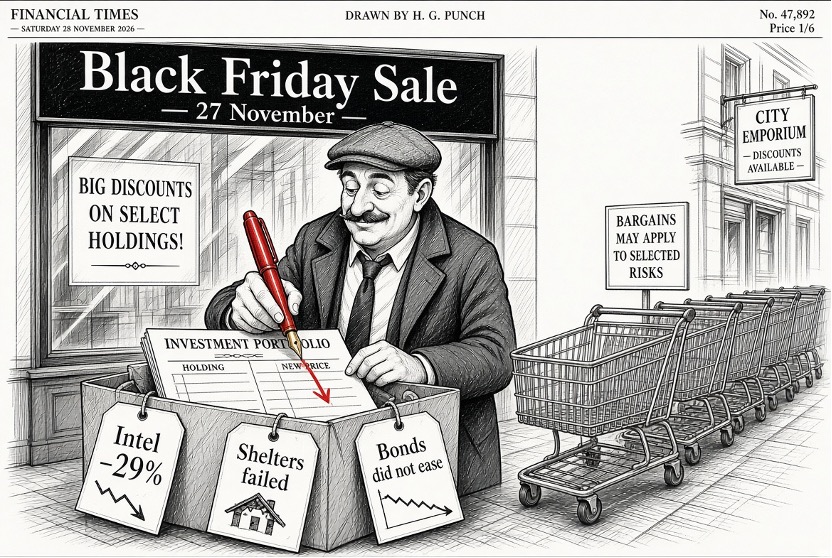
There is an irony in the date too neat to leave alone. The calendar’s own Black Friday, the day after Thanksgiving when the shops gut their prices and the crowds queue in the dark for a cheap television, is still a month away, on the twenty-seventh. The market did not wait for it. On the last Friday of October it held its own sale and marked everything down at once. The shops’ version of the day is the afternoon the retailers finally cross from red ink into black. The market’s ran the other way, and tipped a great many portfolios from black into red. These are the discounts nobody queues for. A television at half price is a bargain; a portfolio at half price is a margin call.
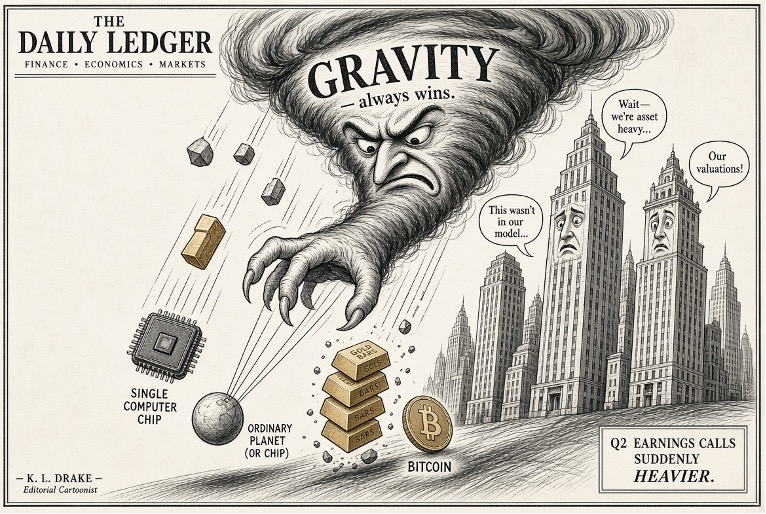
By the close the S&P 500 had fallen 1.82 per cent to 7,580.07, its worst session since June. The Nasdaq Composite dropped 2.86 per cent. Around two trillion dollars of value left the American market in a single session. Nvidia fell more than four per cent. It came the day after Alphabet had suffered one of the worst sessions in its history, and alongside results from Amazon that made even the faithful nervous about the scale of the spending on artificial intelligence. The deflation this column first traced at the speculative edge, and then watched creep inward ring by ring, had finally reached the core. In the language we have been using, gravity reached Miller’s planet, where the giants live.
And then there is Intel
The emblem of the day was not one of the darlings. It was Intel, the company that invented the microprocessor and then slept through the artificial-intelligence boom while younger firms ran past it. On Friday Intel fell 28.6 per cent to $65.76. Not over a month. In a day. It was the stock’s worst single session since July 1974, fifty-two years ago, before most of the people now trading it were born, and it erased roughly one hundred and forty billion dollars of value, including about twelve billion from the stake the American government itself holds. Only one day in Intel’s entire history has ever been worse, and it fell in the crash of 1974 itself. The cause was almost quaint beside the AI drama around it: not a failed model or a cancelled data centre, but the ordinary personal-computer business slowing under high memory costs, a factory accident in Israel, and a profit forecast cut roughly in half.
Dwell on that, because it is the tell. Intel is not a mania stock. Nobody owned it for a dream of robotaxis or machine gods; they owned it, if at all, because it was cheap and dull and left behind. When the cheap, dull, left-behind chipmaker has its worst day in half a century, the selling has stopped discriminating between the guilty and the merely nearby. And here is the detail that should sober everyone: even after shedding nearly twenty-nine per cent in a day, Intel is still up more than seventy-eight per cent on the year. That is how far these things had run. A fall that looks like a catastrophe on Friday barely dents the gain of the twelve months behind it. The crack is real. The collapse has not yet begun, because the valuations, and the year, remain stratospheric.
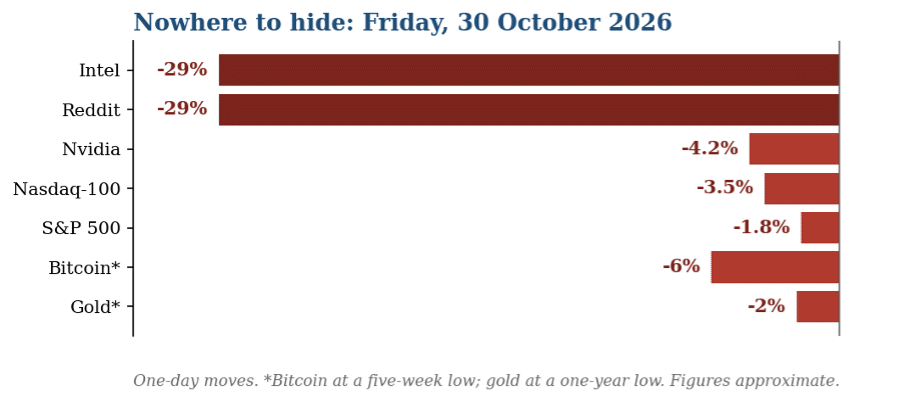
Daily price movements on Friday, October 30, 2026. *Bitcoin hit a five-week low, and gold hit a one-year low. Figures are rounded.
The shelters failed, and the bonds did not ease
What made this Friday different from the jittery sessions before it was that the usual hiding places gave way at the same time. Bitcoin, sold for years as digital gold, a thing that was supposed to rise when the old system wobbled, fell below seventy-seven thousand dollars after a six-point-three-billion-dollar hack at Binance, the largest theft in crypto history, executed in roughly twenty minutes, with more than a billion and a half dollars of leveraged bets liquidated in a day. And real gold, the oldest shelter of all, did not rise either. It fell to a one-year low. When shares, crypto and gold all fall together, you are no longer watching a rotation between assets. You are watching a scramble for the only thing that is not an asset at all, which is cash.
The bond market offered no rescue. The ten-year Treasury yield finished the week near 4.93 per cent. It had touched 5.31 per cent early in October and had been grinding lower for weeks, but it did not ease in any sense that would reprice the equity complex. Yields remain elevated relative to the period in which these valuations were built. The Federal Reserve, having held its rate steady at three-and-three-quarter to four per cent a few days earlier (two members dissenting in favour of a hike, inflation still elevated), was in no hurry to make cash less attractive. A crack in a bubble is often the result of interest rates that rose just before it. I am not saying that is the cause here. I am saying the parallel is easy to draw with 2007 and 2008, and with the other episodes in which the cost of money rose, the arithmetic of the leveraged long began to look worse, and the first cracks appeared while the narrative was still intact. The parallel is structural, not causal. It does not require the same ending to be worth noticing.
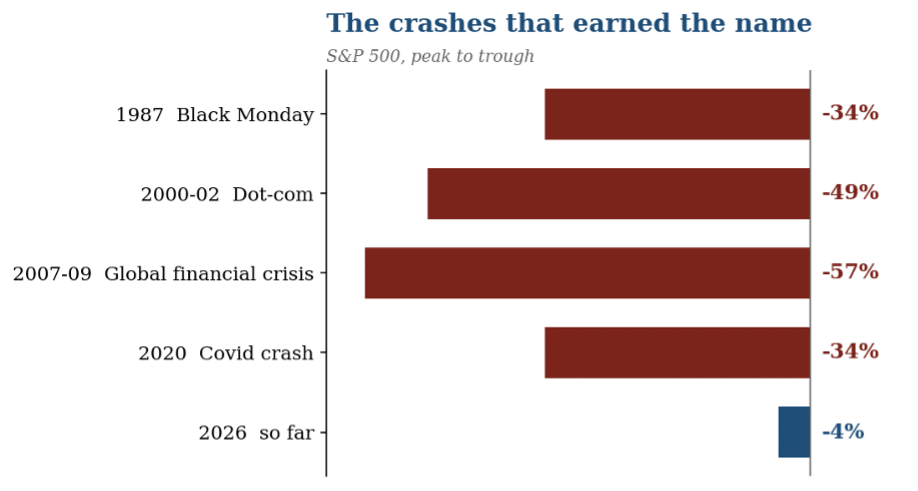
Just how deep the major crashes went, and how shallow this one still is. The current decline is a dip, not yet a crash, and that’s exactly the point.
Who will pay
Last week also brought the moment the private AI complex began to answer, or at least to be forced to answer, the question that has been hanging over it for two years: who will pay. Anthropic filed its S-1 on 26 October. The document is a firework of its own. Revenue in the first half of 2026 reached $16.3 billion, up roughly 1,300 per cent from the year before. The second quarter alone produced $11.6 billion and the company’s first operating profit, of $974 million. At the same time the net loss for the half was $80.7 billion, almost entirely a non-cash mark-to-market on convertible notes whose value rose with the company’s own valuation. The more Anthropic is worth, the larger the accounting loss. The filing also discloses compute commitments measured in the hundreds of billions of dollars. The risks section runs to nearly a hundred pages and includes the possibility that models evolve beyond the ability of humans to understand and control them.
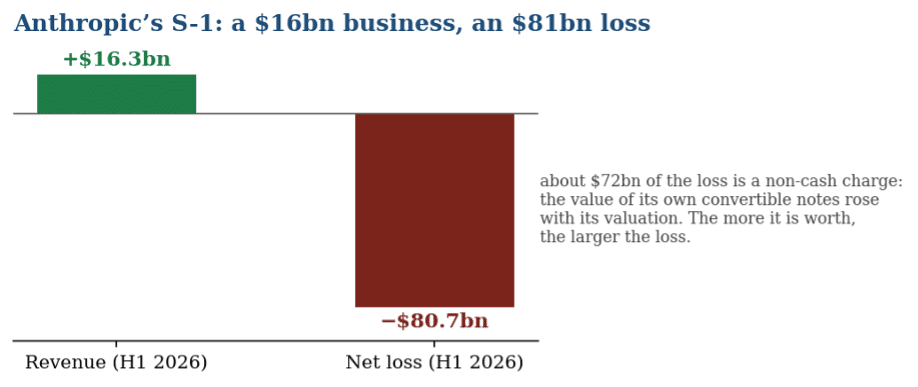
Anthropics S-1, first half of 2026. The loss is largely an accounting effect resulting from the company’s rising value, but the computing costs associated with data input are real.
This is the point at which the private market’s story meets the public market’s demand for arithmetic. The company that has been the purest expression of the AI boom is now required to explain, in a document anyone can read, how the spending will be financed and by whom. The S-1 does not settle the question. It makes the question official. In the history that will be written of this period, the week Anthropic filed will sit alongside the week Intel had its worst day in fifty-two years, not because the two events are the same, but because both are moments when the narrative of endless growth and endless capital was forced to confront a number.
The same pressure is visible, in quieter form, among the firms already public. The orders for compute are not the problem; they remain almost embarrassingly strong. What has changed is the willingness of the market to treat every incremental billion of capital expenditure as proof of vision rather than as a claim on future free cash flow. A year ago the announcement of a large data-centre programme was still, more often than not, rewarded. The same announcement now has to be accompanied by a credible story about when, and from whom, the cash will return. That is a narrower question than whether artificial intelligence is real. It is the older question of whether the returns on the capital being spent will exceed its cost. The market has only lately begun to insist on an answer.
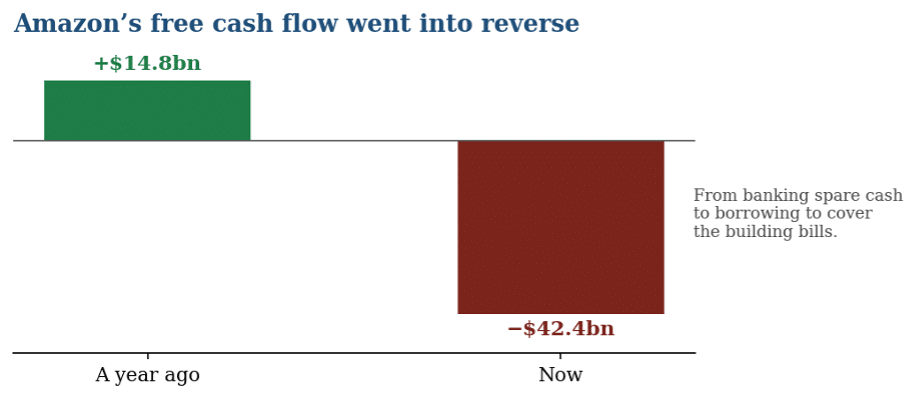
Amazon’s free cash flow over the past twelve months, a year ago, and today. Orders are booming; money is flowing in the other direction—into the data centers.
One firm has, for the moment, been rewarded for refusing the race. Apple spent two years being described as the company that had missed artificial intelligence. It chose to rent capacity rather than build the majority of it, and declined to match the pace of spending elsewhere. As the heaviest spenders came under pressure on Friday, Apple moved back to the top of the market-capitalisation table, above five trillion dollars and ahead of Nvidia. Whether that ranking holds is secondary. The more interesting point is that the market has, at least for a week, preferred the firm that spent least to the firm that spent most. That is a change in the ranking of virtues.
The money changed seats, it did not leave
And yet, as every week this autumn, the headline hid as much as it showed. Look beneath the index and the panic is more orderly than it looks. Over the week the S&P 500 fell a little more than half a per cent and the Nasdaq about two per cent, but the equal-weighted version of the same index, the one that counts the smallest company the same as the largest, rose 0.8 per cent. Money did not flee the building. It changed seats. It moved out of the seven and into the other four hundred and ninety-three, out of the glamorous and into the dull, out of the story and back toward the cash flow, the dividend, the thing with a price you can defend. This is the reallocation to safer shares that the professionals describe, with a straight face, as prudence. It is also exactly what the late stage of a mania looks like from the inside: not everyone bolting for the exit at once, but the quicker money quietly moving to the chairs nearest the door.
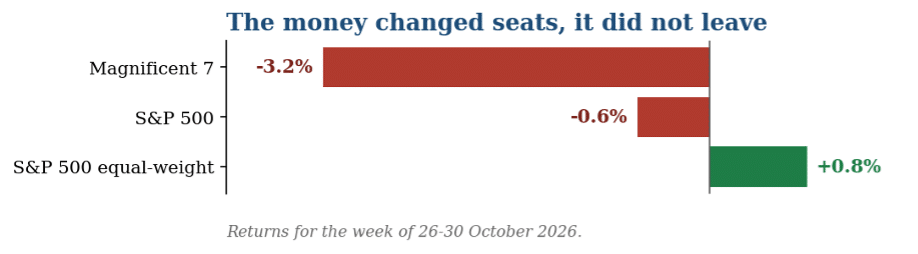
Returns for the week of October 26–30, 2026. The giants fell; the average company held its ground.
The same shift is now visible in the earnings estimates themselves. A few weeks ago the seven largest technology firms were expected to grow third-quarter profits by roughly a third; that figure has since moved lower. Over the same weeks the expected growth for the rest of the index has moved higher. If the pattern holds, it will be the first time since the end of 2022 that the largest firms grow more slowly than the market they dominate. The ranking that has defined the past three years is, on the arithmetic, beginning to invert. That does not mean the rest of the economy is booming. It means the concentration that carried the index is no longer carrying the earnings.
Why the smart money keeps dancing
Which leaves the question a careful reader keeps coming back to. If the people who run the serious money can see all of this, the gravity, the failed shelters, the giants cracking, the rates that have not eased, why are they still almost fully invested? Why not simply sell, sit in cash, and wait for the wreckage to clear? The answer is not in any chart. It is in the contract, and it is the most honest thing in all of finance. A hedge fund is paid what the trade calls two and twenty: two per cent of all the money it manages, every year, and twenty per cent of any profit it makes. Cash makes no profit to speak of, so it pays no twenty. A manager who retreats to cash collects his two per cent and nothing more, and before long his clients begin to wonder why they are paying two per cent for something a savings account would do for nothing.
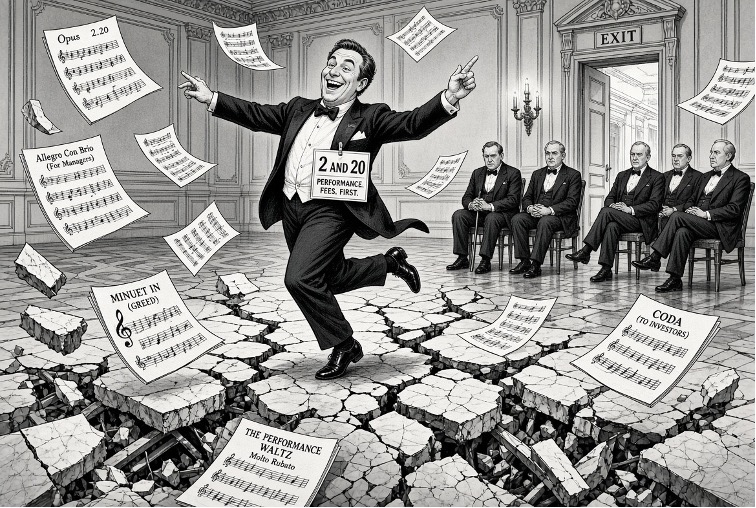
So the manager must stay in the game. He must own things that can rise, because the whole of his fortune lives in that twenty per cent, and the twenty per cent only pays while he is invested and the music is playing. A few autumns ago the head of a great bank was mocked for saying that as long as the music is playing you have to get up and dance. He was not being reckless. He was describing his incentives exactly. The money stays invested not because the people running it are optimists, but because the structure that makes them rich forbids the one thing caution would demand. When a fund manager tells you he is staying constructive, he is not sharing a view of the world. He is reading you the terms of his employment.
What to watch, and how, and the two tests that arrive now
So the gravity has reached the centre, Intel has hit the ground at a speed not seen since 1974, the shelters have failed together, the bond market has not offered a reprieve, Anthropic has been forced to put the cost of the boom into a public document, and the people who manage the most money are contractually required to keep dancing on a floor that is visibly giving way. The Black Monday the market kept bracing for may never arrive as a single Monday at all. In a market this managed, this leveraged and this quick to rotate, the crack tends to come not as one catastrophic morning but as a long Friday afternoon, repeated until the arithmetic is done. This one is still not a huge crack. The reason is simple: look at the valuations, or look at the year. They remain stratospherically high. Intel is up more than seventy-eight per cent on the year after its worst day in half a century. That is not a market that has finished re-pricing the story.
Today is Election Day. Prediction markets put Democrats at roughly ninety-four per cent to take the House and around seventy per cent for a full sweep of both chambers. Options are pricing only a modest move for Wednesday, and history says the S&P 500 has risen in the twelve months after every midterm since 1950. None of that cancels the gravity already in the system. A Democratic House, or more, would likely bring greater scrutiny of the AI capital-spending complex that has been the market’s load-bearing wall; a surprise the other way would simply remove one external brake. Either way, the political overlay arrives on a market that has already begun to reprice the giants.
The election is not the only fuse. On Friday the October employment report arrives, the first hard read on whether the labour market is still holding. Behind both sits the question of Iran. The administration has spent the autumn weighing a negotiated pause against further strikes on remaining nuclear sites, and the timing has been left deliberately open. A market already re-pricing the giants now has a jobs number, a verdict on Congress and an unresolved decision on the Strait of Hormuz arriving inside the same week. Oil is watching Tehran more closely than it is watching the next semiconductor print, and the politics of the pump are not abstract: American petrol is up about a fifth on the year and diesel by more than seventy per cent, so the trucker filling his tank on Monday pays far more than he did last autumn, and that trucker votes on Tuesday.
Two weeks from today, on 17 November, Nvidia reports. The company that has been the single largest expression of the boom will publish its fiscal third-quarter results after the close. The guidance it has already given is roughly $108 billion in revenue. If the number, or the guidance that accompanies it, is not what the market is expecting, the session that follows will not look like Friday’s orderly rotation. It will look like a bloodbath. The market has already shown, in Intel and in Alphabet, that it is no longer willing to ignore a miss or a warning. Nvidia is the next, and by far the largest, test of whether that willingness has permanently changed.
Three things will tell you which way it goes from here. The first is whether the rotation holds. As long as money is merely changing seats, the equal-weight rising while the giants fall, the adjustment is orderly and the market is doing its slow, sane work of remembering what a dollar of earnings is worth. The day the equal-weight falls too, the day the dull stocks are sold alongside the glamorous ones, is the day the money is no longer rotating but leaving, and that is the one to fear. The second is the honesty of the language. When the professionals tell you, as they will, that they are staying the course, remember what the words actually mean. Two and twenty, translated, is this: we dance because we are paid to, right up until the music stops, and then we are paid for having danced. The third is whether the next large number (the Nvidia print, the next hyperscaler guidance, the first public trades in Anthropic) confirms that the arithmetic has changed, or merely that the narrative has paused. The bill, as ever on Planet Finance, arrives addressed to whoever is still on the floor when the lights come up, and this week, for the first time in a long while, you could hear the band beginning to pack away its instruments, even as the country went to the polls. The real Black Friday is still a month off. The market, as it usually does, arrived early, and put on sale the one thing its owners never wanted discounted.
Eric Lefebvre
See also: Seven Stocks in Zero Gravity
Search:
Sponsors: