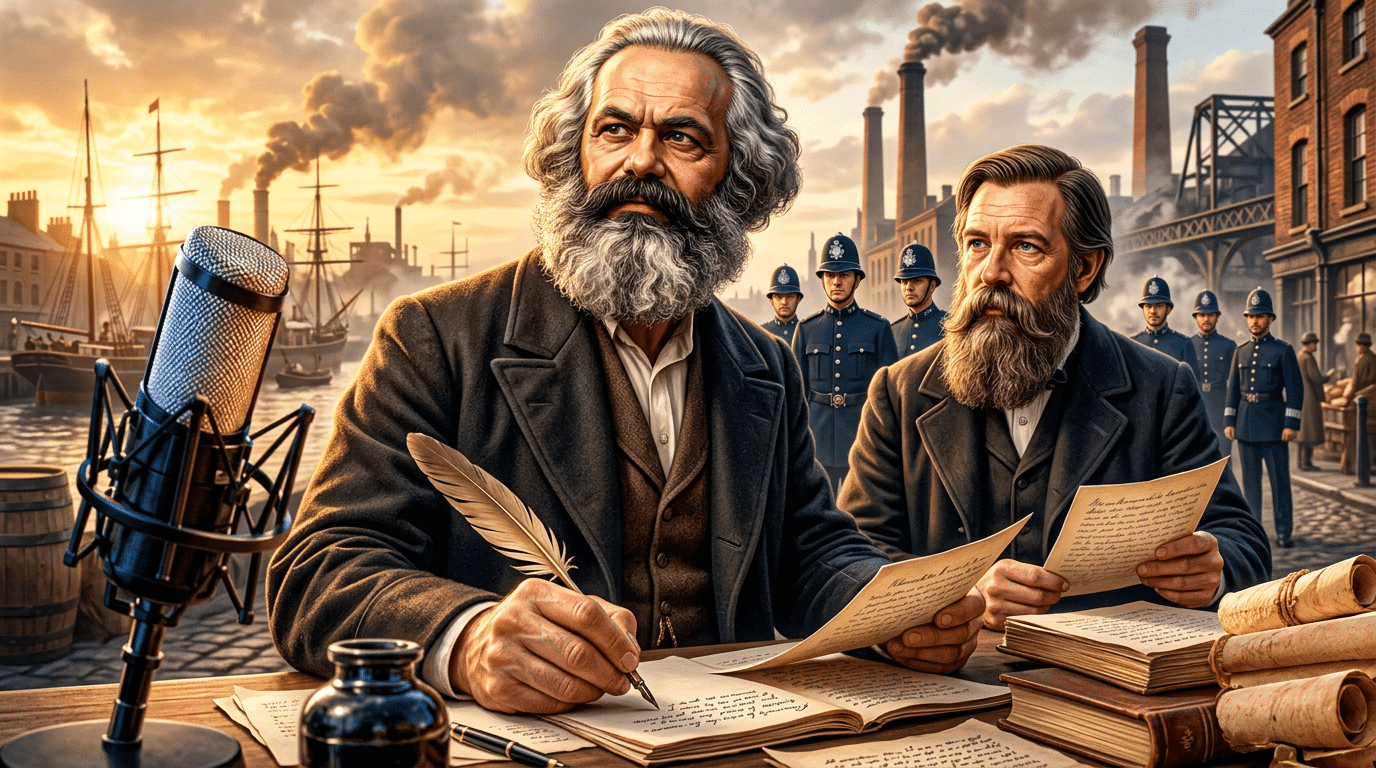
What would Karl Marx and Friedrich Engels say about today’s European insurance markets? In today’s episode of “Paul the Insurer,” Paul undertakes a thought experiment that raises more questions in four and a half minutes than some industry conferences do in an entire day.
The premise is simple: If the two fathers of Capital were alive today, their critique of the insurance industry would likely begin exactly where they dissected capitalism back in the 19th century. Economic institutions, according to their thesis, serve the interests of the propertied class and cement inequality only this time packaged as stability and protection. Insurance, which likes to see itself as a social good, would from this perspective simply be part of the infrastructure that keeps the capitalist order running.
Protection for whom?
The first criticism strikes at the very heart of the industry’s self-image. Insurance systems, Marx and Engels might argue, primarily protect capital, not people. Property, business interruption, and liability insurance safeguard entrepreneurs’ assets and profits. And even where the benefits for workers are undisputed, such as with accident insurance or health insurance, a second function can be discerned: they keep the workforce productive and compliant. Those who are insured are less likely to rebel.
From the Collective to the Data Profile
Things get more interesting with the second point, because here the thought experiment aligns with a real-world trend. European insurance markets are increasingly turning to individualized risk pricing: premiums based on personal data, behavior, and lifestyle. This follows market logic, not the logic of solidarity. Marx and Engels would see this as a retreat from collective protection, mutual aid is being replaced by competition among the insured. Those who live healthier lives, drive more carefully, or simply provide better data pay less. Those who don’t pay more.
The State as a Facilitator of the Market
Even public-private models, such as those found in Europe in the areas of health care, social security, or natural disasters, would not escape unscathed. Rather than replacing the market, the state supports it by assuming those risks that are not profitably bearable for private providers. For Marx and Engels, this would not be a compromise in the interest of the general public, but rather a state acting on behalf of capital, and not on behalf of the proletariat.
Who Stays Outside
The fourth point is the most uncomfortable because it is the least likely to be dismissed as mere theory. Despite regulation and subsidies, access to insurance coverage remains unevenly distributed. Migrant workers, gig workers, and those in precarious employment are often excluded or inadequately covered. From a Marxist perspective, insurance systems thus reproduce class differences rather than eliminating them.
Data as Unpaid Labor
The two would likely be particularly suspicious of digital insurance, which relies on real-time data from smartphones, wearables, and connected devices. The argument goes that, under the guise of risk-based premiums, capitalist control is encroaching on private life. Data would become a new form of labor extracted from people without them receiving any compensation. It’s a thesis that doesn’t require one to be a Marxist to find it worth considering.
What Remains of the Thought Experiment
Paul’s conclusion is consistent: According to Marx and Engels, insurance under capitalism is not primarily about protection or equality. It is a mechanism that stabilizes production, curbs social unrest, and preserves hierarchies. Reforms may promote greater fairness, but genuine solidarity and universal protection would only emerge in a post-capitalist, communal system in which human needs, rather than capital, drive the economy.
You don’t have to agree with this conclusion to benefit from listening to the episode. After all, the irony is obvious: Insurance originally arose precisely from the kind of mutual aid whose loss the thought experiment laments. Cooperatives and mutual insurance companies continue to shape the industry to this day, including in Switzerland. And here in Switzerland, a conscious decision has been made to avoid full individualization in key areas, for example, through flat-rate premiums in mandatory health insurance or solidarity-based coverage for natural disasters.
The real question Paul is asking, then, is not an ideological one, but a very practical one: How much risk are we, as a society, willing to bear collectively, and how much do we leave to the algorithm that assigns a price to each individual? This decision is not made by software. It remains a matter of human judgment, and thus one that the industry itself must answer before others do it for them.
Binci Heeb
Listen to and read: Odysseus Starts an Insurance Company
Search:
Sponsors: