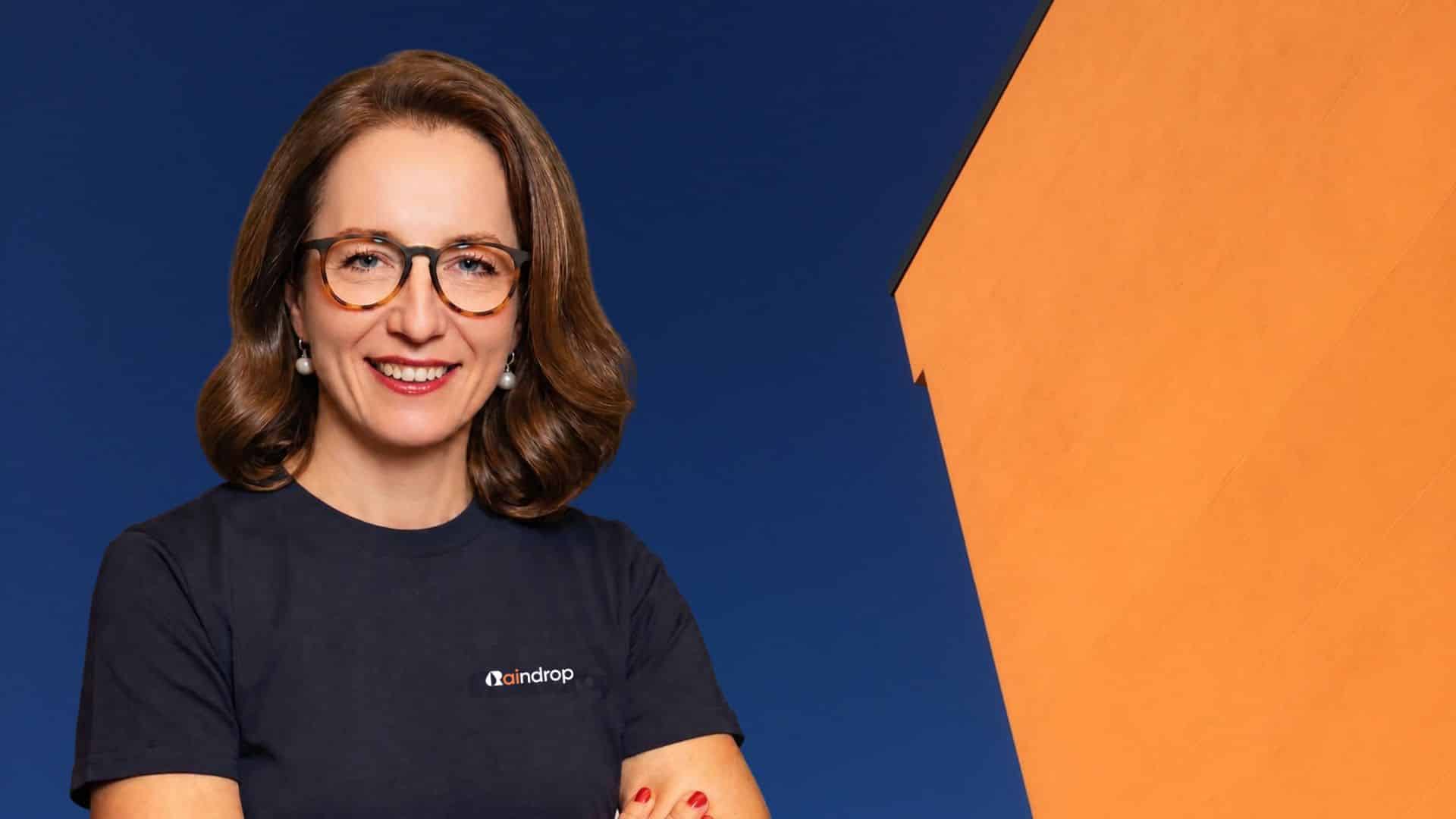
Eight insurance policies, fifteen hours of work, and ultimately the realization that no one is solving this problem. Jasmin Flori-Hess, a former UBS banker, used this insight to found the InsurTech company Raindrop in Darwin, Australia. Her Insurance Ontology breaks down policy wording so that brokers, insurers, AI agents, and customers all understand it the same way. Now she wants to bring the model to Switzerland.
Jasmin Flori-Hess had actually planned to stay only two years. In 2017, she moved with her family from Australia to Switzerland so that her children could learn about their European heritage, and she went back to work at UBS. After four years and a pandemic, her wanderlust became too strong: five months off, a camper, Australia. There, she decided to finally lay out the family’s eight insurance policies side by side. After fifteen hours, she had a matrix, but also a question: Why is this so absurdly difficult?
A friend from the startup scene told her she should solve the problem herself. She came back from the bush with a business plan, and he became her first angel investor. This was followed by market validation with insurers and brokers, the NLP working group for insurance at HWZ, a pitch in New York, and then a move to Darwin—all within eight weeks. There, she founded Retja. The name is a Yolngu word for the jungle with jasmine vines: vital and at the same time overwhelming—just like the insurance world.
The Raindrop brand represents the distillation of this complex web. At its core is a proprietary insurance ontology that breaks down insurance terms and conditions into small, structured units and reassembles them so that both humans and machines can interpret them consistently. What began as an idea to help insurers compare products has since evolved into something more. Insurers are realizing that AI agents cannot read their PDFs, which is why their products remain invisible to ChatGPT and similar platforms. Raindrop is a member of Insurtech Australia, InsurTech New York, and, most recently, the Swiss InsurTech Hub. We spoke with the founder about the jungle, data, and the courage to launch a startup later in life.
Ms. Flori-Hess, a campground in Australia, eight insurance policies, fifteen hours of work. When did that hassle turn into a business idea?
The real epiphany came somewhere between Ningaloo and Mataranka. I was far away from everything, surrounded by absolute silence, and had a clear view of the Milky Way. And suddenly it dawned on me: The problem isn’t that insurance companies have too much information. The problem is that we can’t grasp its meaning quickly and clearly.
Raindrop was born from this idea.
However, the business idea has grown and evolved significantly since then. What began as a desire to make it easier to compare insurance policies has now become something much more fundamental: We are building a layer of meaning that makes insurance knowledge understandable and reliable for both people and AI.
You had never started a company before and had never worked with technology. What convinced you to do it anyway, and what surprised you the most as a founder?
My background is in communications, change management, and project management—not in technology, nor in the traditional startup world. What convinced me, however, was a problem I kept seeing: In the insurance industry, many things don’t fail because of a lack of information. It fails because people interpret the same terms and conditions differently.
The more I delved into it, the clearer it became to me: This isn’t just a communication problem. It’s a structural technology problem. If people can’t consistently interpret complex insurance terms, how is AI supposed to work with them reliably?
That convinced me that we need to build something fundamental here—a reliable foundation on which people and AI can understand the same meaning.
As a founder, I’ve learned above all that you don’t have to be able to do everything yourself. You have to ask the right questions, attract the right people, and be willing to learn very quickly.
What surprised me most was how much starting a business has to do with perseverance. You change your mind, learn from customers, discard ideas, and rebuild them. Technology is important. But in the end, it’s about people, trust, and truly understanding the real problem.
At first, I thought what I needed most was a vision. Today, I believe what you need most is the ability to keep looking at things with fresh eyes and to adapt your own ideas without losing sight of the problem.
RETJA is a Yolngu word; Raindrop stands for a drop of clarity. What do these names say about your understanding of insurance?
For me, it represents a connection to Australia and something that goes deeper than just a purely technological company name. Insurance is, after all, something very human: it’s about trust, security, and a promise for when things go wrong.
Raindrop is the next step in developing this idea. A single drop is small, but it sets something in motion. And that’s exactly what we want to achieve with Raindrop: to bring a drop of clarity to an industry that is often unnecessarily complex and difficult to understand.
Because I believe insurance doesn’t have to become simpler by omitting content. It has to become more understandable by making the meaning behind the words visible.
For me, Raindrop therefore stands for clarity, transparency, and trust—and for the conviction that people and AI can only make good insurance decisions when they truly understand the same things.
Explain Raindrop to someone without a technical background: What happens in the seven minutes after a “policy wording” is uploaded?
Imagine you give Raindrop a 100-page insurance document and say, “Please understand this.”
In the first few minutes, Raindrop doesn’t just skim through the document. It breaks it down into its individual components and identifies what it’s actually about: What is covered? What is excluded? What conditions apply? Which terms are defined? And most importantly: How is this information interconnected?
The original document is then transformed into a structured map of meaning. Every statement remains traceable back to its original source.
So after about seven minutes, we don’t just have a summary of the document. We have a structured, verifiable version of how this insurance contract works.
And that is precisely the key difference: Raindrop doesn’t try to summarize the text in a more elegant way. We make the meaning behind it accessible to both people and AI.
This allows brokers to compare options more quickly, insurers to operate more consistently—and AI to finally analyze insurance terms on a reliable basis.
At the heart of it all is your insurance ontology. How does it differ from a standard language model that reads PDFs, and how do you ensure that your assistant, Neptune, doesn’t hallucinate?
A typical language model is very good at understanding language and formulating a plausible response based on it. But that is precisely the problem when it comes to insurance: plausible does not automatically mean correct.
Our insurance ontology is therefore more than just a language model. It provides a structured representation of the meaning of an insurance contract: What is covered, what is excluded, which definition applies, which condition is related to what—and where exactly in the original document can this be found?
You can think of it like a translator. The language model understands the language. Our ontology ensures that it interprets insurance terminology correctly and understands the relationships between the individual clauses.
With Neptune (the King of the Seas, where all Clarity Raindrops are collected), the goal is therefore not simply to generate the most intelligent answer possible. Neptune should only say what can be derived from the underlying, verified database. Answers remain traceable to their source and can be checked against the original policy wording.
Of course, no AI system can credibly promise that it will never hallucinate. But we’re changing the architecture: we don’t rely on the language model as a source of knowledge. The model serves as the interface—Raindrop provides the verified meaning and the evidence behind it.
That’s exactly what makes the difference between “AI that can read a PDF” and “AI you can trust to make an insurance decision.”
You say that the same insurance claim can be approved or denied depending on how it’s interpreted. How big of a problem is inconsistent interpretation, really, and who is hit the hardest by it?
The problem is bigger than it seems at first glance. That’s because an insurance policy isn’t a simple “yes” or “no” document. Often, the answer to a claim depends on how various clauses, definitions, exclusions, and conditions interact.
Let’s take two people who are assessing the same claim. Both read the same policy wording, but one interprets a definition or exclusion differently. One says, “That’s covered.” The other says, “No, that’s excluded.” Both may be convinced that they are right.
It is precisely this inconsistency that is the problem.
In my view, it hits customers the hardest. For them, insurance is a promise: if something happens, they want to know whether they’re protected. But brokers and insurers also bear the consequences—through follow-up inquiries, rework, complaints, E&O risks, longer claims processing, and, above all, a loss of trust.
And now AI is entering the picture. As we begin to use AI to support or automate insurance decisions, this problem becomes even more critical. After all, an AI that provides different answers to the same policy wording doesn’t just scale efficiency—it also scales inconsistency.
That’s why, for me, the crucial question isn’t: “Can AI read policy wording?” It can.
The crucial question is: “Can it reliably convey the same meaning for the same contract today, tomorrow, and across different systems?”
This is exactly the problem we want to solve with Raindrop.
Insurers are realizing that AI agents don’t understand their documents and that their products don’t appear on ChatGPT and similar platforms. Will visibility in AI become the industry’s next sales challenge?
Yes, absolutely. Today, insurers ask, “How can I be found on Google?” In the future, the question will be, “How will my product be understood and recommended by an AI agent?”
After all, it’s not enough for policy wording to be available online. The AI must be able to correctly understand the coverage, exclusions, and conditions.
This makes AI visibility the new sales issue—but it’s actually about more than just visibility:
Insurers need to have a thorough understanding of machinery.
That’s exactly why Raindrop provides the necessary layer of meaning.
How did you learn the complex insurance terminology and concepts?
I didn’t learn this from a textbook. I sought out the right people.
We work with insurance experts who have been in the industry for decades—people who have written policies, developed products, and assessed claims, and who understand how the various terms and clauses are actually interconnected.
I’ve learned a great deal from these experts—and at the same time, we’ve begun working together to map out this knowledge in a structured way. What’s particularly exciting is that these people aren’t just contributing their existing knowledge; they also want to actively participate in shaping the industry’s future.
Thus, my initial difficulty in understanding the subject has gradually given way to a shared understanding of how insurance significance can be structured.
You make your IP available through white labeling so that “the industry can improve.” That’s unusual for a startup. How do you still protect your competitive edge?
For us, white labeling doesn’t mean we’re giving up control of our IP. Our ontology, data structures, and the actual logic remain with Raindrop.
However, our competitive edge lies not only in a single software feature. It lies in our insurance expertise, the relationships between policy provisions, and how we structure and continuously develop this knowledge.
And we believe this will have a broader impact: The more insurers operate on a solid, reliable AI foundation and the better insurance terms and conditions are understood, the better the entire industry will become. Fewer misunderstandings, more consistent decisions, and better customer experiences ultimately benefit everyone.
For us, that’s not a contradiction.
We can make the technology widely accessible while protecting the intellectual property behind it. Our goal is not to control knowledge—but to ensure that insurance is properly understood.
The IP remains in Australia, while you raise capital separately in the U.S. and Switzerland. Why this model, and what role do the potential proofs of concept in New York play?
This is a deliberate model for us. The IP and development remain in Australia—because this is where we’ve built our team, our expertise, and our technological foundation. At the same time, the problem we’re solving is global.
That is why we also want to attract capital and customers in the regions where the major insurance markets are located. The potential proofs of concept in New York are particularly important to us because they can demonstrate that the problem of differing interpretations of insurance terms and conditions is not an Australian problem, but a global one.
We aim to achieve international market validation through this—while continuing to leverage Australian capital and expertise.
For me, that’s actually the strength of the model:
We build in Australia, validate, and scale internationally.
You are currently in talks with Swiss insurers, and some prefer to handle everything in-house. Where do you see the biggest differences between the Swiss and Australian markets?
I see the difference less in the problem itself and more in the approach.
Australia is a relatively pragmatic market. People are more willing to try out new solutions with external partners if they quickly demonstrate tangible benefits.
In Switzerland, I’ve noticed a stronger emphasis on control, quality, and long-term self-reliance. That’s why some insurers ask first, “Can we build this ourselves?”
But that’s no obstacle for us. On the contrary: it shows just how important it is to build a solution that is truly robust from a technical standpoint and can be integrated into existing structures.
And ultimately , the fundamental problem is the same in both markets: insurance knowledge is complex—and AI needs a reliable foundation to be able to work with it.
For Raindrop, Switzerland is therefore also an important test: If our technology proves itself there, given the high standards of quality and control, that will serve as strong global validation.
Swiss InsurTech Hub and a presentation in the CAS “Insurance Transformation with AI” program at HWZ: What role do research and networks play for a young insurtech company?
Research and networks are incredibly important for a young InsurTech company—precisely because we work at the intersection of insurance and AI.
We can build technology, but we want to combine it with the best insurance expertise and scientific insights. Initiatives like the Swiss InsurTech Hub or my presentation in the CAS “Insurance Transformation with AI” program at HWZ bring us together with people who offer a wide variety of perspectives.
We would also be very interested in potential research funding—for example, from the National Science Foundation—because it would allow us to conduct in-depth scientific research on issues that are relevant to the entire industry.
At the same time, networking isn’t just about contacts or customers.
The goal is to work together to develop standards and a shared understanding of a new technology.
When it comes to AI in the insurance industry, I believe that no one can solve this on their own.
You’re starting a company in your late forties and often find yourself facing investors who are significantly younger during pitches. Is experience in fundraising an advantage or a hurdle?
I tend to see it as an advantage. I bring over 25 years of professional and life experience to the table—and with that, the ability to quickly assess complex situations, bring people together, and think long-term.
Of course, when I’m fundraising, I often find myself sitting across from people who are significantly younger and may have already founded several startups. But I don’t see it as a competition. I can learn from them just as much as they might benefit from my experience.
And maybe that’s exactly the point: Starting a startup isn’t just a matter of age. It’s about truly understanding a problem, getting people excited about it, and having the perseverance to solve it.
You specifically support young women in the tech and insurance industries. What advice do you have for women who want to start a business today?
My most important piece of advice is: Don’t wait until you feel “ready.” I wasn’t a tech expert myself, nor was I a “traditional” founder. If I had waited until I had all the answers, Raindrop would never have been founded.
Find people who can do things you can’t. Build a strong network, and don’t be afraid to ask questions. As women in particular, I believe we sometimes spend too long trying to master everything perfectly before we dare to take on a challenge.
And above all: You don’t have to be the loudest person in the room. You have to be convinced of the problem you want to solve—and have the courage to get started.
Where will Raindrop be in three years, and what needs to change in the industry so that customers are more likely to get a “yes” when they file a claim?
In three years, I want Raindrop to be an international standard for making insurance knowledge understandable and reliable for both people and AI—with customers all over the world!
And I hope that we can also bring about change in the industry: that a claim shouldn’t depend on who interprets the policy wording or which system provides the answer.
After all, “more ‘yes’ answers” isn’t really the goal. The goal is more appropriate “yes” answers—and more justifiable “no” answers. If a claim is covered, the customer should be able to trust that it will be recognized as such. And if it isn’t covered, it should be clear and transparent why.
If Raindrop helps make insurance decisions more consistent, transparent, and understandable, then we will have accomplished a great deal in three years.
The questions were asked by Binci Heeb.
Jasmin Flori-Hess is the founder and CEO of the Australian InsurTech company Raindrop. She has many years of experience in communications, change management, and project management in the financial and medtech industries. In these roles, she has supported international organizations and worked at the intersection of people, technology, and change. The idea for Raindrop arose from her own experience with the complexity of insurance terms and conditions. What began as frustration with policies that were difficult to understand evolved into a technology platform that structures insurance knowledge and makes it understandable, consistent, and transparent for both people and AI. Today, Jasmin is driving Raindrop’s international expansion and is committed to the responsible use of AI, as well as to increasing the number of women in technology and startups.
See also: SIH: Check First, Then Replace
Search:
Sponsors: