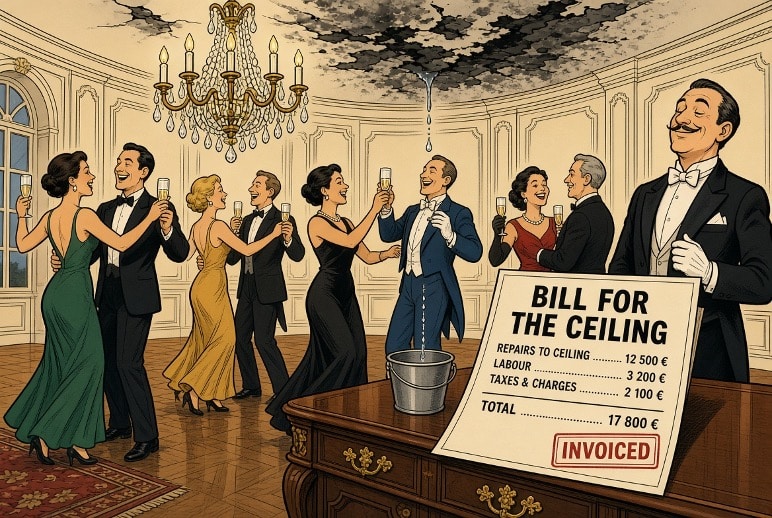
The market spent this week doing what a host does when the ceiling leaks on the night of the dinner. He puts a silver bucket under the drip, he turns the music up, and he tells the guests the rain is part of the charm. The bucket is the promise of no attack before the third of November. The music is a diesel delivery from Moscow worth, against American exports, about thirty hours, and a hundred million barrels from the emergency tank, which is a single day of the world’s thirst. The sanctions are lifted until the seventh of April. The rain is still coming through the plaster. The guests are still dancing. The bill for the ceiling arrives on the fourth of November, and it is already being written in the credit market, which does not trade in charm.
Every market runs on a bedtime story. Not a lie, and not quite the truth: a thing told often enough that everyone agrees to stop checking it. This autumn’s story is the one every child knows. Be patient. The frog will become a prince. The artificial intelligence will pay for the cathedrals. The bond buyers will wander back. The diesel is coming. Kiss the frog one more time. It is a wonderful story, and it has the feature that makes it irresistible to a tired market: it never has to end.
Fairy tales run until the afternoon somebody declines to take the story on trust and looks at the frog. This week, in one kingdom, somebody looked. France is no longer a European sideshow. France is the live demonstration of what happens on the morning the storytelling is caught. It does not explode. It reprices, quietly, and it hurts.
The kingdom where the clock struck
There is an old habit in the bond market of handing a doomed borrower an acronym. The acronym is the real downgrade, the one that arrives before the agencies get out of bed. Fifteen years ago the letters were PIGS. This month the wits handed France its own. The frogs. The English have form here. For thirteen years, from 1994 to 2007, they made the Eurostar arrive at Waterloo station, and they found it extremely funny. The French lost Waterloo badly, which is the part of the story Paris prefers to file under other people’s problems, and the City has not forgotten. When your sovereign debt acquires a nickname, the nickname is the verdict.

France now borrows more dearly than Greece, the Greece its officials have spent a fortnight insisting France is nothing like. It borrows more dearly than a long list of its own companies: L’Oreal, LVMH, Sanofi, and Air Liquide, a firm whose principal product is air. The market would rather lend to a company that sells air than to the Republic. L’Oreal cannot raise your taxes. It cannot send a gendarme for seventy euros of face cream. The Republic can do both, and is still the worse credit. One can only marvel that the bankers believed the story for as long as they did. France has been broke, in any honest accounting, since Mitterrand at least, and the market spent a decade pricing her as if the euro had abolished arithmetic.
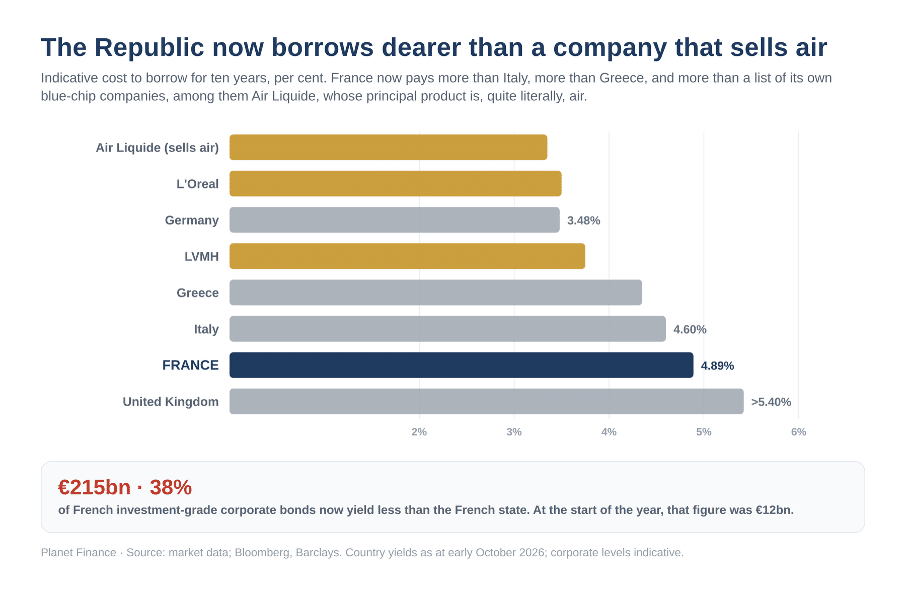
The numbers, for anyone who still needs them, are not subtle. From 2007 to the second quarter of this year the French public debt rose by 198 per cent, to three thousand six hundred billion euros. The debt per head rose by 157 per cent, to fifty-two thousand euros. The debt as a share of the economy rose by more than fifty points. Over the same years the economy itself grew by 61 per cent, and the economy per head by 42. The debt, in other words, grew three times as fast as the country. I have been saying for years that France was broke, and for years the answer was a story: the euro would discipline her, the recovery would arrive, the prince was merely late. It was the oldest trick in Kipling. Kaa, the great python of the Jungle Book, does not chase his dinner; he settles his coils, fixes the eyes, and murmurs trust in me, trust in me, until the thing he means to eat walks calmly into the loops of its own accord. The French frog, or the French snake, whichever you prefer, spent a decade doing Kaa’s work on the people who lend money for a living. And the people who lend money for a living, who are paid above all else to look closely, looked into the eyes and went to sleep. They have woken now, and badly. France today borrows more dearly than Italy, the country it spent a generation lecturing on how a serious nation keeps its books, and dearer than Greece besides. When the audience you hypnotised is Italy, and Italy is the one who edges first towards the door, the spell is well and truly over. It is, when you write it down, almost unbelievable.
How does a nuclear power with a permanent seat arrive here? By telling itself a story for too long, and by casting a leading man to tell it. At a dinner at the Elysee last spring, seafood and wines the rest of us never see, the President explained to a handful of deputies that France’s problem was not that it spends too much. The problem was that it does not raise enough. It is the sentence of the man who has never suspected the problem might be him. One of the week’s commentators noted, not unkindly, that it was also the precise argument of his ex-wife on the subject of alimony. You cannot tax your way out of a hole you dug by spending, not when the taxes already asphyxiate the companies you are counting on to fill the bucket. The bucket, carried once too often to the well, has cracked.
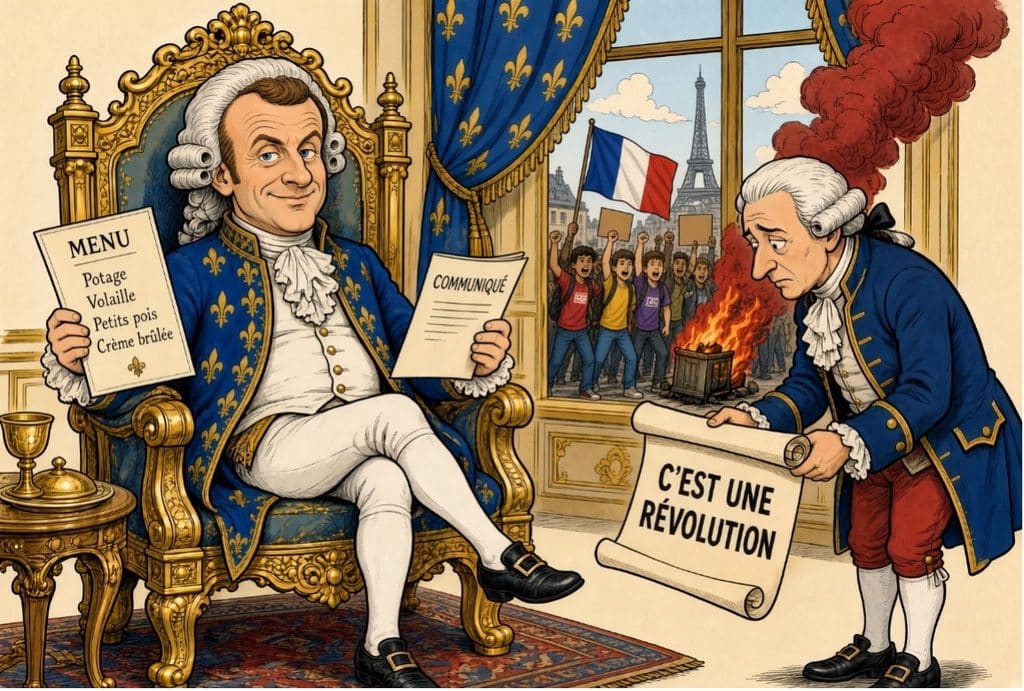
There is a line for this sort of man, and it is older than the euro. On the night of the fourteenth of July 1789, Louis XVI was woken at Versailles and told that the Bastille had fallen. “C’est une revolte ?” he is said to have asked. “Non, Sire,” replied the duc de La Rochefoucauld-Liancourt, “c’est une revolution.” Macron is the modern version, without the charm and without the excuse of a palace. He is told the spread has blown out, the banks are being repriced, the euro is sliding, and he hears a revolt of the markets, a temporary unpleasantness, something that can be managed with a dinner and a communique. It is not a revolt. It is the arithmetic, and the arithmetic does not take appointments.
France has not presented a balanced budget since 1974, the year ABBA won Eurovision with a number called Waterloo. A nation that last balanced its books in the year of Waterloo, now meeting its own. More than a trillion euros of debt matures by 2030. Some three hundred and forty billion must be raised next year alone. The interest bill is set to climb by close to sixty per cent by the end of the decade. For years before the euro she had a simple remedy for this sort of thing, which was to devalue the franc and start again, and the French did it with the regularity of a man who knows where the spare key is kept. That door is closed. She is stuck in a currency she cannot print, run by a central bank that answers first to a Germany which is not yet broke and will be, and she pays into the European budget more than she takes out, while her President, characteristically, wants the bill larger. The rot has reached the banks: insuring Societe Generale against default now costs more than insuring Deutsche Bank, a gap that did not exist at the end of August. The euro has slipped to a seventeen-month low, because the market has stopped distinguishing between the sentence France has a problem and the sentence Europe has a problem. And the European Central Bank sits trapped. Euro-zone inflation is back at 3.8 per cent, producer prices are rising at better than eight, activity is the strongest since 2023, all of which argues for another rate rise, except that every rise tightens the rope around Paris. Christine Lagarde may let the inflation run, or she may let France sink. There is no third door.
The oldest fairy tale
If France is the kingdom where the clock has struck, the grandest story still being told is the one America tells itself about the dollar. For more than fifty years the arrangement has been simple. America protects the Gulf. The Gulf prices its oil in dollars and recycles the proceeds into American debt. Call it an alliance, or a partnership, or, if you are honest, a protection racket with good tailoring. It has let the United States borrow on terms no other nation could dream of, because the world needed dollars to buy the one commodity the world needs. Every protection racket depends on one thing. The protector must, when it matters, protect.
Almost twenty years ago, on the floor of the House, a congressman named Ron Paul gave a little-noticed speech he called The End of Dollar Hegemony. He named the signal to watch for. We will know the ground has shifted, he said, on the day the oil producers begin to ask for gold, or its equivalent, rather than dollars, for their oil. The plumbing for exactly that now exists. Shanghai has run a yuan-denominated oil future since 2018. China has built a path from yuan into physical gold, an asset with no issuer and no counterparty. That last feature stopped being abstract the day Washington froze Russia’s reserves and showed every creditor that a Treasury bond is a promise that can be cancelled with a keystroke. The Gulf has a road from oil to gold that bypasses the dollar. The war is the thing that could persuade them to take it, because the one question a protection racket cannot survive is whether the protection is still real. Three struck tankers and a carrier group are not a reassuring answer. This is the turn that matters more than any tariff: not a divorce from the dollar, but a quiet building of the exit.
You could see the smaller version in oil itself. The crude is back through the Strait, something like ten million barrels a day, three-quarters of the old rate. The refined product is not, because the refineries were the thing that got hit, and a refinery is rebuilt in months, not in a weekend. They have reopened the mills and blown up the ovens. Diesel has risen some seventy-seven per cent this year, to a record above six dollars a gallon in America and past eight in California, and diesel is the fuel that moves the food and the parcels, so its price ends up, without exception, in everybody’s basket. The week’s masterpiece was the self-described greatest negotiator in human history lifting sanctions on Russia for a delivery that, set against American export volumes, covers roughly thirty hours, timed to land three weeks before an election. The G7 emptied a hundred million barrels from the emergency tank. That is a day of the world’s thirst. We are being shown an empty cupboard and told, with ceremony, that dinner is served.
The bill that cannot be stopped
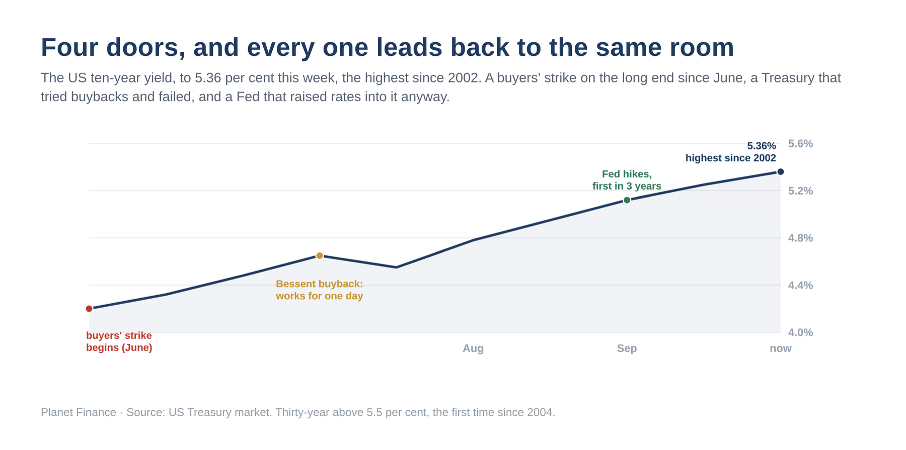
Behind the story sits a ledger, and America’s has stopped balancing in a way that is difficult to narrate prettily. The national debt has passed forty trillion. The deficit for the year just closed was around two trillion, north of five per cent of the economy, with no recession and no pandemic to blame. The interest alone is over a trillion a year, heading toward two, and that forecast assumed the ten-year would sit around four. It touched 5.36 this week, its highest since 2002. The thirty-year is above five and a half for the first time since 2004. There has been, since June, a buyers’ strike on the long end, the part of the market where the government most needs somebody else to show up.
There are four doors out of the room, and every one leads back into it. The Treasury can buy back its own long bonds, which it tried; it worked for a day and then reversed, and it shortens the debt so that every future rise bites at once. It can cut rates, which the President wants, except that cutting into inflation of three and a half would send the long end up, not down. It can raise rates, which Kevin Warsh just did, the first hike in three years, except that every hike enlarges the deficit he was hired to shrink. Or it can do nothing, and sit at five per cent for as far ahead as anyone can see. Last month Scott Bessent told the bond market he was the house, that the house always wins, and dared it to bet against him. A fortnight later he told an interviewer he cannot, in fact, control the bond market. The house, it emerges, does not always win. Sometimes the house simply owes the table.
America does not repay its debt. It refinances it. Roughly a third of the tradable debt comes due within twelve months, something like four trillion this year alone, at an average coupon of 2.78 per cent, rolling into a market that now charges four to five. It is a mortgage on which a third of the balance resets every year, at whatever rate the room feels like, and on which you are not permitted to say no. The only question is who will be made to buy the paper nobody wants. The answer, increasingly, is you. The new stablecoin rules oblige those digital dollars to hold short-term Treasuries. They already hold some two hundred billion. The Secretary has floated three trillion by 2030. An economist at the Kansas City Fed did the sum: for every dollar that moves from a bank deposit into a stablecoin, demand for Treasuries rises about thirty cents, and lending to the real economy falls about fifty. The plan is to convert the nation’s savers into the buyer of last resort, and unlike a Japanese pension fund the saver cannot walk out. For which trouble the saver is at last being paid. Cash and short bonds now yield comfortably over four per cent. The prudent, insulted for a decade, are getting a raise. I include it so you can never say I bring you only bad news.
One trade, told as five hundred
The load-bearing story, the one that must stay true or the whole edifice reprices, is artificial intelligence. Information technology is forty per cent of the S&P 500. Add Google and Amazon and you are at half. Add the utilities keeping the data centres lit and the industrials building them and you are north of two-thirds. Nvidia by itself, at five and a half trillion, is more than eight per cent of the index, worth more than several entire sectors. The man who owns the index in the name of spreading his risk now owns one enormous bet wearing the costume of five hundred companies.
How fragile that bet has become showed its hand this week. A newspaper reported that the house of ChatGPT had told its investors to expect an annualised fifty billion of revenue, where the chatter had been seventy. A twenty-billion gap, in a number nobody computes the same way twice, from a company that is not listed and whose audited accounts no outsider has seen. Hundreds of billions evaporated across the chip-makers in an afternoon, and reassembled themselves the next morning as though nothing had occurred. That is not a market pricing a business. That is a congregation flinching because somebody coughed during the sermon. And the priests are borrowing to build the cathedrals. Alphabet, Amazon and Meta now run negative free cash flow over the trailing year. The five largest issued something like a hundred and thirty-two billion of bonds in the first seven months, against a habit nearer thirty-five. The people selling the shovels have started taking out loans to buy their own. It can still come good. It now requires a story about 2029 to be true, and the bond market to stay in a forgiving mood.
The one grown-up in the room
Every fairy tale keeps one character off-stage, because he does the accounts and accounts are not enchanting. This autumn he has walked on. While the index sat near its record, the index of the largest American banks finished its fifth straight losing week, its longest slide since 2022, more than a tenth below a high it set less than two months ago. A bank is paid to watch the repayments rather than the dreams. It sees the missed instalment before the economists do, before the ministers do, before the index does. When the banks are falling while the index flies, it is not, as a rule, the banks that have it wrong.
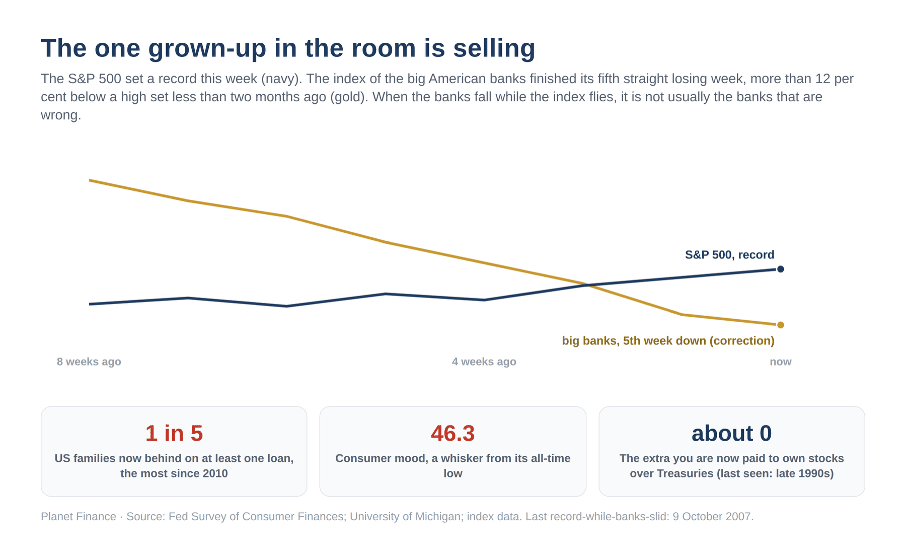
What is the accountant seeing? A Federal Reserve survey, taken once every three years, found that nearly one American family in five is now behind on at least one loan, up from about twelve per cent, the worst reading since 2010. In 2010 unemployment was ten per cent and the world had just ended. Today joblessness is low, growth holds, and the market is at a high. The share of families spending more than forty per cent of their income servicing debt is the highest since 2013, while the net worth of the richest rose thirty-one per cent. Consumer confidence has fallen to 46.3. Inside that number, the line for current conditions fell to 44.7, the lowest the survey has ever recorded. Junk-bond yields are the highest since 2020. Distressed leveraged loans the most since the pandemic, thickest in technology. Delta missed for the first time in two years, and yet fares are up a quarter and the planes are full, which can be squared exactly one way, and the way is a credit card. And the equity-risk premium, the reward for braving shares over government bonds, has fallen to roughly zero. At nineteen times earnings the index yields about 5.26 per cent. Lending to Washington pays about 5.32. Buying American stocks today pays you about what lending to the Treasury pays, with the risk of a crash thrown in at no extra charge. The last time shares yielded less than government bonds was the late 1990s. I shall decline to comment on the year, and merely mention it.
There is a date nobody is mentioning. This week fell almost nineteen years to the day after the ninth of October 2007, the afternoon the S&P last set a record high while the banks were quietly sliding on something everyone had agreed to regard as contained. The banks looked cheap that autumn. They were. They then became a great deal cheaper for the following eighteen months. On Tuesday the great banks report. The trading line will be magnificent. The line to read is provisions, the money set aside for loans that may never come home. That is the accountant telling you, in the only language he is permitted, whether he still believes the story.
The morning somebody looks
The market will tell you, if you let it, that the week was fine. Profits should be up around thirty per cent. The auctions found buyers. The President has promised calm until the vote. The Russian diesel is on its way. The artificial intelligence is sold out to 2029. The banks will post record trading on Tuesday. All of this is true, in the way that a host is true when he says the dinner was a success. It was a success. The music was loud, the bucket under the drip did not overflow, and nobody looked up.

A fairy tale does not become a lie on the afternoon it ends. It becomes a lie on the afternoon you notice it was only ever a story, and decide to keep telling it anyway. France has had that afternoon. She now borrows dearer than a firm that sells air, and the bankers who priced her as a prince for a decade have discovered, rather late, that the euro did not abolish arithmetic. The dollar’s afternoon is further off, protected by the one privilege France never had, which is that the world still needs the thing America issues. Further off is not never. On Tuesday the great banks report, and the line that matters is not the trading line, which will be magnificent, but the line marked provisions, the money set aside for loans that may never come home. That is the accountant, speaking in the only language he is permitted. Keep a little of your wealth in the things no story can fake: the metal that answers to no issuer, the cash that has at last begun to pay you, the honest business that does something no model can. The guests are still dancing. The bill for the ceiling is already on the sideboard.
Eric Lefebvre
See also: How the Tables Have Turned
Search:
Sponsors: