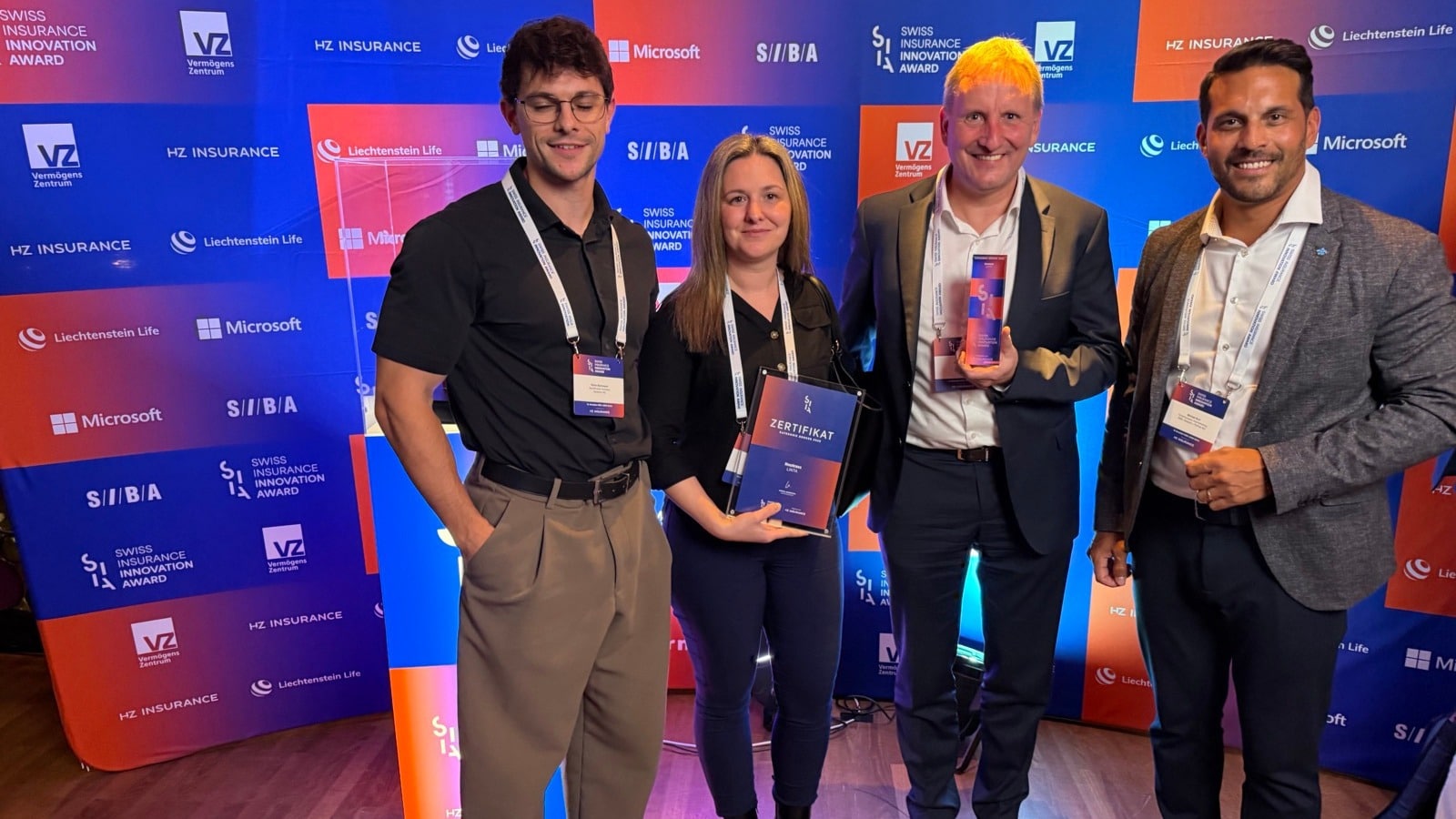
At the 28th Swiss Insurance Innovation Award hosted by HZ Insurance in Zurich, a broker award was presented for the first time. It went to Neutrass AG and its in-house developed platform, LINTA—a solution that doesn’t aim to replace people, but rather to give them back their time. An evening featuring glacial melt, digital twins, and a rope on a hook.
Anyone who attended the Swiss Insurance Innovation Award ceremony on Wednesday evening, November 18, 2026, didn’t see any innovation at first—just a bill. In his keynote address, climate researcher Reto Knutti from ETH Zurich showed dried-up riverbeds, shrinking glaciers, and green ski slopes on New Year’s Day. Since records began, Switzerland has warmed roughly twice as much as the global average; heat waves, heavy rainfall, hail, and rockfalls are on the rise, and insured losses are increasing along with them. Knutti concluded with a statement he attributed to the insurance industry itself: A two-degree world may be insurable, but a four-degree world certainly is not. It was a wake-up call that set the tone for the evening. In this industry, innovation is not a hobby, but increasingly a matter of future viability.
A new category created at the industry’s request
The highlight of the evening was that, where the Audience Award is usually presented, a new category was on the program this time: the Broker Award, introduced at the industry’s own request. Jury member Michael Kurt, who has been in the brokerage business for over 25 years, summed up the situation matter-of-factly. In nine out of ten conversations today, the topic is artificial intelligence; large corporations are investing billions in automation, and it’s not always easy for SME-sized brokers to keep up. Nevertheless, the brokerage business remains unique, because there’s one question he hears from his clients time and again: “How would you handle it?” That is precisely where the broker’s value lies, and no technology can replace that. What technology can do, however, is create more time by simplifying administrative tasks—such as reviewing premiums, preparing comparisons, or tracking claims payments.
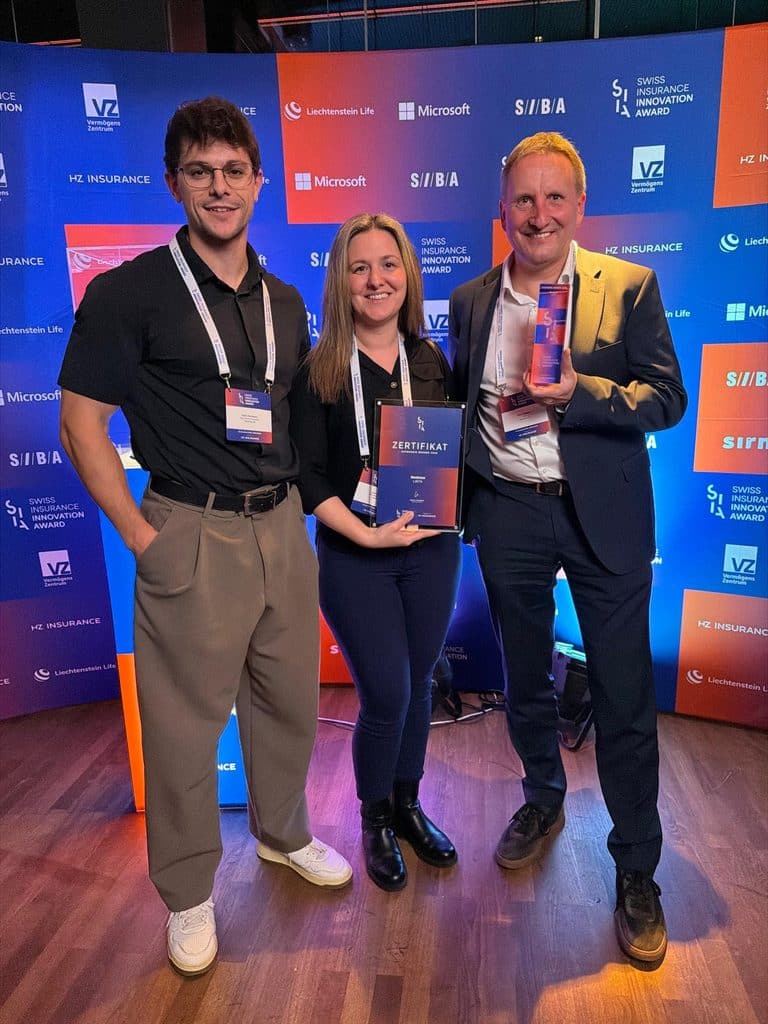
The first Broker Award went to Pascal Walthert and his team at Neutrass AG for LINTA. “This isn’t just another piece of software,” Kurt said in his acceptance speech; “it reimagines the day-to-day work of a broker.” Standardized processes, automated workflows, and clear lines of responsibility ensure that all employees know what to do at all times. At the same time, the solution integrates the customer portal, specialized applications, and interfaces with partners, thereby laying the groundwork for the future use of artificial intelligence.
Less Searching, More Consulting
LINTA brings together tasks, customer data, documents, and communication in one place. When a claim is filed, for example, responsibilities, available documents, and next steps are visible at a glance, rather than having to be pieced together from various systems. About 85 employees are already using the platform, which serves more than 13,000 customers and manages over 50,000 policies. Since its launch, more than 48,000 processes have been handled. Customers also have direct access: through the portal, they can view policies and documents, file claims, and contact their personal representative.
“This award is a great honor for our entire team and makes us proud,” says Pascal Walthert, CEO of Neutrass AG. “LINTA was born out of a simple conviction: Our employees shouldn’t have to spend their time searching for information, but should be able to devote it to where they make the biggest difference—with our customers.”
On stage, Walthert appeared visibly surprised and refreshingly honest. The team had been working on LINTA for five years, he said, and while it wasn’t finished, they were continuing to work on it every day. In the end, there had even been a three-month delay. They are particularly proud that, as a small brokerage firm, they managed to make it work at all—at a time when many IT projects never reach their goals. Even when asked about time savings, he refrained from using marketing hyperbole: initially, the transition actually took more time because everyone had to get used to it first. Meanwhile, the benefits are clearly evident in day-to-day operations. According to internal calculations, individual sub-processes now take about one-third less time than before. However, this does not apply to all processes. For a broker, this is more than just an increase in efficiency: it creates additional leeway for personalized advice, for complex client concerns, and for conversations that no system can replace.
A Personal Impression
thebrokernews had the opportunity to see LINTA in action during Neutrass’s day-to-day operations and was genuinely impressed—not by flashy dashboards, but by how seamlessly the processes fit together. Every step has a designated person in charge, every piece of information has its place, and tedious searches for documents or points of contact are eliminated in many work steps. You can tell that this solution wasn’t developed in a software company’s lab, but at the desks of brokers who know exactly where time is wasted in their day-to-day work. For me, that’s precisely what distinguishes digitalization as an end in itself from digitalization that makes people’s lives easier.
A rope, digital twins, and a second attempt
Helvetia won its first innovation award with a car insurance policy that bridges the gap between partial and comprehensive coverage. Until now, drivers who switched to partial coverage after five to seven years were protected against hail and glass breakage, but not against their own mistakes. The new coverage protects against total loss following a collision caused by the policyholder, at a premium that is about one-third lower than that of comprehensive coverage. Jury member Florian Schreiber illustrated this with the story of a hiker who slips on a ridge and is held by a rope that the hut warden had detached from an expensive complete set and hung individually on a hook. The jury’s takeaway: Lots of technology, lots of artificial intelligence—but in the end, it was a rope that won them over.
Generali Switzerland took second place with five AI-based personas—so-called digital twins—that can be queried at any time about campaigns, customer journeys, or product ideas. In the test, their responses matched those of real customers more than 85 percent of the time. Compasso took third place with ReWork, a digital dialogue tool that brings employers, employees, medical professionals, and insurers together. Instead of a sick leave certificate, it creates a profile of what is still possible despite illness or injury.
The Rope for the Brokers
Perhaps it’s no coincidence that two winners told the same story that evening. Helvetia removed the rope from the expensive all-in-one package, while Neutrass freed its advisors—at least in part—from administrative burdens. In both cases, the innovation isn’t spectacular—it’s necessary. While the industry debates agents, models, and billion-budget initiatives, a medium-sized Swiss broker demonstrates that innovation can also be measured by a very down-to-earth question: Does it ultimately leave more time for the client? At Neutrass, the answer is yes. Not because all processes run faster, but because targeted improvements in day-to-day work free up time that can be put to better use elsewhere. And the question “How would you do it?” will continue to be answered by a human being.
The entrepreneurial courage behind this is also remarkable: An owner-managed Swiss brokerage firm has invested considerable financial and human resources over the years in a platform it developed in-house, with no guarantee that this effort would pay off. The fact that this has resulted in a practical solution—and now also an award—deserves the highest praise.
Binci Heeb
See also: LINTA by Neutrass: When the Process Thinks
Search:
Sponsors: