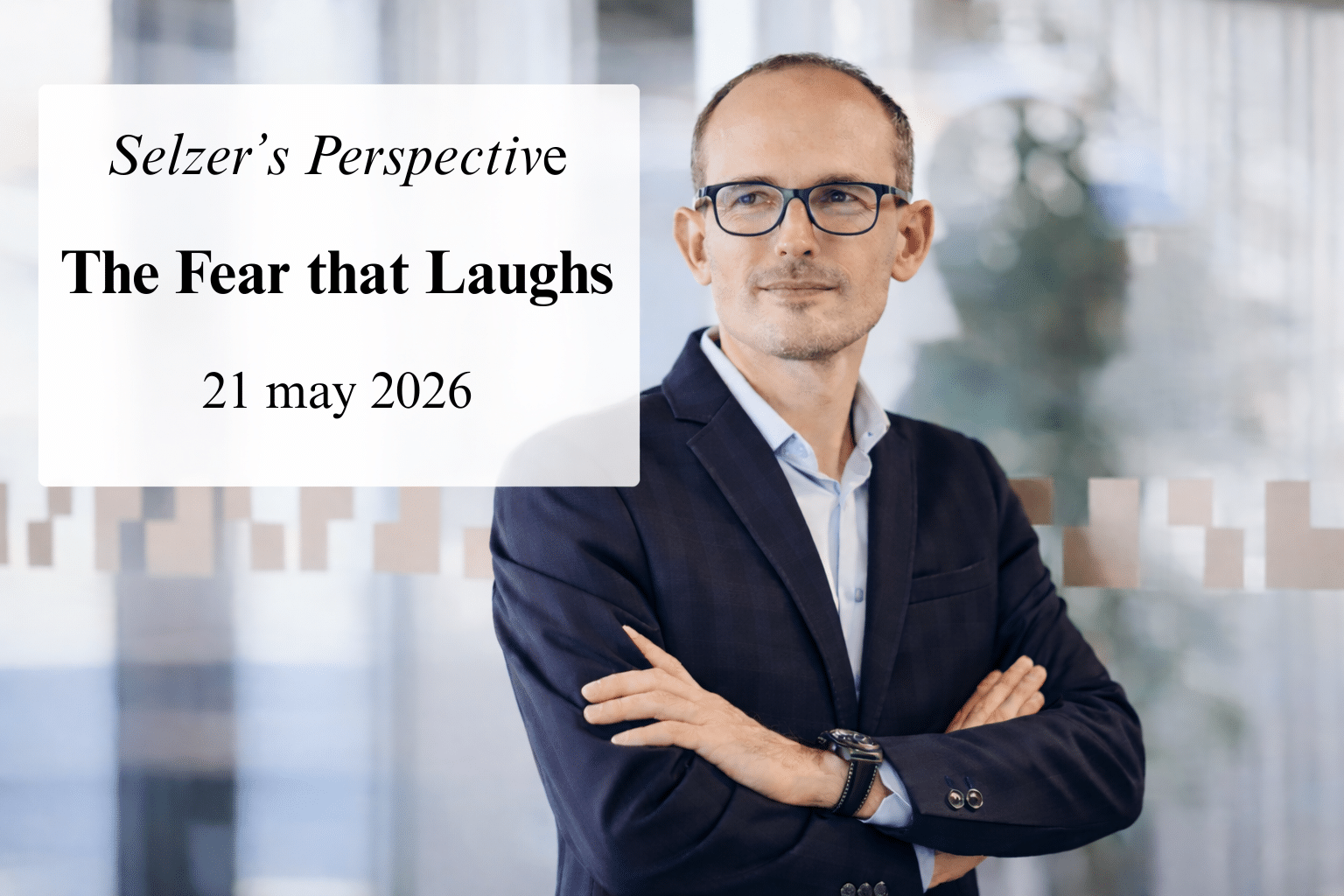
We often laugh when something scares us. Not loudly, not hysterically, rather casually, almost charmingly. It is precisely this laughter that runs through Marcus Selzer’s column like a silent warning signal of an industry in transition. Between AI, pressure to be efficient and digital transformation, he describes a fear that many people know, but few speak out: the fear of no longer being needed at some point.
After a long day of seminars, a colleague asked me whether they would still be needed in five years’ time. He laughed. But he was serious, and I haven’t let go of this question since.
It was the end of the afternoon, the group had broken up and we were still standing together with a coffee. He has been working in the field for almost twenty years, knows his customers by their first names and has been involved in claims involving far more than just money. Then he casually asked: “Do you honestly think they’ll still need us in five years’ time?”
He laughed at the same time. That light, short laugh that you make when you ask something that you don’t want to be labeled as a serious question. I know that laugh. I’ve worked with people in this industry long enough to know what’s behind it. It wasn’t a rhetorical exercise. It was genuine concern disguised as small talk.
I have heard this question many times since then. In different formulations, with different undertones. Sometimes as a joke, sometimes as exhaustion, sometimes as a silent provocation at the end of a long meeting. But always with the same core: Am I still relevant? Do I have a place in what is happening?
The actual game
It would be convenient to dismiss this question as a fear of technology. But that would not do it justice. What my colleague described is not mistrust of AI. It is something much older and deeper: the fear of no longer being needed. And this fear has found a new, very concrete source of nourishment in recent years.
In behavioral research, there is a term for this: FOBO, Fear of Becoming Obsolete. It describes the diffuse, not always conscious fear of losing relevance due to technological or structural changes. Not the worry about the next quarter, but the deeper question of one’s own place in the system. FOBO is not a burnout or a classic competence problem. It is not caused by personal failure, but by the feeling that the system is changing and you don’t know whether you still fit in.
The tricky thing about this fear is that it is silent. It does not sound the alarm. It announces itself with a light laugh after a long afternoon.
What FOBO does
And this is where the real problem begins. Because FOBO changes behavior long before anyone is actually redundant. I have been observing this in my work with sales teams in the insurance industry for years, and the pattern is the same every time.
People who have good judgments no longer speak them because a dashboard seems more objective than their experience. Brokers who have spent years reading subtle signals in conversation that no software captures begin to doubt whether that sense still matters. Leaders who know why a product is wrong for a particular client still sign up because the model recommends otherwise.
The paradox is that the very skills that AI cannot replace are weakened by FOBO. Judgment, relationship skills, contextual thinking, the ability to say the right thing at the right moment. These things don’t atrophy because AI takes them over. They atrophy because we hold them back ourselves, out of uncertainty as to whether they are still needed.
This is the moment when you replace yourself before anyone else has had the opportunity to do so.
In the insurance
This is particularly tricky in our industry. Insurance is, reduced to its essentials, a product of trust. And trust is not created in algorithms. It is created in conversations, in the moment when a customer realizes that someone has really listened, in the moment when a broker doesn’t recommend what the system suggests, but what they think is right after twenty years.
These moments are not valuable despite AI. They have become more valuable because of AI, because they are becoming rarer.
AI takes over the routine. That’s good, and I say that without reservation. What remains is what routine is not: assessment, empathy, attitude. And anyone who withholds this for fear of redundancy is depriving the industry of precisely what it cannot produce itself.
I see leaders wondering if their experience still matters, while at the same time they are the only ones in the room who understand why a customer isn’t buying right now. I see brokers who are embarrassed not to put something in a CRM field, even though the most important thing they know never fits in a field. This is not a skills problem. It’s a visibility problem. And behind it sits, usually silently, FOBO.
What I think
I think my colleague asked the wrong question. Not because it’s irrelevant, but because it reverses the causality. The question is not: “Do they still need us?” The question is: “Are we using what they can only get from us?”
This is not a reassuring formula. It is an imposition. Because overcoming FOBO does not mean ignoring or belittling AI. It means becoming clearer about what your own contribution is and making this contribution consistently. Auch dann, wenn ein Modell etwas anderes empfiehlt. Just then.
Three months later
I saw my colleague again some time after this conversation. He had retained a customer that an automated early warning system had classified as a termination risk. The system had recommended sending a more favorable offer. He had called instead.
During the conversation, it turned out that the customer hadn’t thought about the price. He had learned that his wife was ill and did not yet know what this would mean for their joint insurance policies.
There is no model for this. Instead, there is a person who takes off.
He laughed again when he told me that. This time it sounded different.
Marcus Selzer
Golden Sail Consulting GmbH – golden-sail.ch
Read also: Trust is not a feature
Search:
Sponsors: