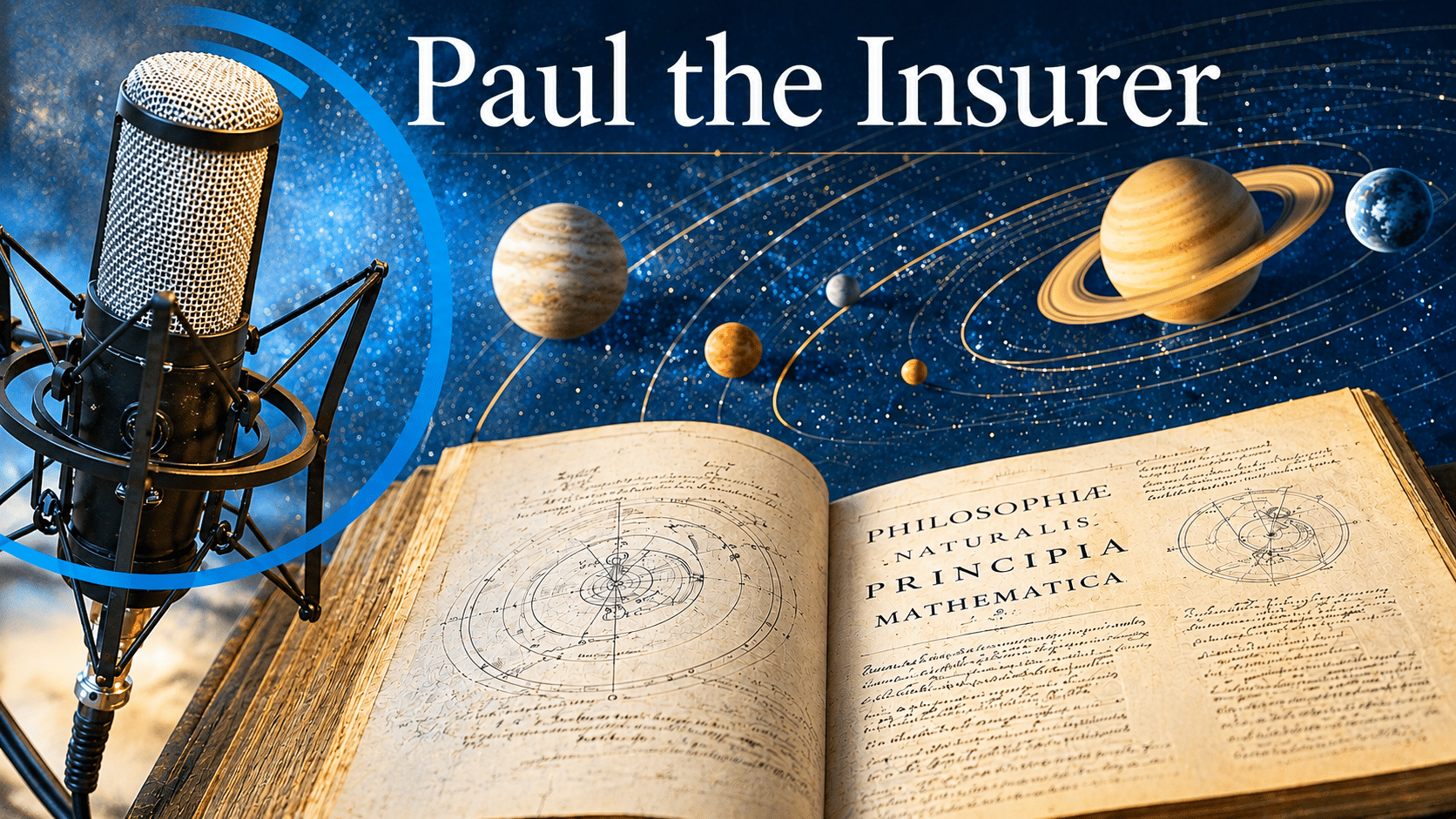
What does Isaac Newton have to do with reinsurance? More than you might think. The podcast “Paul the Insurer” kicks off a new series with the law of gravity, bringing together the laws of nature and the logic of insurance to create a picture that holds up surprisingly well.
Newton’s law of gravitation states that every object attracts every other object with a force that depends on the mass of both bodies and the distance between them. When this principle is applied to the insurance market, it creates a picture that is more than just a metaphor. Mass becomes a measure of risk. The larger the industrial facility, the portfolio, or the exposed asset, the more capital it attracts. Large risks draw attention, money, and scrutiny into their orbit just as the sun holds the planets in place.
And what about the distance in Newton’s formula? In everyday insurance practice, it corresponds to the gap between the insurer and the insured. This gap can result from a lack of information, cultural misunderstandings, or simply geographical distance. The greater this distance, the weaker the connection, and the more cautious underwriters are in committing capital.
Zurich, London, Bermuda: the centers of gravity
It is particularly appealing to view market clusters such as London, Zurich, or Bermuda as centers of gravity. They attract the industry because that is where critical mass – in the form of capital, experience, and tradition- is concentrated. Anyone working in the insurance business inevitably gravitates toward these centers not by chance, but because that is precisely where the critical mass that attracts business lies.
When Gravity Becomes a Danger
Not every form of attraction is desirable. Some risks draw their underwriters into dangerous spirals—into volatile exposures that can spiral out of control. This is where reinsurers come into play. They function like satellites, absorbing part of the gravitational pull so that the primary insurer is not crushed under the weight of the risk. This role as a buffer and risk distributor is one of the quiet but central contributions of the reinsurance industry.
Capital, Information, Reputation
The podcast draws a simple but apt conclusion: Newton showed how the universe works through force and attraction. In the world of insurance, these forces are just as real—they’re simply called capital, information, reputation, and risk. Those who understand these forces also understand why business is concentrated where it is, and why distance whether geographic, cultural, or informational always plays a role in underwriting.
The next episode of the series takes the leap from Newton to Einstein and asks what happens when risk warps the space-time continuum of the insurance world.
Binci Heeb
Paul the Insurer has additional content that might interest you, such as a series of interviews with insurance industry executives.
See also: What Caesar Teaches the Insurance Industry
Search:
Sponsors: