This week the artificial-intelligence boom let slip how it is really being paid for: a chipmaker helping to arrange five hundred billion dollars of loans so that its customers can buy its chips, that same chipmaker quietly owning those customers, the great banks pledging trillions more to join the circle, and a central bank that has chosen this exact moment to switch off the lights. A boom that has begun to finance itself is running on a fuel it would rather you did not see.
Every schoolchild is taught, sooner or later, why the perpetual-motion machine cannot exist: a device that runs forever on its own output, making more energy than it consumes, breaks a law of physics that does not take bribes. And yet every so often finance builds one anyway, or rather builds something that looks like one for a while, a contraption that appears to power itself and invites you to invest before anyone thinks to ask where the energy is actually coming from. This week the artificial-intelligence boom showed us its wiring, and the wiring runs in a circle. Across my last few columns I have kept returning to the single question every press release about this boom steps carefully around: who, in the end, earns the return on the hundreds of billions being poured into it? This week offered an answer, and it is not the comforting one. Increasingly, the boom is being financed by the people who profit from it, lent to the people who buy from them, and owned by the very companies whose sales it is meant to justify. The money has started going in a circle.
The vendor becomes the bank
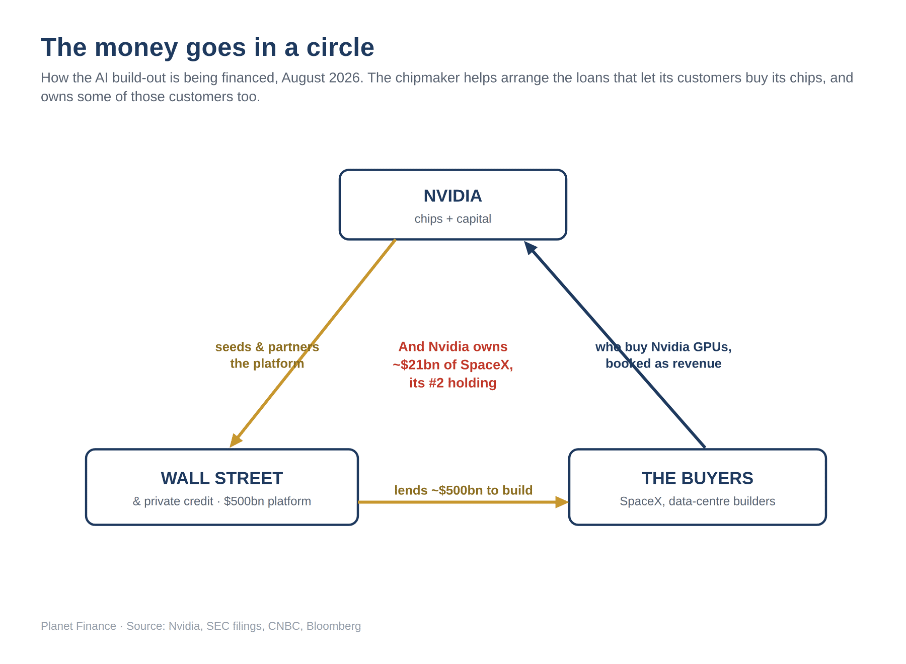
Begin with the announcement that ought to have alarmed people and instead delighted them. Nvidia, whose chips are the boom, has joined with a roll-call of Wall Street’s largest financiers, among them Apollo, Blackstone, BlackRock, Brookfield, Goldman Sachs and KKR, to build financing platforms that will mobilise more than five hundred billion dollars. And what is that half-trillion dollars for? It is to be lent to the builders of data centres so that they can buy Nvidia’s chips. Read that twice. The chipmaker is helping to arrange the loans that let its customers purchase its product, and it will then book those purchases as revenue, the very revenue that convinces the market the boom is real. Nvidia’s chief executive has taken to calling his processors an investable asset, a remarkable phrase once you sit with it, because it means the chips are no longer merely equipment to be used up but collateral to be borrowed against, in the way a house was collateral in 2006.
There is a name for a company that finances its own customers so they can buy its product, and anyone with a grey hair remembers where it led the last time. It is called vendor financing. In the telecommunications mania of the late 1990s, Lucent and Nortel lent billions to the upstart carriers so that those carriers could buy Lucent and Nortel equipment; the sales looked magnificent, the revenue lines soared, the share prices with them, and then the carriers went bankrupt and took the loans, the revenue and the lenders down together. A sale you had to finance yourself is not quite a sale. It is a loan wearing a sale’s clothing, and it flatters the present quarter at the direct expense of some quarter still to come.
Everyone owns everyone
If the vendor financing is the machine’s first loop, the ownership is its second, and it is tighter still. This week happened to be the season of the thirteen-F, the quarterly filing in which the great institutions must at last disclose what they hold, and this time the disclosures read less like a set of portfolios than like a family tree with rather too much marriage between cousins. Nvidia, it emerged, now holds around twenty billion dollars of SpaceX, making Elon Musk’s rocket-and-data-centre empire its second-largest investment on earth, behind only its stake in Intel. Alphabet, the parent of Google, turned out to be sitting on a SpaceX position worth some ninety-four billion dollars at the quarter’s end, its single largest holding of anything at all; even AMD was on the share register. Follow the thread and it knots itself: Nvidia put ten billion dollars into Musk’s artificial-intelligence venture, xAI; SpaceX then swallowed xAI in a deal that valued the pair north of a trillion dollars; and so Nvidia finds itself owning a thick slice of SpaceX, which has in turn announced that it will build its data centres exclusively on Nvidia chips. The chipmaker owns the customer, and the customer buys only from the chipmaker.
And the marks move the profits. Alphabet’s record quarter last month was flattered, as I noted at the time, chiefly by paper gains on these very holdings, its stakes in SpaceX and in the AI laboratory Anthropic. The trouble with a portfolio of your friends is that it giveth on the way up and taketh on the way down, and none of it is a sale: as SpaceX’s shares slid from around a hundred and seventy dollars in June to a hundred and forty now, the same filings showed the retreat quietly carving some twenty-eight billion dollars out of Google’s book in a matter of weeks. Meanwhile the machine readies its next act of self-valuation. Anthropic, the lab whose paper worth helps hold up Alphabet’s, is now rumoured to be preparing a stock-market debut at more than two trillion dollars, which would make a company most people have never knowingly used worth more than the entire German stock market. Even the most reliably wrong man on financial television has surfaced to vouch for the price, which longtime readers will recognise as a contrary indicator in its own right.
This is not a market in the sense your grandfather understood the word, a place where independent buyers and sellers meet and disagree about price. It is a small, closed circle of giants who invest in each other, lend to each other, sell to each other, mark up their holdings of one another, and then present the sum of these mutual favours to the rest of us as the arrival of the future.
Wall Street rushes the same narrow door
And the banks, having watched all this from the wings, have decided they cannot bear to be left out. In the same handful of days, Bank of America pledged two hundred and fifty billion dollars over eighteen months to finance the whole artificial-intelligence supply chain, from the data centres themselves to the power stations that must feed them and the mines that must yield the critical metals; and Morgan Stanley, not to be upstaged, dangled a figure of one and a half trillion dollars of financing and advice over the coming decade. After a record season of profits, the great American banks have gazed upon the mountain of borrowing this build-out requires and concluded, sensibly enough from where they sit, that they would very much like to arrange it and clip the fee.
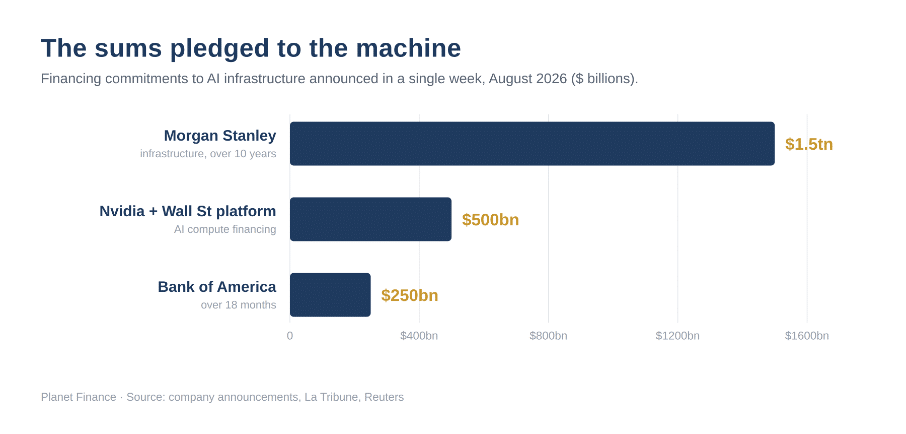
I would only observe that when every large bank stampedes into the same theme, at the same moment, with this degree of unanimity, it is very rarely the opening bell. It is far more often the sound a cycle makes near its top. And note where much of the leverage is actually being routed: not through the visible banks at all, but through the private-credit funds standing beside them, the same private-credit funds that, a fortnight ago in these pages, were quietly barring their own investors from taking their money out.
Building the conqueror’s car
It is worth stepping outside the circle for a moment, because the contrast tells you everything. While Wall Street conjures trillions for companies that finance and own one another, look at what is happening to the industry that all but invented the modern world of things. The motor car was born in Germany, in the workshops of Benz and Daimler, and it was France that first turned it into an industry, in the family firms of Peugeot, Renault and Panhard; for the better part of a century the automobile was a Franco-German achievement, built by old dynasties whose surnames ended up as the badges on the bonnet. And it is precisely there, in that historic heartland, that the industry is now quietly dying. In France, Renault turned in perfectly respectable half-year numbers this season and, in the words of the analysts at Citi, was simply ignored regardless of valuation, its shares priced as though the company were already a museum piece; Stellantis, the group that carries Peugeot and Citroen, has been so thoroughly beaten by Chinese electric cars that it has stopped trying to beat them and started building them, turning its own European plants over to manufacture the vehicles of its Chinese partner Leapmotor, a rival it could not match and has chosen to subcontract for instead; and Renault now fills its showrooms with cars built on the platforms of China’s Geely. In Germany, Volkswagen, Mercedes and Porsche, chained to a Chinese market now expected to shrink by better than fourteen per cent this year, were punished for results that a few years ago would have been called perfectly solid. A continent that spent years raising tariffs to keep Chinese carmakers out is, one factory at a time, quietly handing them the keys.
Think about what that actually is, because it is worse than bankruptcy, which at least has the dignity of an ending. It is surrender dressed up as strategy: the historic forges of French and German industry kept running only by agreeing to stamp out the conqueror’s product under licence, the way a beaten craftsman keeps his workshop by building the furniture of the man who ruined him. These are firms that forge a heavy physical object, sell it to a stranger for more than it cost to make, and hand the difference to their owners, which used to be the entire definition of a business and is now, apparently, a mark against them. And there is the quiet obscenity of this cycle in a single frame. At the very moment the market will finance a closed circle of American giants to the tune of trillions, on the theory that they are the future, it will not spare a year’s patience for the companies that still make the present, and so the birthplace of the motor car is being sold off, floor by floor, to the one bidder left who still believes in making things. Capital has deserted the productive for the self-referential so completely that it will fund a company buying its own chips before it will back a company building a car. If you want to know the hour, that is the clock.
The bull in the china shop
And here, fittingly, is where China walks into the story a second time, because the same country now quietly dismantling Europe’s car industry is kicking the legs out from under America’s artificial-intelligence economy as well. There is an old expression about a bull in a china shop; this year the shop is the whole world’s, and the bull, with some irony, is China. While Silicon Valley spends hundreds of billions to build ever larger and more costly models, a run of Chinese laboratories, DeepSeek and Moonshot and their kin, have been releasing artificial intelligence of comparable quality at a fraction of the price, and in some cases very nearly for nothing. The analysts have taken to calling it the race to zero, and it is the most dangerous phrase in the entire affair, because the whole American edifice, the circle, the vendor financing, the trillion-dollar valuations, rests on a single unspoken assumption: that all this intelligence will one day be sold at a fat and durable profit. If the Chinese are content to give the same thing away in order to win the market, that assumption does not survive the encounter. You cannot service a mountain of debt raised at five per cent by selling a product your rival is delighted to hand out for free. American start-ups have already begun quietly wiring their software to the cheaper Chinese models, which tells you plainly enough which way the price is heading. The circle is betting everything on scarcity; China is busy manufacturing abundance.
The hidden fuel, and the darkened referee
Perpetual-motion machines fail for one reason and one only, and it is always the same reason: the outside energy that was quietly powering them all along, the energy the salesman swore did not exist, runs out. The hidden fuel of this machine is other people’s borrowed money, and that money has just become the dearest it has been in a generation. Only last week the American Treasury itself went to market and sold thirty-year bonds at 5.216 per cent, the highest rate the United States has paid to borrow for that long since 2001, a full quarter of a century, and the demand was thin enough that Bloomberg described the sale, drily, as a warning to the Treasury Secretary. Sit with what that means. When the borrower of last resort, the one government that prints the world’s reserve currency, must pay the most it has paid in twenty-five years simply to place its bonds, the idea that a ring of companies can go on borrowing cheaply to buy their own chips stops looking like a strategy and starts looking like a countdown. To borrow at the highest cost in a generation in order to finance a circle of firms selling to themselves is not a stable arrangement. It is a dare.
And here is the detail that should trouble a careful reader most, because it concerns the one institution that might have seen the danger in time. At the very moment the credit machine is being floored, the chairman of the Federal Reserve has resolved to say less. Kevin Warsh has told Wall Street that he means to communicate minimally, to hold fewer meetings, to retire the published forecasts and the running commentary the markets have leaned on for a generation, and even Goldman Sachs, no enemy of the Fed, has warned that a void where the facts used to be will simply fill with rumour and with volatility. I wrote some weeks ago about the day the oracle stopped speaking. The oracle has now gone one better: it has not merely fallen silent, it has reached up and switched off the stadium lights, and it has done so on the very night the game turned rough.
And Tokyo has not gone quiet
There is one more force bearing down on that fuel line, and it is the one I have pointed at since the height of summer, the quiet pin beneath the whole structure. A fortnight ago the United States and Japan did something not seen since 1998 and intervened together to arrest the yen’s collapse, the American Treasury even selling euros to fund it. It has not worked. The yen has already slid back towards its lows, the carry traders are busily rebuilding the very positions the intervention was meant to punish, and the pressure on Japan’s own bond market is climbing again. Why should a reader watching an American technology bubble care about the price of a Japanese banknote? Because Japan is the largest foreign owner of American government debt, and the day its authorities are finally forced to sell those Treasuries in earnest to defend their currency, they will be dumping fresh supply onto the very market that has just, as we have seen, paid the highest yield since 2001 to place its bonds. The machine runs on cheap borrowed money; Tokyo is standing beside the one pipe that still delivers it, holding a lit match. The intervention bought a fortnight of calm. It defused nothing.
Watch the fuel line
So let us name the machine plainly, since nobody selling it will. The artificial-intelligence boom is being offered to the world as a perpetual-motion engine, a self-sustaining marvel that generates its own demand, its own financing and its own profits, and asks only for your capital to keep it spinning. It is nothing of the sort. It is a circle of enormous companies passing the same dollars around a closed table, every lap entered in the books as growth, the whole apparatus greased with borrowed money at the highest cost in twenty years and lit, now, by a central bank that has chosen to look away. None of this means the machine stops tomorrow. Circles like this can turn a good deal longer than any sceptic expects, and a great deal of real money will be made, and then lost, before this one slows. But do not sit waiting for a black swan to end it, because there is no black swan here. The dangers are not the rare, unforeseeable kind; they are grey and lumbering and in plain sight, an elephant standing in the middle of a room the size of the elephant: the cost of money at a quarter-century high, a currency in Tokyo that three governments together could not hold, a Chinese price war dragging the product towards zero, and a ring of companies valuing one another into the trillions. Not one of these is hidden. To be caught out by what happens next, you will have had to work quite hard at not looking. The discipline it asks of you, by contrast, is not complicated. Watch the fuel line, not the flywheel. Watch the lender, not the loan. And hold on to the single law that no financier has ever managed to repeal: the only machine that truly runs forever is the one built to sell you the belief that this one will.
Eric Lefebvre
See also: The Barometer Is Broken
Search:
Sponsors: