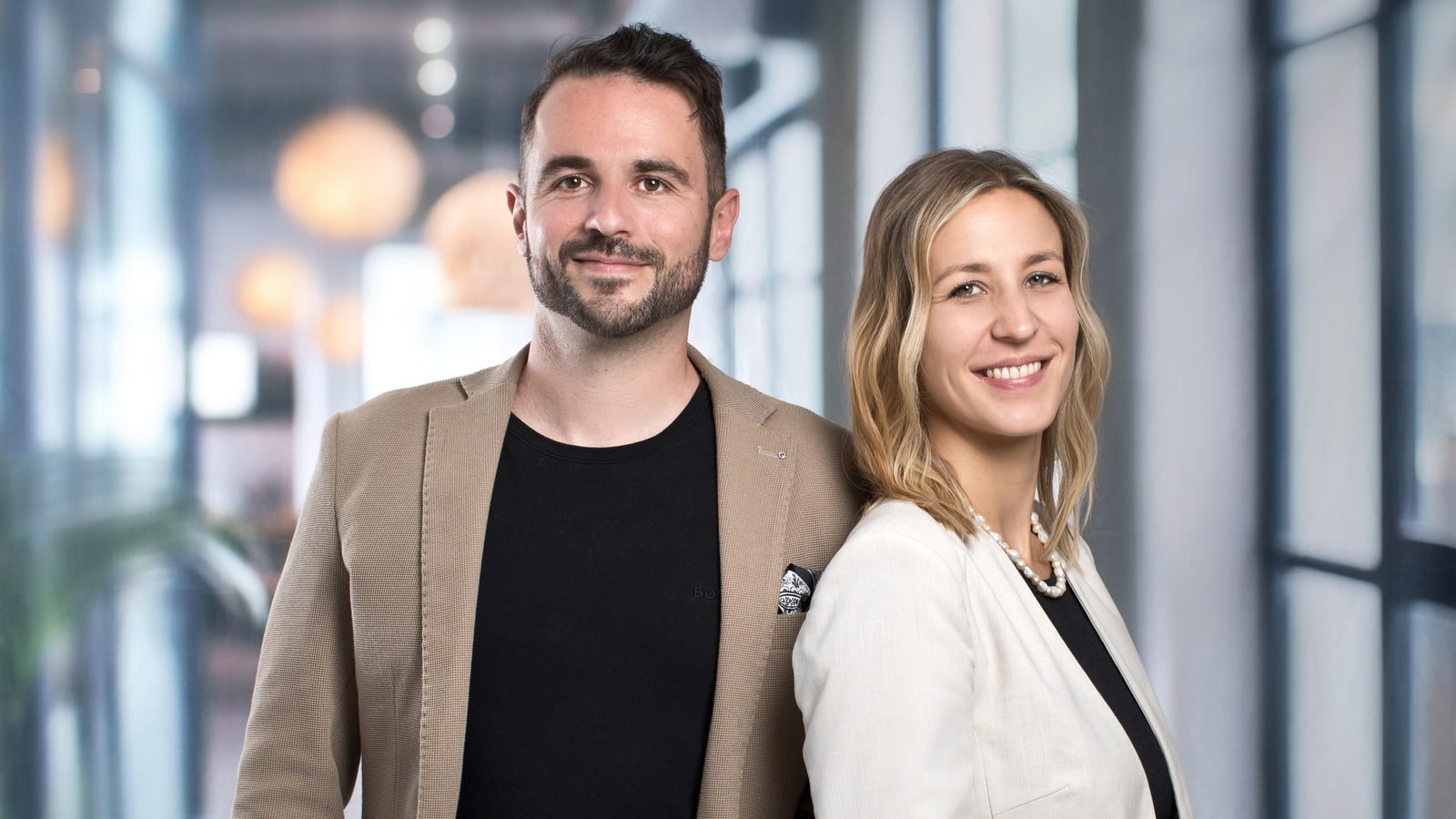
She comes from the claims department of an insurance company; he comes from a family of brokers. Together, Alexandra Kestenholz and Claudio Carrese have founded their own brokerage firm in Liestal. A conversation about the courage to take the leap, underestimated hurdles, and the question of whether “small” is a disadvantage or a promise in the brokerage market.
The Swiss brokerage market is consolidating. Large firms are acquiring smaller ones, platforms promise efficiency, and those operating independently must ask themselves how much longer this can continue. In this very environment, of all places, Alexandra Kestenholz and Claudio Carrese have chosen the opposite path: breaking away from existing structures to start their own company. Carrese Kestenholz Insurance Brokers, or CKVB for short, is based in Liestal (BL) and serves small and medium-sized enterprises (SMEs) in northwestern Switzerland, offering insurance consulting, contract management, claims support, risk management training, and retirement planning advice.
The two bring different perspectives to the table. Alexandra Kestenholz began her career at various insurance companies as a claims specialist and knows what really matters in a policy when an emergency arises. The federally certified insurance specialist has been working as a broker for seven years. Claudio Carrese, also a federally certified insurance specialist, teaches aspiring insurance professionals and, with over 15 years of brokerage experience, is carrying on a family tradition established by his father. Their motto is bold: “We’re the good guys.” We wanted to know what lies behind this motto and how it feels to be self-employed after the first 15 months.
You both could have stayed within safe structures. What was the moment when it became clear: “Now we’re going to do our own thing”?
During a period of reorientation, we asked ourselves exactly that question: If we can be successful for others, why not for ourselves? And wouldn’t it annoy us to have built a great business in five years only to see someone else’s name on the sign? We made the decision over an Aperol Spritz on the Piazza Grande in Locarno. If not now, then never. From that moment on, it was “all in.”
Why work as a team instead of on your own? How did you realize that you work well together as partners?
We’d been working together for a long time even before we started our own business, and that’s when we realized how well we complement each other. Alexandra specializes in property and casualty insurance, while Claudio specializes in personal insurance. Alexandra works in a structured way, while Claudio is more creative. For our clients, this means a support team that covers all bases.
Mr. Carrese, you’re following in your father’s footsteps. Is that a source of encouragement, or does it also create pressure to live up to expectations?
Definitely a boost. Not because of the connections, but because of the values he instilled in me.
Ms. Kestenholz, you spent years processing claims on the insurance side. As a broker today, what do you see that other brokers overlook?
I don’t see myself as a mail carrier who simply forwards claims, denials, and settlement notices back and forth without checking them. I scrutinize the insurers’ responses in particular, because mistakes happen when people are working under pressure. This benefits not only our customers but also the insurers themselves: we help maintain high standards. The workload at the insurance companies is currently enormous, which unfortunately is reflected in phone wait times of up to 45 minutes. There’s room for improvement there. And when I review our clients’ policies, my years of experience in claims processing allow me to spot gaps that would otherwise only be noticed in the event of a claim. We can close those gaps before it comes to that.
What turned out to be more difficult during the setup process than you had imagined?
Getting a nice phone number with a local area code without having to sell a kidney. Joking aside: Reviewing every single collaboration agreement, registering with FINMA, and establishing the general partnership were no walk in the park either.
And conversely: What turned out to be surprisingly easy?
The cooperation agreements with the insurance companies. We had the utmost respect for them beforehand, and then we were able to secure many of them with surprising ease and a great deal of trust on their part.
How have insurers reacted to a new, small brokerage firm? As a newcomer, do you get the same terms and the same level of attention?
No. As a small brokerage firm, we receive, on average, 10 to 20 percent less commission than our industry peers with higher revenue. On the other hand, we’ve had very good experiences with local agencies. There, we know the people personally and receive excellent support. It’s more difficult with broker centers, where you don’t know the people. There, you sometimes feel like you’re insignificant. But even here, exceptions prove the rule.
Where did our first customers come from, and what convinced them to switch to a young company?
From our personal networks and previous business relationships. Many were inspired by our new concept, and our fresh new look made a huge splash. Many customers want to be noticed again, and that’s exactly what we promise. Quite a few were also simply happy for us that we took this leap and chose to work with us to show their support.
“We’re the good guys” is a bold claim. Who, then, are the others, and how exactly should an SME client notice the difference?
“We Are the Good Guys” is a promise: to our customers, to our business partners, and to ourselves. We want to be good, do good, and stay good. We work toward that every day. It’s not about belittling others or pigeonholing them. A customer usually notices the difference at the “moment of truth”—for example, when a claim is denied. That’s when we reach out to them personally, rather than sending an impersonal email, especially during difficult moments.
You promise: one phone call, no passing the buck, no list of contacts. How long can this be sustained as the company grows?
We’ve asked ourselves this question, too. We want to remain a boutique firm and not build a corporate structure. Our growth strategy is based on small client teams and a decentralized approach. This ensures that our promise to clients remains credible even as our team grows. Anyone who works with us should experience excellent working conditions, a supportive environment, and a great deal of appreciation. This motivates them to embrace our values and serve our clients in the true spirit of “We Are the Good Guys.” Maybe we’ll do another interview in five years—then we’ll see how things have gone.
You offer training in risk management and pension planning workshops. How aware are SMEs in the region really of the risks involved, and where is the biggest gap, particularly when it comes to occupational pension plans?
Entrepreneurs already have a very strong sense of risk. The workshops, therefore, focus primarily on sharpening that awareness and developing creative approaches to identifying risks and solving problems. The situation is quite different when it comes to retirement planning. Most solutions are severely outdated, and until now, no one has dared to touch them. After all, it’s the employees’ money at stake, and no one wants to get their fingers burned. But this very attitude causes us to miss many opportunities and leads to exactly what we’re trying to avoid: Employees are stuck in outdated plans, and their money is invested in solutions that are no longer in line with current needs. We raise awareness and break down barriers. The workshops are attended by employee representatives who then actively champion the new solution within the company.
You work with a digital customer portal. What role do technology and AI play in your day-to-day work, and where do you consciously draw the line when it comes to personal advice?
We rely heavily on modern technology. It’s designed to lighten our workload so we can spend our time with clients rather than on data processing. We achieve this through a high degree of automation and end-to-end processes with as few data disconnects as possible. A major advantage of the fresh start: We were able to build from the ground up, free from legacy data from old systems. We use AI every day, though without entering any customer data. You have to stay up to date constantly. However, our consulting remains personal. With us, you’re served by people and merely supported by machines.
The brokerage market is undergoing significant consolidation. Do small, independent brokers have a future, or is a takeover offer just a matter of time?
We’re simply a step ahead of the others. A pendulum always swings back, and we’re convinced that the wave of consolidation will be followed by another phase of decentralization. In a country where 99.7 percent of companies are SMEs and nearly 90 percent employ fewer than ten people, there will always be a need for small and medium-sized brokers who focus on the well-being of their clients. We have, however, already received two takeover offers.
How are things going today, honestly: Where do you stand compared to your plan?
We’ve slightly exceeded our best-case scenario, but our growth has taken a different path than we anticipated. We didn’t expect our new brand identity to be so well-received. That brings challenges we hadn’t anticipated: We need to hire employees sooner, and therefore need more space sooner than planned. Minor concerns. But they don’t stop us from coming into the office with a smile every day.
What advice would you give to someone in the industry who’s thinking about starting their own business, and what would you do differently today?
Have a vision and clear values. Lead the way and don’t let critics discourage you. And do things differently? Our only regret is that we didn’t take the plunge sooner.
These questions were asked by Binci Heeb.
Alexandra Kestenholz She is a co-owner and member of the executive board at Carrese Kestenholz Insurance Broker (CKVB) in Liestal, where she is responsible for finance, client acquisition, and ongoing client support. After graduating from the business high school in Basel, she completed an apprenticeship as an insurance clerk at Baloise, where she worked in the back office as the first point of contact for claims. In 2016, she earned the Swiss Federal Certificate as an Insurance Specialist. From 2015 to 2019, she worked as a claims specialist at Mobiliar in Basel, where she assessed claims on-site, evaluated them, and negotiated with customers. In 2019, she moved to the brokerage side at Balrisk / ASSEPRO. There, as an executive assistant, she was responsible for human resources, market development, and strategic planning, and handled complex claims. In 2025, she co-founded CKVB with Claudio Carrese. She recharges her batteries in the Basel area, on her mountain bike, or while hiking.
Claudio Carrese He is a co-owner and member of the executive board at Carrese Kestenholz Insurance Broker (CKVB). After completing basic technical training as a plant and equipment technician and further training as a technical business administrator, he entered the insurance industry in 2013. He earned his VBV insurance broker diploma, continued his education to become an IAF financial advisor, and in 2017 earned his federal certificate as an insurance specialist. He began his career as a broker as an account manager at QualiRisk AG in Liestal before moving to ASSEPRO as an account manager in 2018. From 2021 to 2022, he served as Chairman of the Executive Board at Balrisk Versicherungsbroker AG, and subsequently as Regional Manager for Northwestern Switzerland at ASSEPRO Brokerage AG. Since 2018, he has also been teaching marketing, sales, and support at the HKVBS Training Center. With CKVB, he has been continuing the brokerage tradition established by his father since 2025.
See also: InsuranceMap 2.0: When AI Gets the Quote Instead of the Broker
Search:
Sponsors: