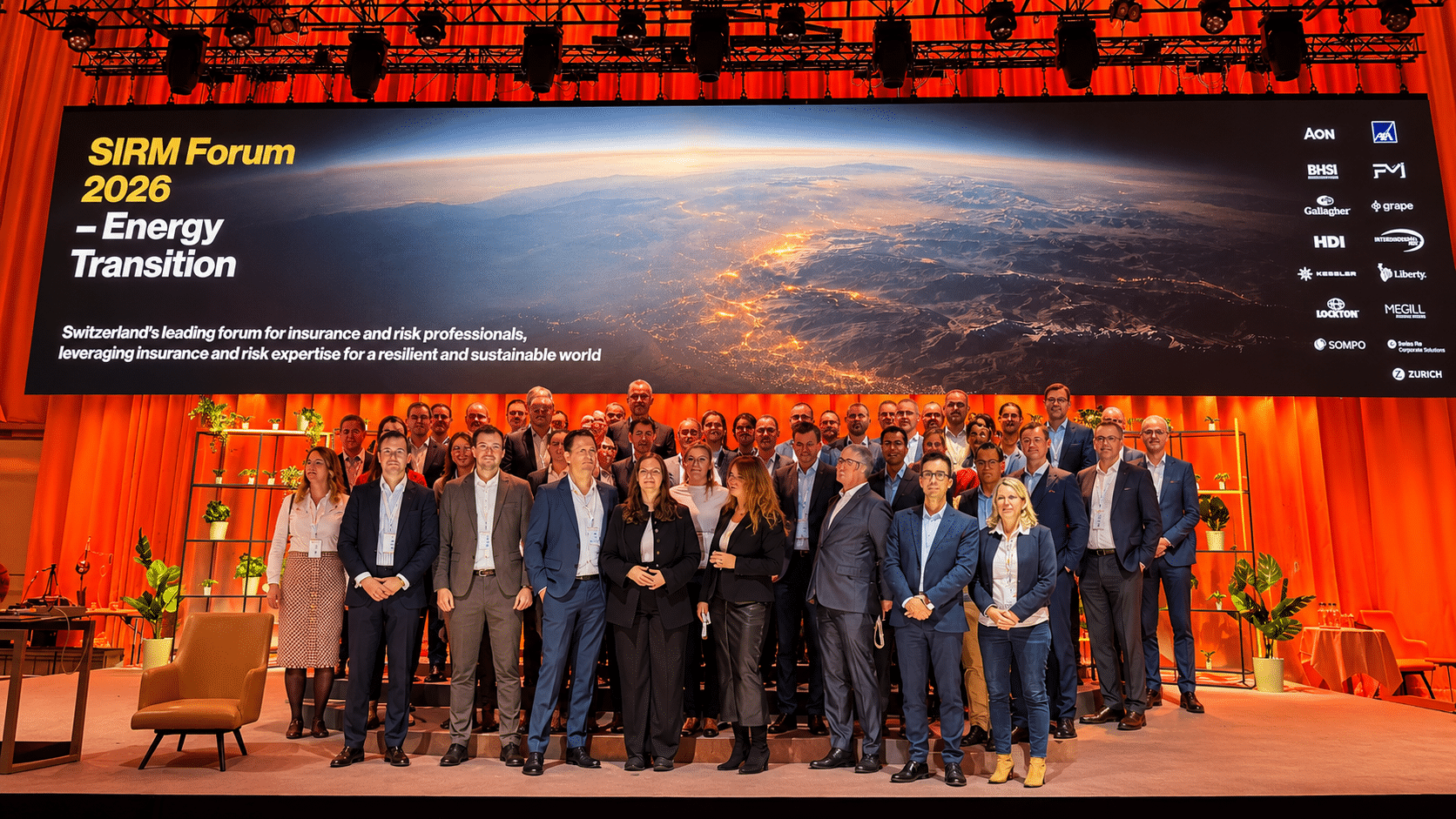
On the afternoon of the SIRM Forum 2026, the discussion turned to the elephant in the room: Who pays if something goes wrong during the energy transition? Companies, insurers, the government, or, in the end, households? The answers given at the Kursaal in Bern turned out to be more uncomfortable than the audience had anticipated based on a show of hands.
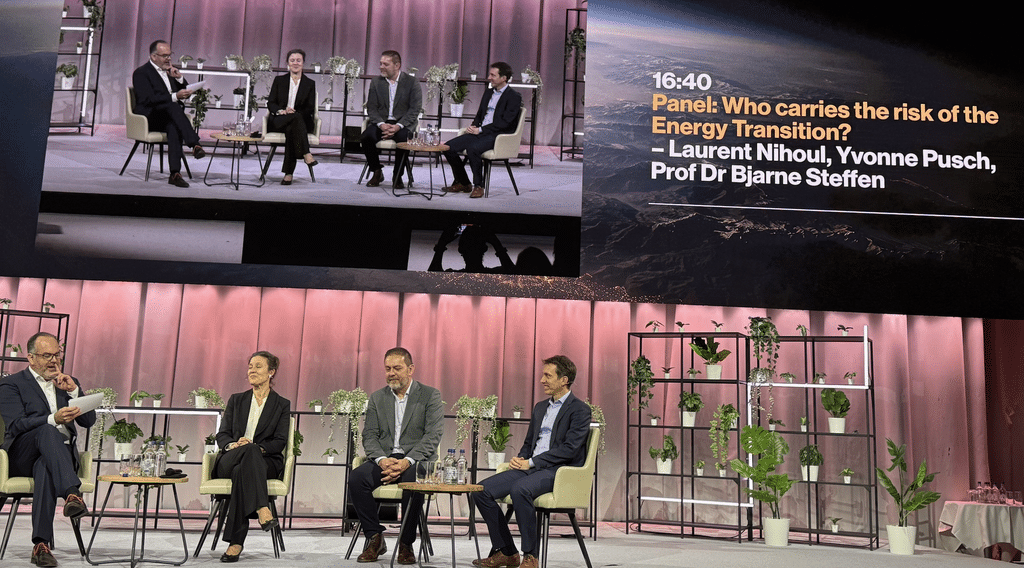
The moderator asked the audience to vote. Only a handful felt that companies bear the lion’s share of the risks today. Laurent Nihoul, CEO of FERMA, immediately disagreed. Security of supply, cyberattacks on the grid, physical damage: Most of the burden falls on companies, and price increases ultimately get passed on to consumers.



Risk Management or Risk Implementation?
Nihoul posed a question that hung in the air. How often has a risk manager changed a decision before it was finalized? Anyone who honestly answers “rarely” isn’t practicing risk management—they’re practicing risk implementation. When it comes to investments in the energy transition, risk managers are usually only called in once everything has already been decided. This is precisely where the opportunity for the profession lies: Decisions regarding decarbonization and energy procurement are now made at the strategic level, and management needs a methodology to weigh risks against opportunities.
Bjarne Steffen, a professor at ETH Zurich, outlined the basic economic principle: A risk belongs to the party best able to manage it. For most risks, that would be companies in the real economy. The government has a role to play when it comes to infrastructure that no single entity can provide on its own. As an example, he cited decarbonization projects in Europe that were canceled because it was unclear whether the CO2 pipelines would ever be built.
Insurability is built, not found
Which risks are difficult to insure? Nihoul recalled the textbook criteria: independent losses, no information asymmetry, understood probabilities, and a worst-case scenario that the market can bear. A large-scale cyberattack on the grid would fail to meet the last criterion; the cost of energy is fundamentally uninsurable. With new technologies such as batteries or hydrogen, however, insurability develops over time through data and collaboration. “Insurability is built, not found,” he said. Companies must take the first step, he added, because they know their business and their risks—even if they often fail to articulate them in a language that insurers can work with.
Steffen added a distinction. The market tends to accept fire and liability risks associated with new technologies relatively quickly. The performance risk is more difficult: How well will a battery function after five years? Here, policymakers could step in, just as they did with feed-in tariffs for wind and solar power until they were no longer necessary. Public de-risking is wise if it has a clear rationale, such as market failure in coordination or technological maturity. Those who merely keep industries artificially alive are engaging in subsidies.
Where the private market ends
Yvonne Pusch, CFO of the Swiss Export Risk Insurance ( SERV), explained where her institution steps in. SERV insures exclusively credit risks associated with Swiss exports, ranging from power plants and grid infrastructure to solar and wind farms. Over the past five years, projects have become more challenging in countries where the private market no longer functions. Surprisingly, solar projects in Germany have also ended up on their desk because the exporter’s balance sheet was insufficient. For large-scale energy projects, equity comes first, followed by multi-tiered debt financing and multilateral lenders. Once their capacity is exhausted, export credit agencies step in.
Three Days of Standstill in February
The host ran through a hypothetical scenario: February, low reservoir levels, a strained European market, and a major grid operator becomes the target of a cyberattack. Production lines across the country come to a standstill for three days. Who pays?
For SERV, whose commitments run for up to 22 years, this would not constitute a claim. Nihoul speculated that most policies would not apply either, because there is no physical damage and the attack does not affect the IT systems of the affected customers. The costs of business interruption would fall on the companies themselves. For such major events, he outlined four levels of coverage: the companies’ deductibles, insurance, a reinsurance pool for the higher tiers, and, at the very top, the government—as is common in terrorism or pandemic response plans. Steffen described the government’s role in three parts: maintaining law and order; coordinating the various actors—quickly on an international level as well, in the case of Switzerland; and providing support to those most severely affected.
Risk exposure is not the sum insured
The next vote was clear. Hardly anyone in the room believed their organization’s energy transition risks were adequately covered. Nihoul was not surprised and cautioned against equating coverage with insurance. The first step, he said, is to understand one’s own risk exposure—and that is not the same as the sum insured. Business interruption figures are usually derived from the budget or the previous year and are therefore almost always incorrect. Those who are unaware of their dependencies in the supply chain and their political risks will face surprises like the company in the U.S. that had to write off a billion dollars after the government halted a nearly completed wind project. Yvonne Pusch advised including the energy transition in top-level risk assessments and running through various scenarios, because the world is no longer stable.
A representative from Helvetia turned the perspective around: Perhaps the greatest risk is that the transition is moving too slowly. Can insurers speed things up? Yes, said Nihoul, but it’s a chicken-and-egg problem. No investment without insurance, no insurance without experience. Cooperation and data sharing would help—areas where associations can play a role that individual insurers are barred from due to antitrust laws. Steffen added a less popular observation: Insurers are also accelerating the transition by ceasing to underwrite certain projects, such as new coal-fired power plants.
In the final round, no one wanted to point the finger at anyone. Steffen reminded everyone that, in the end, all risks are borne by people anyway. What matters, he said, is that they are distributed fairly and that the burden isn’t shouldered by just a few.
Education and Mountain Forests
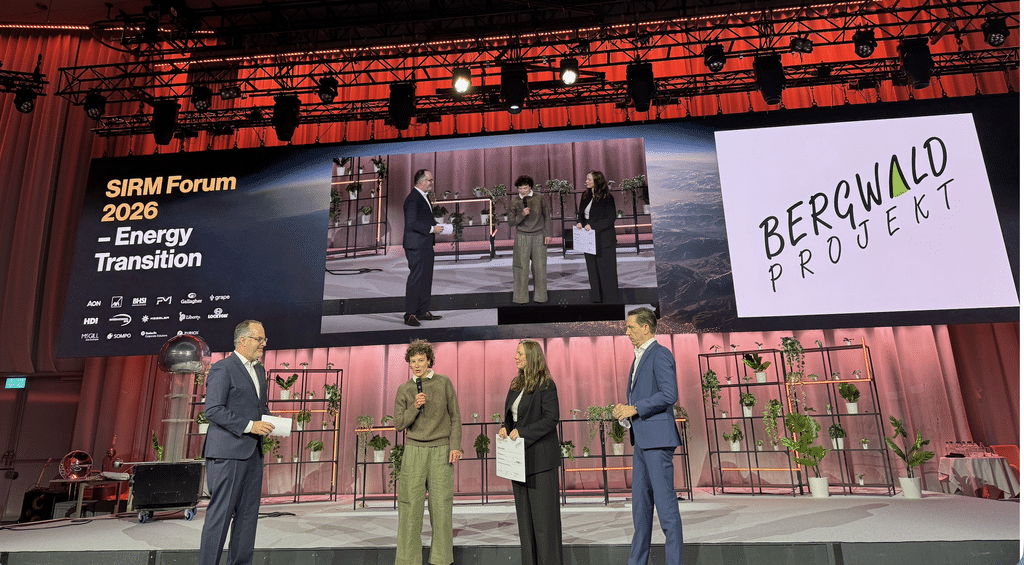
Finally, SIRM Treasurer Michael De Boni and Dr. Julia Braun from ZHAW presented the new CAS in Corporate Risk and Insurance Management. It combines enterprise risk management, risk financing, and insurance management; is taught in English; and brings together risk managers and underwriters. The online information session will take place on December 1, and the first course begins on April 2, 2027. Instead of giving out promotional items, SIRM is supporting the Bergwaldprojekt this year, an organization that maintains protective forests in the mountains, which also serve as CO2 sinks.
The risks associated with the energy transition cannot simply be passed on to others. They can only be better understood, addressed earlier, and shared collectively.
Binci Heeb
See also: Will the lights stay on?
Search:
Sponsors: