How a Swiss broker software provider approaches digital transformation from the inside out, what LINTA has to do with it, and why automation without judgment is not a solution.
It all began with a simple realization: The existing software solutions weren’t enough, and buying a new one didn’t necessarily mean doing the right thing. So, about five years ago, the team led by Pascal Walthert, CEO and owner of Neutrass AG, developed its own solution—not as a CRM replacement, but as a process-based system that maps out the entire day-to-day operations of a brokerage firm within a single, internally regulated workflow. LINTA has been successfully in use at Neutrass since 2025 and will, of course, be made available to all brokers who are interested.
The name LINTA, derived from Old High German, is no coincidence but rather a tribute: It is named after the village linden tree, which formed the center of a village and served as a gathering place for exchanging news in earlier times. The linden tree symbolizes not only strength, but also growth and sustainability. Today, LINTA is a platform with over 130 active processes, a relational database architecture, and a design principle rooted in traditional industry: the ERP concept, which is still largely unestablished in the insurance industry.
Process Instead of a Click
David Frick, a Neutrass in-house developer at Omegasoft, demonstrated what sets LINTA apart from traditional systems during a presentation to various insurers in Rotkreuz. The tool is not just a user interface, but the underlying logic. Every task—whether it’s a change of address, policy processing, or a claims case—is not initiated manually but is controlled by a predefined process. Instead of seeing a blank form, the employee sees a process step: what needs to be done next, who did what and when, and what comes next.
That sounds like control, but it’s really more about taking the pressure off. After all, when you know where you stand in the process, you no longer have to search. And searching takes time—more than most systems have ever admitted.
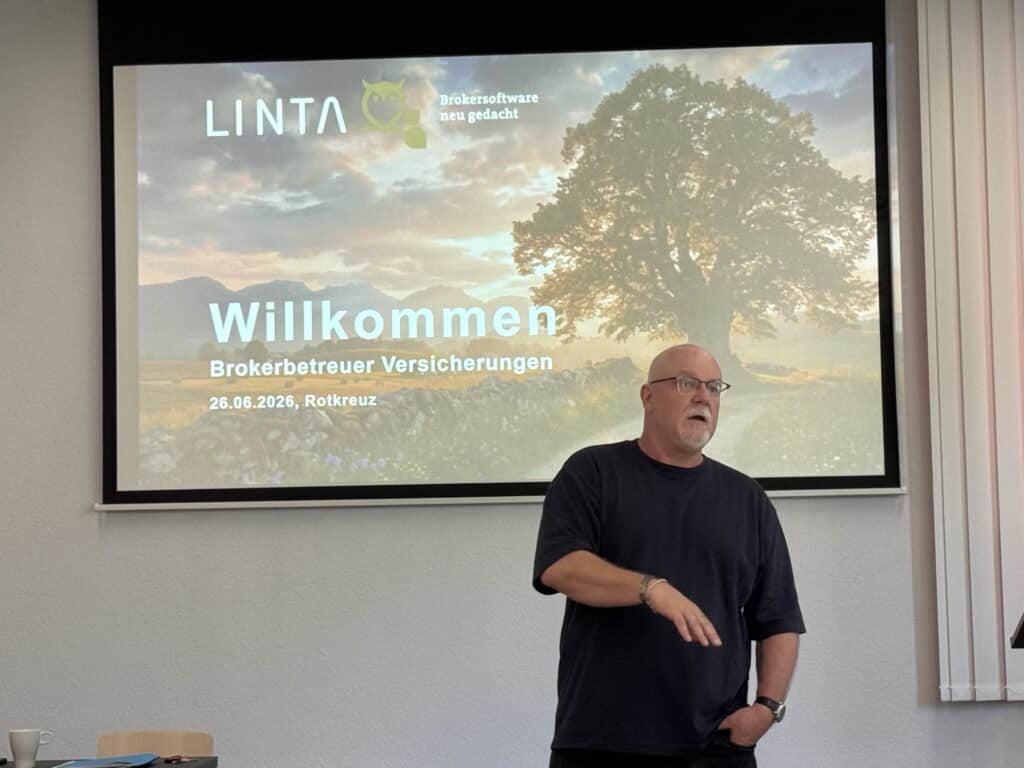
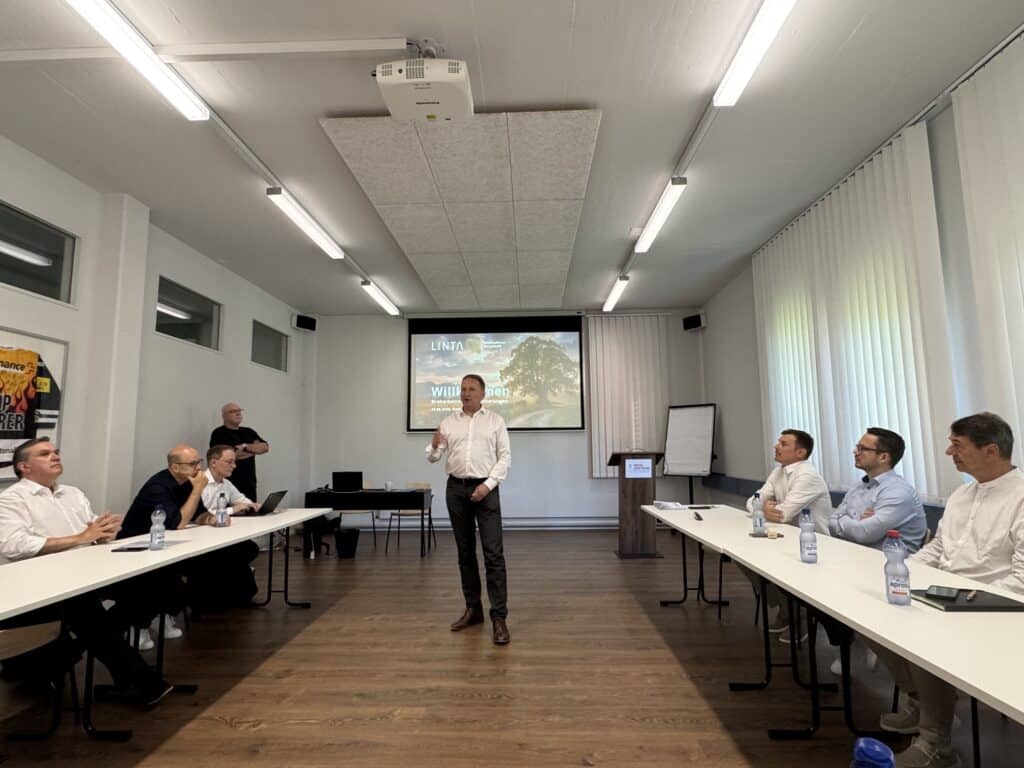
Excitement in the hall
The response from the insurers in attendance left no doubt that a nerve had been struck. Amid questions about the system architecture, appreciative comments were heard time and again, and many attendees lingered on the screens longer than a mere courtesy visit would have warranted. Following the presentation, we heard that the company had received numerous positive responses, some of which already expressed concrete interest in deeper collaboration. The fact that a broker of this size could showcase such a sophisticated in-house development clearly commanded respect in the room, and to be honest: even our editorial team left Rotkreuz with a certain sense of excitement. When a process actually thinks for itself, rather than just managing forms, that’s rarely the norm in this industry.
Redundancy as the Enemy
A key principle of the architecture is the avoidance of redundancy. Each field exists only once, each data record is stored only once, and every change is documented in a history row—without any special programming effort—simply because a history entry is automatically created for each save operation. It is possible to trace who did what in which process at any time, even years later, even if the person in question has long since left the company.
This has consequences for data quality, compliance, and the trust that customers must place in a software solution before entrusting it with their finances.
Automation with a Sense of Proportion
Technically, LINTA has long been capable of fully automating many processes: nightly runs for reminders and commission settlements, automated email sending, and process initiation without human intervention. And yet, the team has made a conscious decision to keep a human in the loop for now.
The reason is not technical immaturity, but practical experience: If you automate too soon, you lose sight of what the system is actually doing. Only when processes are running smoothly, and employees understand and trust the system, does full automation make sense. This isn’t hesitation—it’s a method.
AI as an assistant, not as a decision-maker
This principle becomes particularly clear when discussing AI. LINTA integrates an AI assistant named “Optimus Lintus,” which provides support for complex processes such as address changes involving multiple policies and insurance companies. It is complemented by “Gandalf,” the help function built into LINTA that guides users through processes directly within the system. Optimus Lintus doesn’t give incorrect answers because clear limits have been set for it: If a question is too complex—for example, whether a newly purchased dog is covered under an existing liability insurance policy—it simply states this and explains why it cannot provide an answer.
That is the key difference from a Large Language Model (LLM), which generates probabilities and occasionally comes up with answers like “two plus two equals five.” Not because AI is fundamentally wrong, but because, without a controlled database and clear boundaries, it is simply too dangerous in areas such as insurance consulting.
The ecosystem is growing
LINTA isn’t alone. An ecosystem of partners and interfaces is taking shape around the core platform, all of which can be accessed immediately via any API: a document management system, a tool for converting premium invoices from PDF to XML, a digital mail service, and an Ecohub connection. A customer app with a claims reporting feature and push notifications is currently in development. The philosophy behind it is simple: any interface is welcome, as long as it benefits the customer.
What is consistently avoided in this process is ideology. No tower that looks in only one direction. No blanket rejection of technology on principle. And no digitalization that ultimately creates more work than before.
Binci Heeb
See also: Neutrass AG Appoints Edith Müller Loretz to Its Board of Directors
Search:
Sponsors: