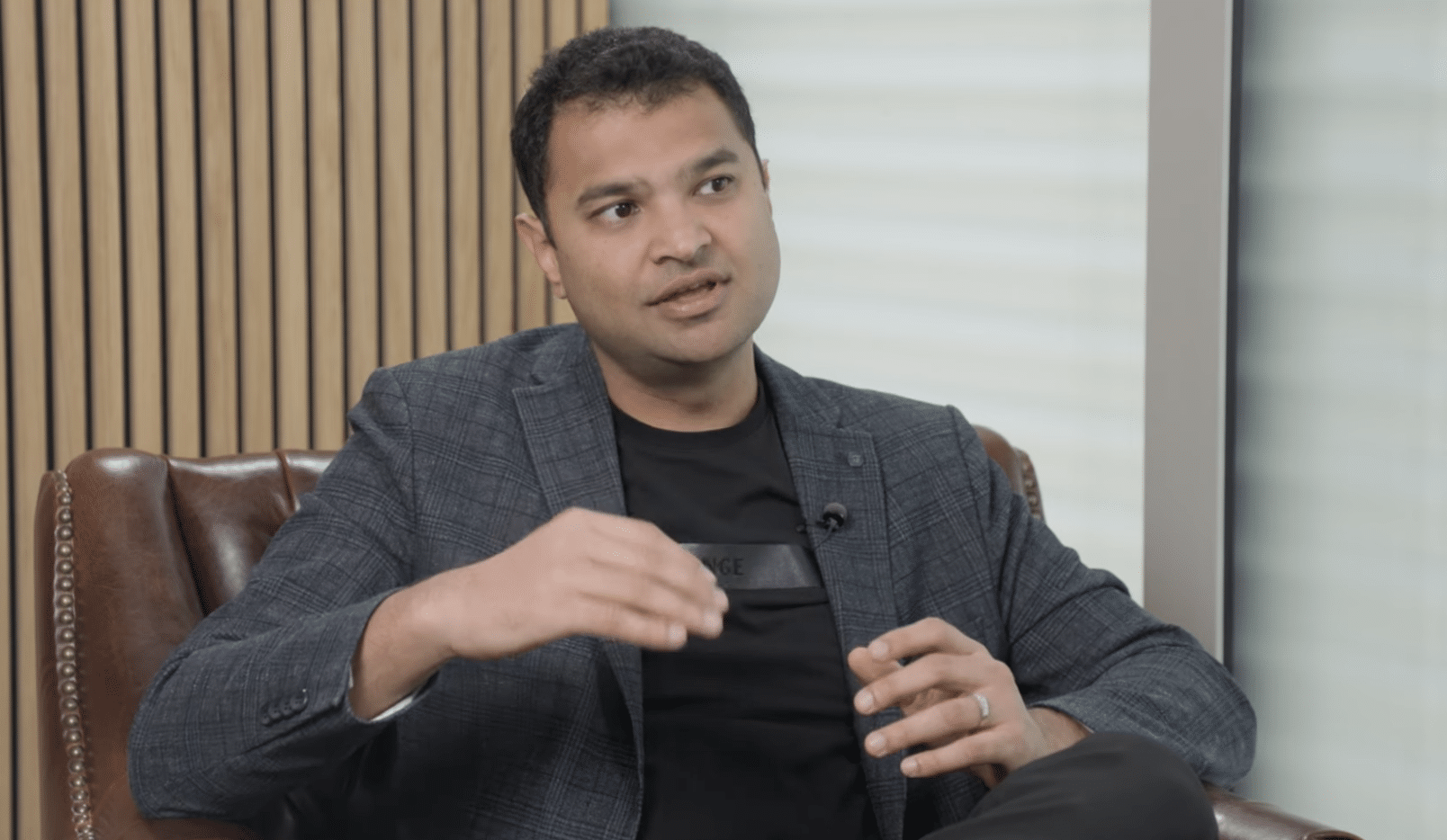
Pranay Jain, CEO and founder of Enterprise Bot, is convinced that artificial intelligence does not replace humans—it makes them stronger. In this interview, he explains why the customer service of the future will combine AI employees with human colleagues, what companies can do specifically today, and why he calls himself the worst employee in the world.
Pranay Jain remembers it clearly: an evening in the U.S., a canceled flight, a call to American Airlines, and then a 74-minute wait on hold. For him, this wasn’t just a personal annoyance—it was proof of a structural problem. “As a company, you’re basically guaranteeing that the customer will leave,” he says. This is exactly the problem Enterprise Bot aims to solve.
The Swiss AI company he co-founded in 2017 specializes in transforming customer service. Clients such as AXA, Generali, and DHL use the technology to handle customer inquiries more efficiently—not by replacing people, but by specifically taking over routine tasks. According to Jain, about 30 percent of a typical call is spent on administrative steps such as identification and data entry. “That’s not the moment for human connection,” says Jain. “That’s exactly where AI should come in, so that people can focus on other people.”
What AI Shouldn’t Be Expected to Solve
Jain makes a clear distinction between two categories: what AI cannot yet solve and what it fundamentally should not solve. The former is becoming increasingly smaller, while the latter remains central.
He cites life insurance as an example: When someone has to report a death, it’s an emotional moment. That’s when a human voice and a human ear are needed. The same applies to complex claims, where policyholders want to feel that the insurance company is truly listening. “We often underestimate the value of genuine human connection,” he says. He deliberately draws the comparison with an ATM: An ATM is perfect for transactions. But anyone looking to buy a house wants to speak with a real person in the end, despite all the digital calculators.
From India to Switzerland via the United Kingdom
The path to Zurich took a few detours. Enterprise Bot began as an idea in India, participated in an accelerator program in the United Kingdom, and was involuntarily reoriented by Brexit. “Then came F10, ”says Jain, referring to a Swiss accelerator program for FinTech and InsurTech companies. What was initially uncharted territory turned out to be a stroke of luck: In its first three months in Switzerland, Enterprise Bot forged partnerships with the Swiss stock exchange SIX, Generali, PwC, and Swiss Life. “Switzerland was very welcoming. We never looked back.”
The company has been established in Switzerland for eight years and employs about 100 people. While its focus has traditionally been on companies with 1,000 or more employees, Enterprise Bot is increasingly expanding into smaller businesses with 50 or more employees.
AI Employees as the New Reality
What sounded like science fiction just a few years ago, Jain is already implementing internally: AI agents that participate in every meeting, analyze emails and Slack messages, track commitments made to customers, and automatically create follow-up tasks. “I live in a bubble where I think everyone does this,” he openly admits. That’s not the case—even his CFO, a graduate of one of India’s top business schools, still doesn’t use AI.
Jain’s credo: AI must not be used to replace oneself. Anyone who does so is squandering its potential. The right approach is the opposite: “Use AI to enhance yourself. Your thinking, your judgment, your human intuition—all of that can be scaled through AI.” His analogy: AI is like a highly talented assistant who carries out every task, but it is up to humans to provide the human perspective.
With the upcoming launch of a new contact center platform, Enterprise Bot is implementing exactly this approach: human employees and AI employees work together as equals—a concept designed from the ground up.
Growth requires culture, not just strategy
Enterprise Bot is growing. Spain, Italy, France, Poland, the Middle East: expansion is in full swing. But Jain warns against viewing scaling as merely a sales issue. The real risk lies elsewhere: in the culture. “You can’t scale in silos,” he says. As the company grows, with hybrid roles and multiple locations, there’s a risk that collaborative thinking will disappear.
His solution: quarterly meetings of the entire team, clear processes instead of constant improvisation, and a philosophy he sums up in one sentence: “If you want to go fast, go alone. If you want to go far, go together.” (If you want to go fast, go alone. If you want to go far, go together.)
He takes a sober view of the market environment: AI makes it easier to launch startups, but it also makes it easier for large companies to enter new markets. The window of time during which a new idea can grow unchallenged is shrinking. Where Jeff Bezos once estimated three years, today there’s barely more than one and a half to two years left. Those who don’t find the right niche and occupy it quickly will lose out.
Strength as a Founder, Weakness as an Employee
When asked if he would apply for a job at a large corporation, Jain answers without hesitation: No. “I’m the worst employee you can imagine.” Not out of arrogance, but out of self-awareness: Anyone who has a strong vision and wants to implement it without regard for hierarchies doesn’t fit into large organizations. “The best thing you can do is prove that you’re right and build something.”
When asked about his life motto, his answer is simple and direct: “Make things happen.” Many people have ideas, he says. It’s the step from idea to implementation that sets some apart from others. And the courage to take action is also the only way to recognize one’s own blind spots.
Incidentally, if he could have one superpower for the AI era, he wouldn’t choose a technological ability. Instead, he’d choose the ability to truly understand people and their feelings, needs, and pain. “AI will never be able to replace that.”
Binci Heeb
See and read more: Technology That Helps Save Lives
Search:
Sponsors: