This week, Wall Street reacted to a strong jobs report as if it were a disaster, only to rebound thanks to reassuring words from a “dove” and unchanged inflation figures—because the only thing it still cares about is the price of money. Meanwhile, the real economy—to which this money represents a claim—is quietly crumbling, from American diesel to European factory floors.
In every market, there is one sign that is more revealing than any forecast, and that is the moment when the crowd starts cheering for the wrong things. This week, they cheered, and then they panicked, and the order in which this happened gave the whole game away. On Thursday, a relatively low-ranking Federal Reserve official—one of its more cautious voices—said that, if it were up to him, he would leave interest rates unchanged this month. The market didn’t just react to this statement. It surged. The Nasdaq jumped more than one percent, the dollar weakened, and for a few happy hours, all was right with the world. Then, on Friday, the real news came: The United States had added 162,000 jobs in a single month—about three times as many as anyone had forecast. More Americans in work, more households with an income. And the market fell. If you read about these two days back-to-back, you’ll understand the current state of affairs better than from any strategist’s analysis. Good news has turned into bad news, and the reason for this is the only one that still makes any difference at all. It’s the cost of money.
The Market That Rants Against Labor
To see just how complete this reversal has become, compare the two trading days side by side.
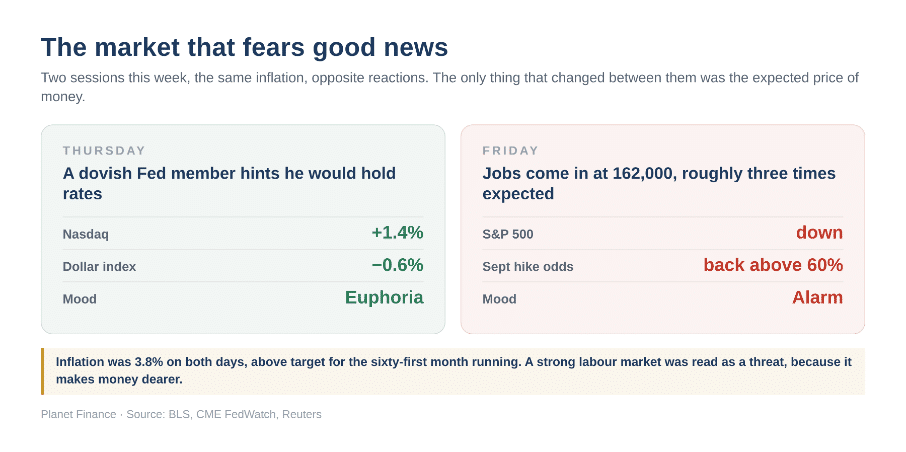
On Thursday, a “dove” representative made a reassuring statement, and stock prices surged. On Friday, the economy showed positive signs, creating jobs, and stock prices fell, because a strong labor market is exactly what revives the case for an interest rate hike on September 16, and the probability of that happening promptly rose back to over sixty percent. Between those two days, the inflation rate hadn’t changed by even a decimal point; it stood at 3.8 percent, above the Fed’s target for the 61st consecutive month. Nothing had changed in the real world. What changed—and that was all that changed—were the expected cost of borrowing. A market in this state no longer weighs the nation’s prosperity, which it is actually supposed to assess. It is a single instrument tuned to a single frequency: the next decision on the price of money. And it has reached a truly strange point where it hopes that its own citizens will be a little worse off so that money remains a little cheaper. There is a word for an economy whose stock market tacitly works against employment, and it is not a flattering one.
It was never the economy’s fault
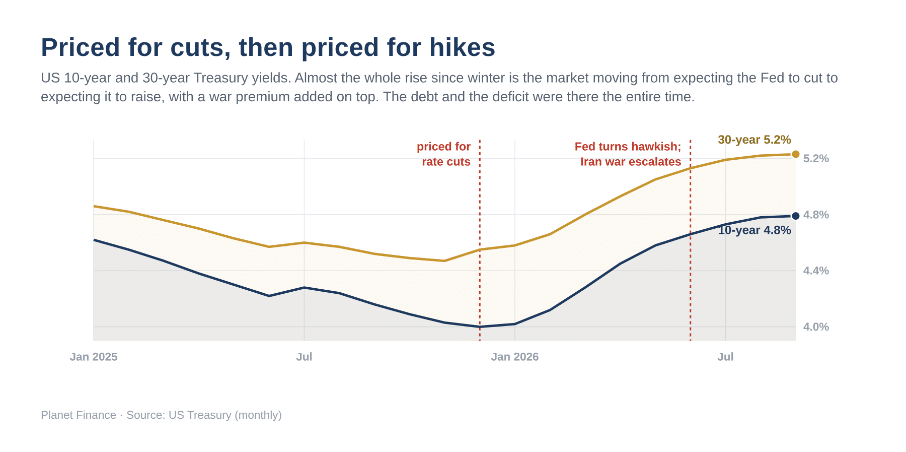
It’s worth clarifying what actually drove this, because a great many self-assured commentaries have latched onto the wrong cause. You’ll be told that bond yields have climbed to five percent—nearly reaching their highest level in almost two years—because the world has finally taken notice of U.S. debt, the war in the Gulf, or the budget deficit. But none of these things is new. The national debt surpassed the forty-trillion-dollar mark weeks ago and had been enormous long before that; the war has flared up and died down repeatedly for a year; the budget deficit has been a scandal for a decade. When the yield on ten-year bonds was still below four percent this past winter, each of these facts was already true. What has changed since then is more specific and revealing. Within a few months, market expectations have shifted from a Fed rate cut to a rate hike—perhaps even more than once—and this reversal alone accounts for the bulk of a percentage point in the ten-year bond yield. The rise in yields is not a judgment on the nation’s finances. It is a reassessment of a single variable—the expected course of a committee—which confirms rather than complicates the diagnosis. The only thing this market trades on, in both directions, is the price of money.
What a Lender Is Really Paid For
Let’s set the Fed aside for a moment, because the portion of the increase caused by the war is the only part that has nothing to do with the committee, and it’s worth examining it on its own. A bond yield, in layman’s terms, is simply the price of borrowing. It’s what a borrower must pay to convince someone to lend them money now, wait for repayment, and bear the risk that they might never get it back. When a war breaks out and this cost rises, the obvious reason—the one everyone immediately cites—is that the fighting drives up the price of oil, oil fuels inflation, and a lender who expects to be repaid in cheaper money reasonably demands more of it. But there is a second reason, one that is quieter and more revealing, and it concerns precisely what a lender is paid to take into account. He is paid to ask what the borrowed money is intended for.
In theory—and often enough in practice as well—a government takes out loans to build something. It takes out loans to build roads and railways, expand the power grid, extend the port, and fund research laboratories, and the very purpose of this debt is that it stimulates economic growth, so that the loan ultimately pays for itself. Such borrowing is not a burden but an investment, and a lender should charge very little for it. War debts are the exact opposite. They create nothing that would ever stimulate economic growth in the national economy that must service them. They fill the order books of the companies that manufacture weapons and—let’s be honest—the pockets of the men who award the contracts; then the money is spent and gone, and all that remains is the bill. A lender is right to charge more for money that he suspects will be squandered rather than invested. Not because the mountain of debt has suddenly grown, but because its nature has changed. That is the honest answer to the currently popular claim that the bond market has finally taken notice of the U.S. deficit. It hasn’t. What a rising war premium tacitly documents is not the size of the debt, but the emerging suspicion that the latest portion of it is being borrowed for the sole purpose of never being able to repay it.
And yet a careful analyst owes America a fairer judgment than its naysayers would allow, for the criticism leveled against it can be greatly exaggerated. Despite all its borrowing, the United States is still growing—more so than most of its competitors—and it continues to play a pioneering role. Artificial intelligence—regardless of the bubble surrounding it—chips, rockets, and the return to space—the driving forces of the next half-century—are being developed there and almost nowhere else. A country that is still inventing the future can bear a heavy debt burden, for the future itself is a kind of security, and America, despite its follies, has not stopped inventing it.
To be honest, the same cannot be said for the other side of the Atlantic. Europe has ended up with the unfortunate combination of debt and a lack of momentum. For the most part, it takes on debt not to build the next thing, but to cushion the comfort of the past, and it has neither the growth nor the industries of the future to repay the debt when it comes due. One might forgive a continent for a mountain of debt if it were using it to buy the future. All too often, however, Europe is merely renting its past.
Half the inflation that no one can vote on
That would be a tolerable way to run a casino if what everyone is trading were actually what matters. But it isn’t. While the screens fixate on whether money will cost a quarter-point more or less, inflation—which is actually accelerating—has reached a point where no committee can touch it.
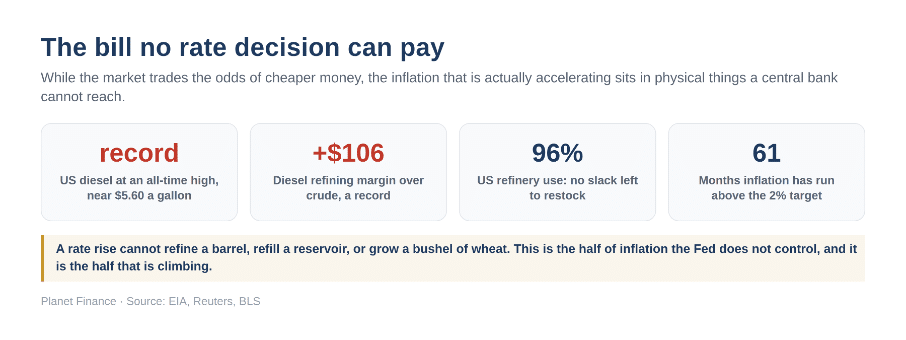
The price of diesel in the U.S. has just hit an all-time high—nearly five dollars and sixty cents per gallon—and the margin that a refinery operator earns from converting crude oil into diesel has also set a record: more than one hundred dollars per barrel above the price of oil. Refineries are operating at 96 percent of capacity—that is, at full throttle—with no leeway to replenish inventories, even though September is supposed to be the month for doing just that.
None of this is a monetary policy event, and no interest rate has any influence on it. Diesel is what transports goods to stores and harvests from the fields; therefore, it translates—with a few weeks’ delay—into higher prices for almost everything and impacts a grain harvest that is already weakened by war and drought. That’s half of the inflation over which the Fed has no control—the half that shows up in barrels and bushels rather than in wages, and it’s the half that’s rising. And this is the trap the new chairman has fallen into. He is apparently preparing to make money more expensive to combat inflation pouring in from the oil fields—and he’s doing so in an economy that, behind the headlines about employment figures, isn’t actually that strong. If you set aside the construction boom in the field of artificial intelligence, U.S. growth stands at just under one and a half percent, with no net increase in employment over the past year and a real estate market that has been quietly dead for months. Tightening monetary policy in this situation to counter a price shock that tightening cannot resolve is not exactly a bold move. It’s the kind of step that draws applause in the boardroom but is regretted across the country for years to come.
And it won’t pass quickly, no matter what else they may tell us, because the forces driving it are structural rather than seasonal in nature. About eighty percent of agricultural shipments are transported using diesel; fertilizer, the other key input, was unaffordable for seven out of ten American crop farmers this year; and the national cattle herd has fallen to its lowest level in seventy-five years. This last figure is more significant than it appears, because a herd cannot be rebuilt overnight. It takes nearly four years for the decision to raise more cattle to result in meat on the shelves. In other words: Higher food prices are not a temporary spike that will reverse in the next quarter; they are set to persist for the next few years due to the sheer length of the cycles involved. This needs to be stated clearly, because we will soon be told the opposite. The same institutions that assured us the last wave of inflation was temporary—first and foremost the European Central Bank and its president—will assure us that this is the case this time as well. They were wrong back then—which cost us dearly for years—and nothing in the equation involving oil, fertilizers, and a shrinking cattle herd suggests that they will be right this time. Of course, they can keep adjusting the basket of goods and quietly swap steak for chicken and chicken for canned goods so that the published figures add up. What they cannot do, however, is reevaluate the actual shopping cart at the checkout. You can perhaps manipulate an index for a while. But you can’t lie to a household about the cost of its food indefinitely.
Meanwhile, a continent is quietly coming together
If you want to see what the real economy looks like once the flood of cheap money has truly subsided, don’t look to Wall Street, where people are still arguing about the water temperature. Look to Europe, where the tide has visibly receded. The official narrative there speaks of a slight recovery: Industrial production in the eurozone rose by one-tenth of a percent last month, and commentators have gratefully clung to that figure. If you look more closely—which almost no one does—the number falls apart. That one-tenth of a percent refers to a single month—the best of the last six—and the statisticians themselves have marked three of those six months as estimates rather than actual figures. If you narrow the figure down to manufacturing alone, it has fallen by a full one percent over the past six months; the stagnant overall figure exists only because the utilities sector—the mere costs of maintaining basic services—is quietly offsetting the shrinking production sector beneath it.
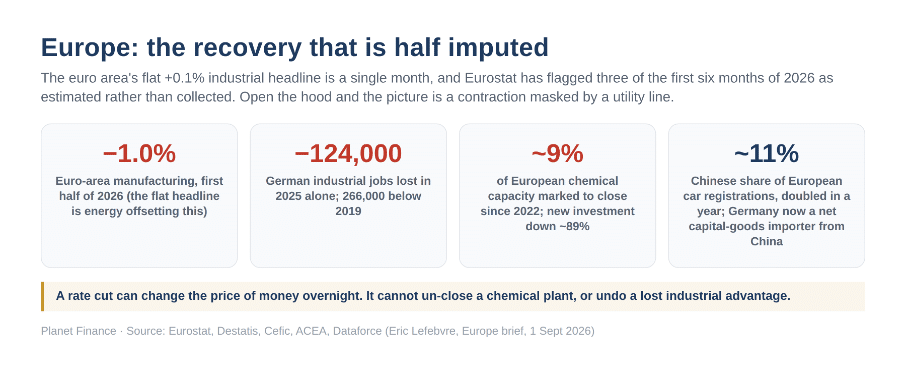
Behind this false sense of calm, the damage lies not in the rate of change but in capacity itself—and capacity does not return once a downturn turns around. Germany, the industrial heart of the continent, has cut 124,000 industrial jobs in a single year and now employs a quarter of a million fewer people in industry than before the last crisis. Nearly one-tenth of Europe’s total chemical production capacity is slated for permanent shutdown, with new investment in this sector having fallen by nearly ninety percent, because energy on this continent simply costs what it costs, and no amount of green ambition—no matter how grand—changes the bottom line for a chemical company competing with the American Gulf Coast. The currently popular consolation—that military buildup is quietly reindustrializing Europe—doesn’t hold up when compared with the numbers: German arms production has tripled and yet accounts for less than a quarter of a percent of Germany’s manufacturing sector—a rounding error disguised as a renaissance. And the deepest wound is the quietest of all. Germany now buys more capital goods—that is, machines that manufacture other machines—from China than it sells there. That was the one thing the German model could undeniably do better than any other in the world, and it has vanished—and no interest rate cut or tariff will bring it back. This is what an industrial recession looks like when it’s polite enough to hide behind a positive growth figure. A country or a continent can post a plus sign in the headlines, while the very thing that made it rich is gradually being shut down—one factory after another. I’ve compiled the complete, country-specific analysis—with sources cited for every figure and estimated data clearly marked—in a separate post for anyone who’d like to review the calculations. You can find it on my Substack.
A place of refuge isn’t always a source of comfort
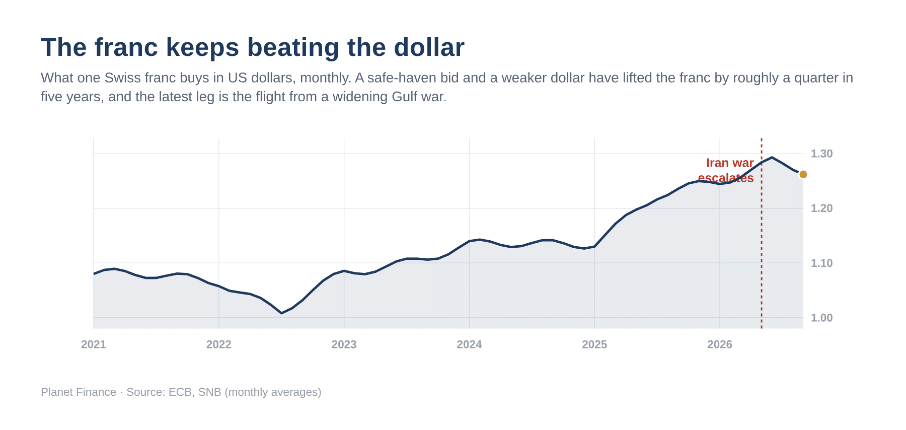
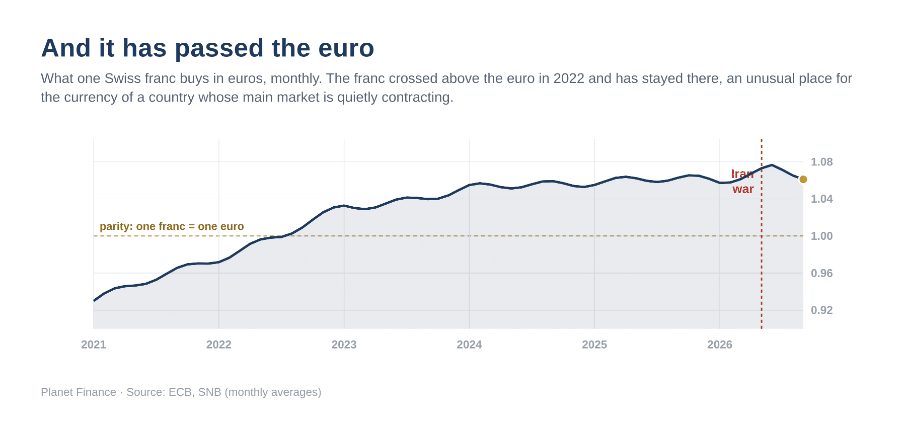
Before I wrap up, a few words about the small country in the midst of all this, because its situation is more precarious than its reputation would suggest. When the world becomes frightening—and persistent inflation, a spreading war, and a neighboring country in industrial decline are arguably the most frightening combination the markets can face—money seeks refuge, and one of the oldest safe havens is the Swiss franc. That sounds like a clear blessing, and in business terms, it is: A strong franc makes imports cheaper, and Switzerland has kept its inflation low while much of the West has lost its bearings. But a safe haven exacts a price for this privilege. The very flight to the franc that keeps prices low in Switzerland is driving the franc higher, and a more expensive franc is hitting Swiss exporters at the worst possible moment—precisely when their biggest customer, European industry, is shutting down plant after plant. Thus, the National Bank is once again being pushed toward the decision it likes the least: to let the franc rise and watch its own manufacturers lose ground, or to sell francs to keep its value low, thereby printing precisely the money whose scarcity is the very reason for its preservation. Switzerland is in the process of importing the world’s unease through its own strength. It is flattering to be the space into which everyone is rushing. However, that is not the same as feeling comfortable there, and the coming months will make that difference clear. The track record of the past five years—against both the dollar and the euro—shows a currency that has done almost nothing but rise, with every new piece of bad news—most recently the war—giving it another boost.
What the money was intended for
So let’s put the two halves of the week side by side. In New York, the richest market in history flinched at the sight of its own population finding work and fainted at the whisper that money might remain cheap, because it had been trained to view the entire world through the narrow window of the next interest rate decision. In Europe, the very machinery of a prosperous economy is being quietly shut down, hidden behind a headline that has been gently rounded off to mean nothing. The two images are one and the same. They show what happens when a market—and the people who observe it—confuse the price of money with the value of things. Money is always merely a claim on real goods—on diesel, wheat, factories, and the know-how to operate them—and this year, that claim is being revalued hourly, while the goods themselves are becoming ever scarcer and, in Europe, are even disappearing altogether. A market that has learned to beg for bad news, to wish a little hardship upon its own citizens so that its loans remain cheap, has forgotten what money was ever meant for. The level-headed response to a week like this is not yet another forecast, for forecasts are cheap and there is already an abundance of them. It is a shift in perspective. Stop reading the market’s lips to find out its next word on the price of money, and start counting the things that money is merely a claim to: the barrels, the bushels, the plants that are still turning, and the hands that still tend them; for these retain their value when paper is revalued, and it is precisely these things that are becoming ever scarcer. The screens will continue to beg for weakness. The rest of us can go out and see what is actually being built and what is quietly being shut down.
Eric Lefebvre
See also: A Single Point of Weakness
Search:
Sponsors: