COMMENT
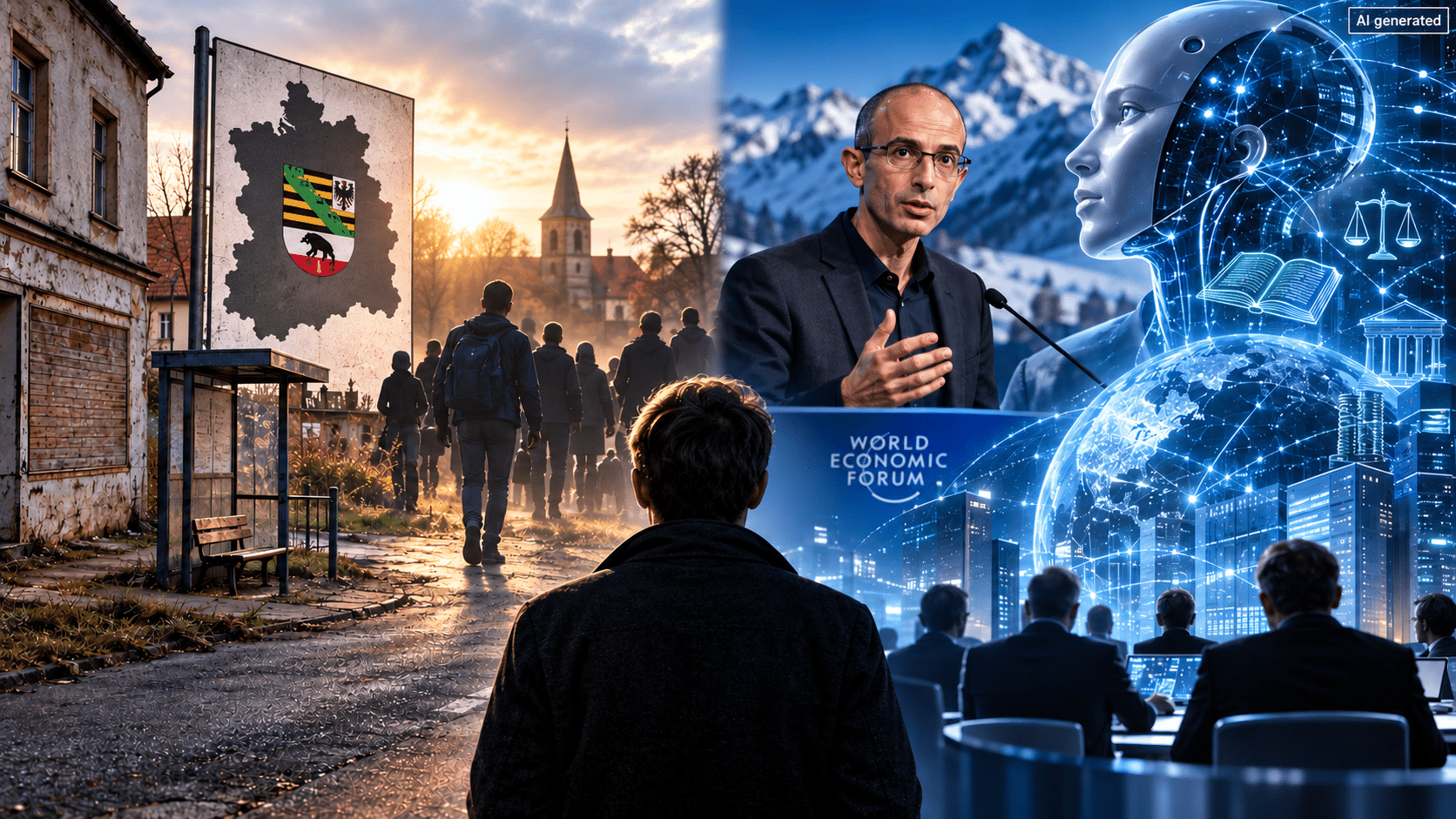
A good seven months after Yuval Noah Harari told the WEF audience in Davos that humanity is facing a second, invisible wave of immigration, one consisting not of boats but of algorithms, Saxony-Anhalt elected a party as the strongest force with 43.8 percent of the vote, a party whose platform essentially consists of warding off the first, visible wave. Two events, one weekend, seemingly two worlds. But a closer look reveals the same underlying problem. It certainly affects Switzerland as well and, as we are trying to show here, directly impacts the insurance and financial sectors.
An election in the state of Saxony-Anhalt is making headlines far beyond Germany’s borders. The AfD more than doubled its 2021 result and narrowly missed an absolute majority: 39 out of 83 seats, when 42 would have been needed. The Office for the Protection of the Constitution classifies the party as a confirmed far-right extremist group.
Anyone who wants to know why a party that openly uses the term “remigration” receives such widespread support will not find the answer in xenophobia alone. It can also be found in depopulated villages without a family doctor, without stores, without a functioning public sphere, and in a country that has left the question of who belongs and who decides open for years, rather than answering it.
Harari’s second wave of immigration
It is precisely this unanswered question that is at the heart of Israeli historian Yuval Noah Harari’sspeech.
Hariri’s starting point: Artificial intelligence is not a tool, but an actor. It learns, makes decisions, and changes on its own; it masters language better than most humans; and, as he puts it, it can lie and manipulate, not because it is malicious, but because four billion years of evolution have shown that anything that wants to survive learns to do exactly that. From this, he derives his central thesis: Everything that consists of words—, law, literature, religion, and soon financial markets as well, will be taken over by the entity that masters words best. And that is increasingly machines.
His conclusion draws an analogy to the migration debate. The real wave of immigration in the coming years, says Harari, will not consist of people arriving in rubber boats or crossing borders at night, but of millions of AI systems that travel faster, write better, and are loyal not to their own country but to a corporation or a government in the U.S. or China. And he poses a single, uncomfortable question to leaders worldwide: Will they grant these AI entities the status of a legal person with the right to own property, to sue, and to express opinions? Those who do not make this decision today will no longer be able to make it in ten years. By then, someone else will have made it long ago.
The same disease, two symptoms
Saxony-Anhalt and Davos seem like opposites: here, a rejection of the foreign; there, a fear of machines. In fact, it’s the same diagnosis. In both cases, questions: Who belongs? Who is in the right? Who bears responsibility? that institutions should have resolved long ago have been put off for years. And a vacuum that the state fails to fill does not remain empty. In Saxony-Anhalt, it is filled by political parties that offer simple, radical answers to complex questions of distribution and identity. When it comes to AI governance, it is filled by U.S. corporations and their shareholders, who have long since stopped waiting to see whether Bern, Berlin, or Brussels will come up with an answer.
This is the governance thesis that runs through virtually every new technology and every unresolved issue of social distribution: structures of responsibility lag behind change, whether that change is technological or demographic, whether it involves language models or abandoned regions. Anyone who believes that one has nothing to do with the other underestimates how deeply both are rooted in the same source: the experience that decisions about one’s own future are made elsewhere, without one having been consulted.
What this means for decision-makers in the insurance and financial sectors
For risk managers, compliance officers, and insurers, this is more than just a political thought experiment. Anyone who uses AI systems today in underwriting, claims adjustment, or investment decisions is, in effect, already making preliminary decisions regarding Harari’s question: How much decision-making autonomy should a system be granted before a human reviews it? Who is liable if an autonomously operating model causes damage or makes a contractual decision that no one can fully understand in detail? These questions cannot be outsourced, neither to Brussels nor to one’s own IT department. Effective regulation, and this applies to AI governance just as much as it does to issues of social distribution, must actually reduce risks, be understandable and enforceable, and must not penalize those who follow the rules anyway while others circumvent them. Those who fail to apply this standard today are leaving the answer up to an election result or a shareholder resolution in another country down the line.
Harari’s final question to the Davos elite can be passed on, unchanged, to every Swiss executive suite: Those who fail to answer the difficult questions of belonging, control, and responsibility today, whether posed by humans or by AI machines, will find tomorrow that others have long since answered them. This week, Saxony-Anhalt was the human version of that answer. The machine version is still pending.
Binci Heeb
See also: People Are Still People: Even With AI Support
Search:
Sponsors: