Scott Bessent missed his target in the bond market, and yields closed the week just under five percent; Christine Lagarde described her interest rate hike as a unanimous foregone conclusion while simultaneously raising her inflation forecast through 2028; and when the inflation figures were released on Friday, gold and Bitcoin fell in the very same minute to align with that forecast. The only competent trader of the week was the computer on my own desk, for the simple reason that it was the only one being watched.
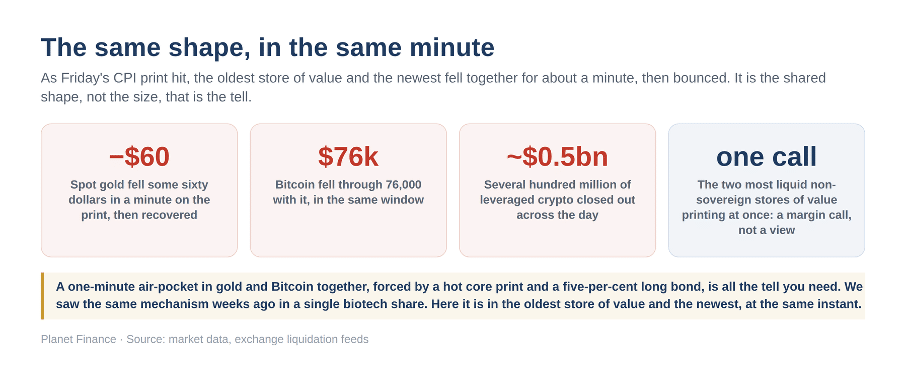
From time to time, the market gives us a single moment that speaks louder than a whole year’s worth of commentary, and this week, that moment lasted about sixty seconds. Gold, which had been trading above $4,300 as a floor throughout the summer, fell by about sixty dollars within a minute as the inflation figures appeared on the screens; Bitcoin slipped below the 76,000 mark alongside it during that same window; over the course of the day, leveraged cryptocurrency positions worth several hundred million dollars were liquidated. Then both stabilized again. It wasn’t a crash, and I won’t portray it as such; it was something more revealing: the oldest store of value that people have agreed upon and the newest one they’ve invented showed exactly the same trend at the exact same moment. When the safest and riskiest things in the world move in unison, you’re not watching someone form an opinion. You’re watching a Margin Call. People don’t sell what they want to sell, but rather what they can sell—liquid assets—in order to raise the cash they need to hedge their uncovered positions. We described this very mechanism a few weeks ago in these pages when a biotech stock was sold off—not because anyone had had enough of vaccines, but because it was the only liquid asset that a loss-making trader could quickly convert into cash. Here it was again, except this time it involved both gold and Bitcoin, and a high core inflation rate along with a long-term bond yielding five percent were the triggers. A “pump and dump” doesn’t require a conspiracy. Cheap money automatically sets it in motion by luring the entire crowd into the same few trades, and then the price spikes, and the entire crowd rushes for the exit in the very same second.
The levers that no longer set the machine in motion
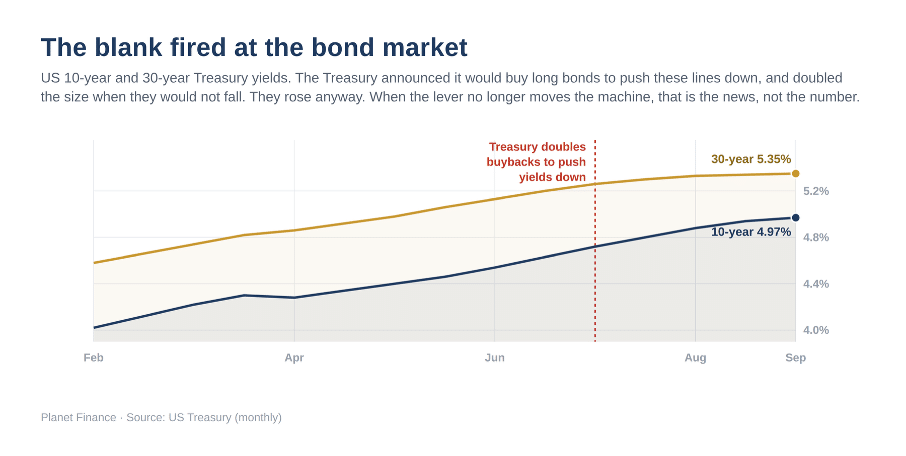
Compare this moment with what the men who are supposed to be in charge have been doing all week, because both are one and the same story, told from two opposing perspectives. Scott Bessent, the U.S. Treasury Secretary, spent the late summer pushing long-term interest rates back down by getting the government to buy its own long-term bonds on the open market. And that is precisely the tool the Federal Reserve used to call “quantitative easing” before the term fell out of favor. On Thursday, his operation purchased $5.19 billion worth of bonds, out of a $6 billion limit. Here’s the figure that’s more important than either of those: traders had offered him 10.5 billion. The market pushed more bonds on him than he was willing to take, and even then, he didn’t use up the entire allocation. If you compare its $5 billion to the $40 trillion the United States owes—and the more than $1 trillion a year it now spends just on debt service, a sum that is now larger than the entire defense budget—then the scale of the situation becomes clear. That’s no bazooka. It’s a blank, and the bond market heard the click. Even Stanley Druckenmiller, whom no one would call a hothead, has commented on it in the newspapers. The yield on 10-year bonds closed the week at 4.97 percent, just shy of five, and that on 30-year bonds at about 5.35 percent—according to some reports, the highest level since 2007— and this happened precisely during the week when the Treasury spent real money trying to steer them in the other direction.
There is a deeper irony behind this that is worth mentioning. Kevin Warsh, the new chairman of the Federal Reserve, was chosen in part because he opposes precisely this kind of intervention. He wants the central bank to withdraw from propping up the bond market and to gradually reduce its own bloated balance sheet—about $6.7 trillion. So just as the Fed is trying to step back from the driver’s seat, the Treasury is pushing its way in, and as it turns out, neither of them is holding a steering wheel connected to anything. That is what you need to understand about this moment, and it’s not about a single number on a single day. It’s about the fact that the men whose entire authority rests on moving the markets are pulling the familiar levers in full view of the public, and the machine is no longer responding. When the steering no longer responds to the steering wheel, the number on the gauge isn’t what matters. What matters is that the steering wheel has slipped from their hands.
The comeback was the same move, just in a better outfit
Take a look, too, at what actually rose on Friday. The stock market rebounded, with the S&P closing the week at just under 7,650 points. Over the course of five days, this represents a decline of just under one percent; on Friday alone, however, it was a gain of a good one percent. If you look more closely, the rally is just the same margin call in a fancier suit. Dell rose 12 percent thanks to Oracle’s cloud figures; hardware manufacturers posted strong gains because the expansion in the field of artificial intelligence is real and the orders are genuine; tellingly, Oracle itself ended the week in the red, and Nvidia slipped. The expansion is real. But a 10-year Treasury bond yielding 5 percent is simply the bill for it, and that bill is now arriving in the mail at the same time as the orders. A market that cheers capital expenditures while turning a blind eye to the cost of capital fails to weigh the pros and cons. Once again, it’s trading based on a single variable and calling it optimism.
An Interest Rate Hike in the Middle of the Chaos
And this is where the farce gets even more absurd, because the very same market that Bessent is currently forcing to accept cheaper money now expects the Fed to make money more expensive—as early as this week. The week began as a debate and ended as near certainty: Following Friday’s inflation figures, the futures market put the probability of an interest rate hike on Wednesday at about nine out of ten. So let me say what my column owes its readers, rather than hiding behind the meeting. The Federal Reserve will most likely raise interest rates on Wednesday. It will do so amid inflation over which it has little control, since the bulk of this inflation is gushing from an oil field—with the Gulf War keeping the price of crude oil at $100 and the price of diesel in the U.S. at a record high—and no interest rate has ever refined a barrel of oil. The price per barrel is making headlines; and the core data shows that the fire is already beginning to blaze from within: Prices excluding food and energy rose by three-tenths of a percent month-over-month, instead of the expected two-tenths, and the housing and services sectors continue to gain momentum. Warsh will use this half-truth as a pretext. The deeper truth, however, is that in the face of a supply shock, he would tighten monetary policy by using the only tool at his disposal against the one problem it cannot solve—and this in an economy that, aside from the boom in the data center sector, is faltering. Growth stands at just under one and a half percent; employment figures rose by only four-tenths of a percent over the entire past year; and the impressive figure of 162,000 in August comes in the context of a year in which the average was closer to 30,000 per month. A single good figure does not constitute a boom. Tightening the interest rate lever in this situation is not the action of a responsible pilot.
It is the action of a pilot who feels the controls losing their response and who pulls harder because pulling is the only thing left for him to do.
Politics only makes matters worse, and here, too, it would be better to name the man rather than the office. Six days before the final stretch leading up to the midterm elections, Donald Trump warns that the Fed had better not raise interest rates, even though his own Treasury Department is spending real money to push interest rates in the opposite direction. This contradiction is no coincidence; it is the whole problem, and I’ll come back to it below.
Europe, a passenger on this train
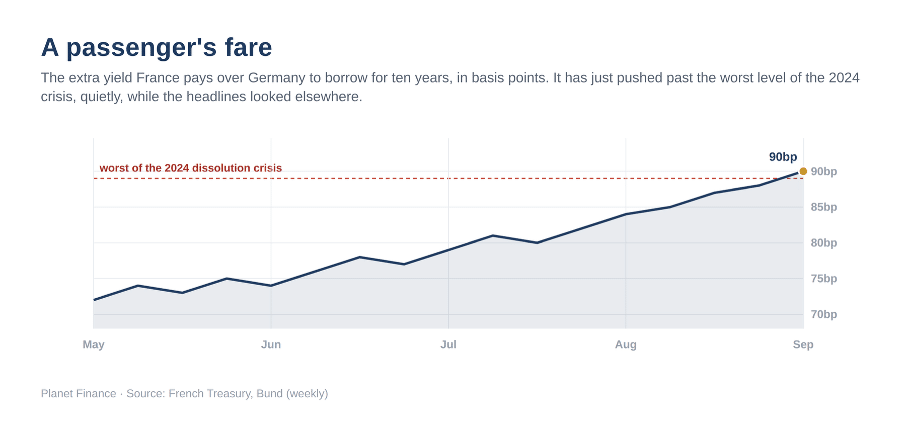
If you want to see where this path leads, you shouldn’t look to America, which, despite all its follies, is still at the helm of something, is still growing, and is still building the machinery for the next half-century. Look across the Atlantic, to the continent that long ago stopped piloting the plane and has resigned itself to being nothing more than a passenger on it. This week, the European Central Bank raised its own interest rate by a quarter of a point to two and a half percent, and Christine Lagarde described the decision as a unanimous foregone conclusion—on the very day that her own staff extended their inflation forecast all the way through 2028. Let that sink in. A central bank raised interest rates while, at the very same moment, admitting that it is likely to miss its target for years to come—which, in monetary terms, is tantamount to turning a steering wheel that the passengers have already been told is not connected to the rudder, and then calling the maneuver a matter of course. And yet the interest rate hike still had an impact domestically: The yield on ten-year German government bonds rose to three and a half percent, a seventeen-year high, meaning that passengers now have to pay more simply for sitting in their seats. The eurozone has no say in this matter, for it is bound by events beyond its control—above all, the narrow Strait of Hormuz, through which the oil it does not produce itself must flow, and to which I will return in a moment. On French highways, a liter of diesel reached three euros, and the government did what governments tend to do: it denounced the refineries’ profit margins, while remaining silent about the 65 percent of the pump price that consists of taxes—that is, its own margin. Meanwhile, the interest rate premium that France pays on loans compared to Germany has risen to around 90 basis points—in some cases higher than at any time since 2012—and no one bothered to put this on the front page.
A passenger can’t steer; all they can do is hold on. That is the current situation in Europe, and it is one reason why, on Friday, when the margin calls came, European investors also turned to cash and sold the gold and silver they had bought as a hedge—precisely because that hedge was what they could sell. The safe haven is turning into an ATM. The continent delivers the same disappointment time and again: it is a passenger on a train whose engineer has lost the brakes, and its greatest remaining strength lies in loudly and unanimously insisting that the acceleration is under control.
The trade I made just for fun
With everything that’s been going on this week, who actually managed to keep a cool head? I’ll tell you, and maybe you’ll find the answer just as strange as I do. I set up a small trading desk and staffed it exclusively with artificial intelligence agents, gave them capital, a mandate, and a strict risk limit—and watched them. They tracked price movements, adjusted their positions to the limit I had set, and closed out a losing trade without needing to be told twice and without sulking about it. It’s worth keeping in mind just how short this journey has been so far.
Four years ago, this technology could barely write a decent birthday message; this week, it wrote a book. It wasn’t scary; it was fast, and that speed deserves respect, because whatever these systems were capable of last year, they’re clearly doing even better this year. They will take jobs away from people, and anyone who claims otherwise is trying to sell something. But they did this under supervision. A human still had to set the boundaries, define the task, and be ready to intervene when the machines —which learned from the same data as everyone else—inevitably encroached on the same trading territory, which is exactly what people did this week with gold and Bitcoin, and for which they had to pay the same price.
Which brings me to the doomsday scenario that’s all the rage right now. A former researcher at one of the major labs warned this week that artificial intelligence, as he put it, has a realistic chance of wiping out humanity before the end of this decade. Perhaps that’s true; I’m not in a position to judge a prophecy. But look at what this particular week has actually shown. The machines on my desk didn’t lose any money they weren’t allowed to lose, because a human was keeping an eye on them. The intelligence that truly spiraled out of control this week wasn’t artificial at all. It was the Treasury Department, which, faced with forty trillion dollars in debt, fired a blank; the central bank, which raised interest rates contrary to its own forecast of failure; and the vast, sophisticated, thoroughly human crowd that leveraged itself into a single trade and had to be liquidated in a single afternoon. If you’re on the hunt for the intelligence that has spiraled out of control and threatens to destroy civilization, don’t waste your time watching the servers. Watch the committee. As always, he appears in a fine suit and, full of confidence, pulls a lever that has quietly slipped from his hand.
The week that will put them to the test
You won’t have to wait long to see the committee in action, because the coming week is almost tailor-made to test exactly that: whether someone with their hand on the lever can still get the machine to respond. It starts off quietly on Tuesday, with the Treasury back in the market—though for a small inflation-linked transaction rather than another duration play. Keep an eye on the coupons, though: If Bessent quietly starts buying the long end again midweek, don’t believe a word of the term “liquidity management.” A bigger shot at the same target that missed the mark on Thursday would be a second admission within two weeks—not a strategy. Then comes Wednesday, when the entire week is condensed into a single morning, as the Fed’s decision and U.S. retail sales figures are announced simultaneously. The base-case scenario is a quarter-point hike—the first since 2023—and by the close of trading on Friday, this had become almost a formality, with a nine-in-ten probability. No one should call this courage. This is the same chair who declared at Jackson Hole that monetary policy was not restrictive, and who is now belatedly reaching for the only remaining lever, while the inflation rate has risen by four-tenths within a month. This is a bill being paid, not a stroke of genius.
And the decision itself is only half the battle, because the press conference is where it all comes down to. If Warsh signals a single rate hike—and no further ones—indicating that he meant business and will now take a wait-and-see approach, the yield on the 10-year bond could fall from five percent, bringing some relief back to all markets. If he leaves October and December visibly open, the long end will remain under pressure and the noose will tighten another notch. This fork in the road—and not the quarter-point hike that everyone has already priced in—is what will actually move the money on Wednesday afternoon. Trump will shout, as he always has, and proclaim that the price of oil will plummet the moment the war is won; ignore the shouting and instead pay attention to whether the statement continues to pretend that the Treasury’s purchases and the Fed’s rate hikes are two separate measures—rather than a government simultaneously pulling on two opposite ends of the same lever.
The second figure shouldn’t get lost in the commotion either, because retail sales figures will be released that same morning, and a consumer staring at gas prices of four dollars serves as a counterbalance to the whole inflation narrative. If spending plummets and interest rates are raised anyway, the “soft landing” theory will die in the very same meeting in which it was conceived.
Later on, the contrast will only become even sharper. The Bank of England will most likely leave interest rates unchanged and issue a muted warning, which is nothing but noise. The Bank of Japan, which meets on the 17th and 18th, is expected to raise its interest rate to 1.25 percent—a level Japan hasn’t seen in more than thirty years—and it remains the only cog in the world that is still visibly bolted firmly to the machine; the yen has already carried out part of the tightening itself, and should Kazuo Ueda even hint at another rate hike before the end of the year, global conditions will tighten without the U.S. stock market ever having to admit it. It is a quiet irony of our time that the only steering column still attached belongs to the country that the West has held up as a cautionary tale for twenty years. And hovering over it all is the price of oil, which remains—no matter what the screens claim—the true measure of inflation. Friday’s two-dollar drop was triggered by a rumor of a meeting regarding the Strait of Hormuz—not a sign of peace—and it occurred on the very day the Houthis seized their island at Bab al-Mandeb at the southern end of the Red Sea. A diplomatic slip-up can lower the price of the barrel with the next delivery month by five dollars; a single tanker can drive it back up immediately. Anyone who bases their week on a single hopeful headline, while the price of diesel—at nearly six dollars—creeps into every price in the economy, reads a press release and calls it a forecast. If you set all the drama aside, the week boils down to a single question directed at the men who pull the strings: Can they show that the steering wheel is still attached to the wheels?
Under supervision
They won’t be able to prove it, and in the end, that’s all that matters—and it can be summed up in two words: under supervision. That’s the entire difference between a machine that traded rationally this week and a market that did not. The great gift of a decade of cheap money was that it eliminated oversight from everything in one fell swoop: from over-trading, which no longer had to be justified; from leveraged funds, which never had to meet a margin call; from the government, that took out loans as if they’d never have to be repaid, because money was free and there was always a buyer. The margin call, when it finally comes, is simply oversight arriving belatedly, all at once, and mercilessly—and it’s arriving now. The sober response to a week like this, therefore, is not to speculate on the meeting that the market has already all but decided for the Fed, but rather to become the overseer yourself while the securities are still being revalued: holding the real assets to which a paper claim always refers; to tailor your portfolio to the worst-case scenario of every question this week will raise—as if Warsh were to open the door and then refuse to close it behind him; as if Bessent’s next buyback were larger than the last and yet had no effect; as if a barrel price of $100 were a range you have to live with, and not an outlier you can simply wait out; and to assume, as a clear working principle, that no one is piloting the plane. Because this week, in Washington as in Frankfurt, and at that moment on Friday, that was exactly the reality. Take note, Planet Finance. The end of the world, if it ever comes, will not be heralded by a runaway algorithm and a glowing red eye. It will look exactly like this: familiar, well-dressed, thoroughly human, and absolutely certain that the controls are still connected.
Eric Lefebvre
See also: Bad News, Please
Search:
Sponsors: