
Power often appears complex but its foundation is remarkably simple: energy. Those who can secure and organize it at industrial scale reshape the balance of the global economy. A closer look at electricity generation and emerging resource dependencies reveals that the tectonic plates are already shifting quietly, yet irreversibly.
Power is often described as complex. It rests on something far simpler. We tend to explain it through markets, institutions and geopolitics, as though it were the product of increasingly sophisticated systems. Yet beneath that apparent complexity lies a more fundamental constraint.
Civilisations run on energy. They always have. What changes over time is not that underlying reality, but the form energy takes and the systems through which it is organised. When those systems shift, power tends to move with them.
If one strips away institutions, ideologies and financial structures, what remains is not a theory, but a condition: without energy, there is no output.
A question left unanswered
Last week we asked a simple question. If economic power ultimately rests on the ability to transform energy into industrial output, which countries are expanding that capability, and which ones are not?
The answer does not lie in financial markets alone, nor in the abstractions of macroeconomic indicators. It becomes visible only when one looks at something more concrete, more structural.
Energy.
The shift in plain sight
Electricity production – the most direct expression of industrial capacity – offers a clear lens through which to observe the transformation underway.
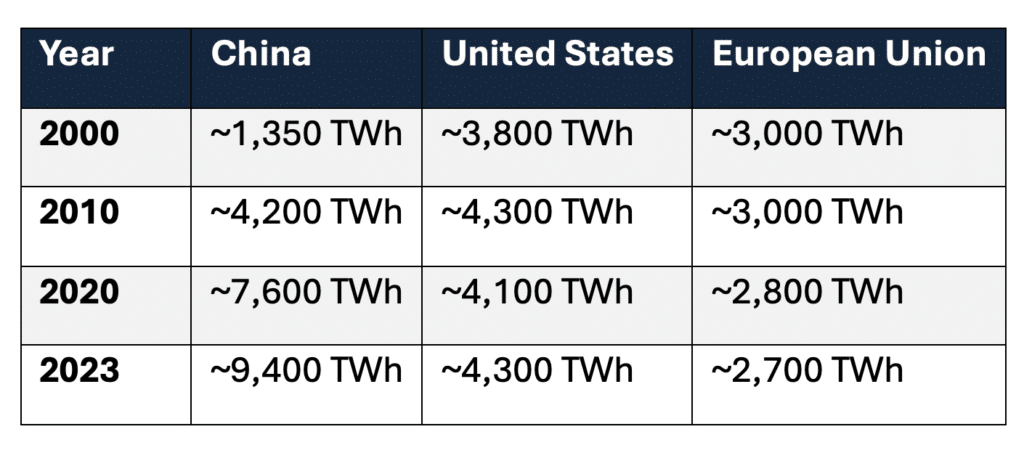
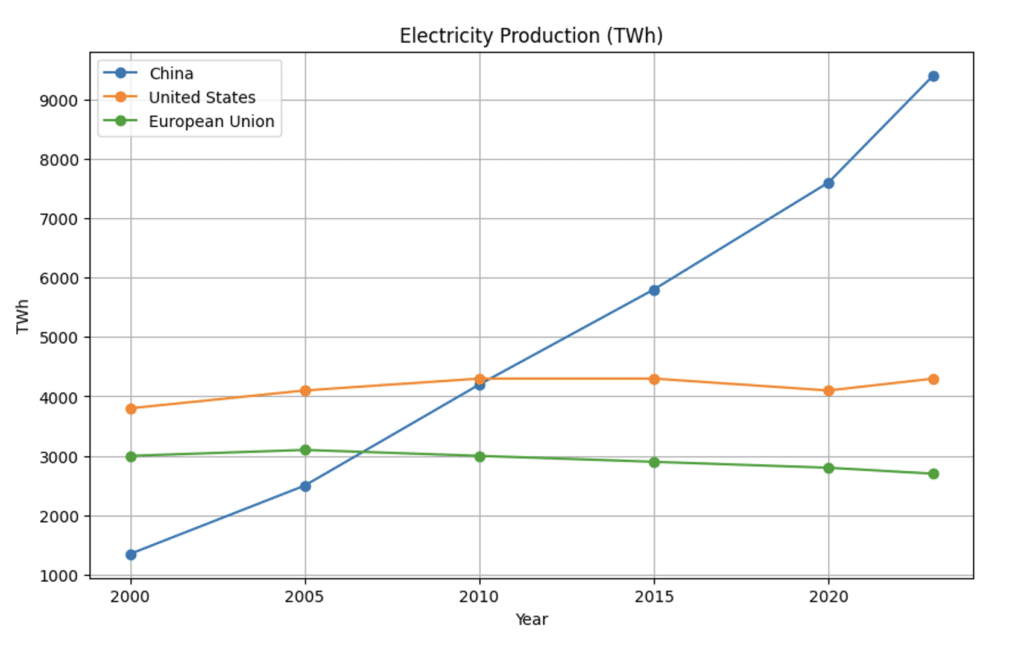
At the beginning of the century, China’s electricity production remained well below that of the United States and Europe. Over the following two decades, it not only closed that gap but surpassed both combined.
This is not a statistical anomaly. It reflects a structural reconfiguration of industrial capacity.
Electricity is not merely an output of the economy; it is one of its enabling conditions. Where it expands, production tends to follow. Where it stagnates, constraints eventually emerge.
China’s energy footprint illustrates this shift at scale. Its coal consumption alone exceeds that of the rest of the world combined, a fact that captures, more clearly than any model, the magnitude of the transformation.
The divergence becomes clearer when visualised.
Growth and energy: cause and consequence
China’s rise is often described as an industrial or technological success. Yet such descriptions risk overlooking a more fundamental dynamic. As its economy expanded, energy demand surged, and crucially, supply expanded with it. Rather than allowing energy to become a constraint, China ensured that capacity, across coal, hydro, nuclear and renewables grew alongside output.
Today, it stands as both the largest consumer and one of the largest producers of energy in the world. It accounts for roughly half of global coal production, maintains significant oil output, and operates the largest electricity system ever constructed.
In that sense, energy has not limited China’s growth; it has enabled it.
What appears at first as industrial expansion reveals itself, on closer inspection, as something more fundamental: the accumulation and organisation of energy at scale.
The observation attributed to Napoleon that “China, once awakened, would shake the world” acquires a different meaning in this context. The awakening is not merely economic. It is energetic.
China’s energy system: strength and vulnerability
China’s energy system embodies both strength and constraint.
On the one hand, its scale is unmatched. On the other, its composition reveals structural dependencies. Coal continues to dominate primary energy supply, while oil and gas remain significant, and low-carbon sources, although growing rapidly, still represent a smaller share in overall energy terms.
In electricity generation, however, the transition is already visible. The relative weight of coal is declining, while renewables and nuclear are expanding rapidly, accounting for most of the incremental demand growth in recent years.
This dual structure reflects a deliberate strategy: sustaining industrial output today while constructing the infrastructure of a different energy system for tomorrow.
Yet this system is not without fragility. China remains heavily dependent on imported hydrocarbons, much of which must transit maritime routes that are inherently vulnerable. The Strait of Malacca, through which a large share of its oil imports flows, represents a particularly critical point of exposure.
Efforts to mitigate this, through pipelines, reserves and diversification are ongoing. But the underlying constraint remains, and in geopolitical terms, constraints tend to shape strategy as much as ambition.
The new resource race
The transition toward electrification does not eliminate dependency. It transforms it.
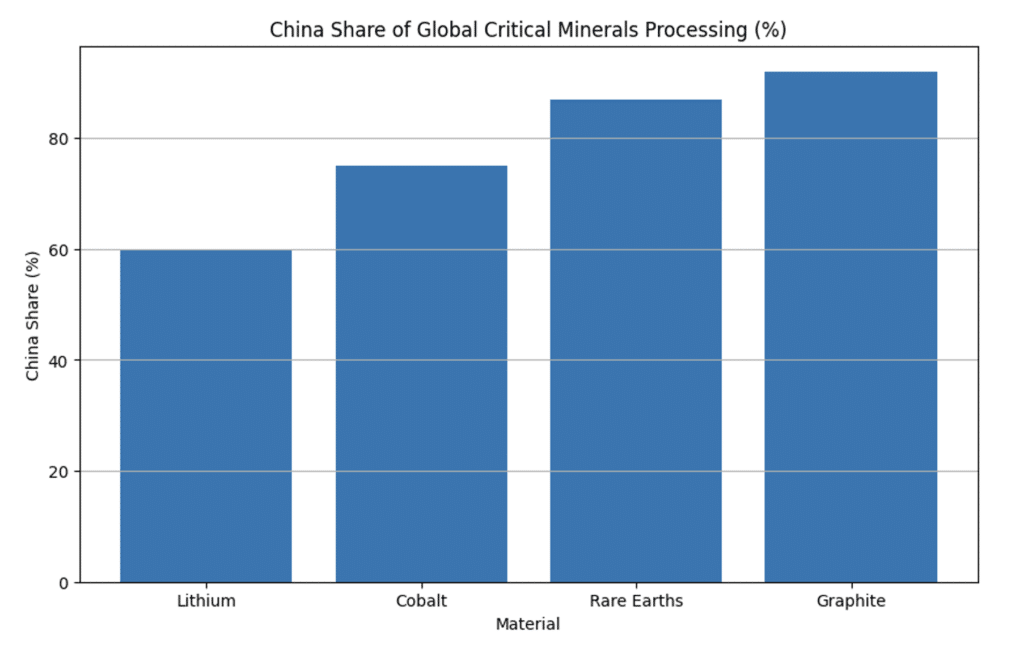
Where oil once dominated, a new set of inputs emerges lithium, cobalt, rare earth elements, graphite and nickel. These materials are essential to batteries, electric motors and renewable energy systems, and therefore to the next phase of industrial development.
China’s position in this emerging system is notable not primarily for its control of extraction, but for its dominance in processing and refining. It is at this stage that raw materials become usable inputs, and therefore where much of the leverage resides.
The structure of dependency is thus being reconfigured rather than removed. This transformation becomes clearer when viewed visually.
In the previous energy system, control lay in extraction. In the next, it increasingly lies in transformation.
Different regions are responding in distinct ways. The United States has focused on investment and alliances, seeking to secure supply chains through partnerships and domestic capacity. Europe has emphasised regulatory frameworks and coordination, though often at a slower pace. China, for its part, continues to integrate and expand.
Different approaches, but a shared constraint: access to energy and its inputs.
When energy shaped society
This pattern is not new; it is, in many ways, the oldest one. For most of history, energy was derived from human and animal labour. Economic systems were therefore closely tied to population size and the capacity to mobilise physical work. At the height of the Roman Empire, large numbers of individuals were effectively integrated into the economic system as sources of labour, illustrating the direct relationship between energy and output. Slavery, agriculture and labour-intensive production were not merely social arrangements; they were expressions of an energy system constrained by biology.
From slavery to machines
The industrial revolution altered this relationship fundamentally. With the development of the steam engine, associated with James Watt, energy became decoupled from human and animal effort. Machines powered by coal, and later oil, could perform work at a scale and intensity previously unimaginable. The economic implications were profound. Tasks that once required large numbers of workers could be performed continuously by a single machine.
While the moral rejection of slavery was a defining historical shift, the availability of alternative energy sources contributed to changing the economic conditions under which such systems had operated. Energy did not directly abolish slavery, but it altered the structure of production in ways that rendered it less central.
Energy and war
The relationship between energy and power becomes even more visible in times of conflict. Industrial warfare requires industrial energy. Winston Churchill recognised this when he transitioned the British Navy from coal to oil, increasing operational capabilities while introducing new dependencies.
During the Second World War, access to energy became a strategic determinant. Germany’s expansion toward the Caucasus and its attempt to reach oil-producing regions reflected less a matter of ideology than of constraint. It never secured those resources.
The Allied powers, particularly the United States, possessed a level of energy production that Germany could not match. In that sense, strategy was often less about intent than about constraint. Courage shaped the battles. Energy shaped the limits within which they were fought.
Energy and money: the invisible system
Energy also shapes monetary systems, although less visibly. John D. Rockefeller demonstrated early on that controlling energy flows could translate into financial dominance. His control over oil refining effectively allowed him to influence a critical input into the industrial economy.
At the global level, a similar dynamic emerged following the collapse of the Bretton Woods system. As the dollar lost its link to gold, it became increasingly associated with oil through pricing and settlement practices. Money, in this context, can be understood as a claim on future energy.
The resulting system created a structural link between energy demand and demand for dollars, reinforcing the role of the currency in global finance. This relationship is reflected in the scale of global oil trade and foreign exchange reserves, which continue to exhibit a strong dollar component.
The evolution of this relationship is more easily understood when visualised.
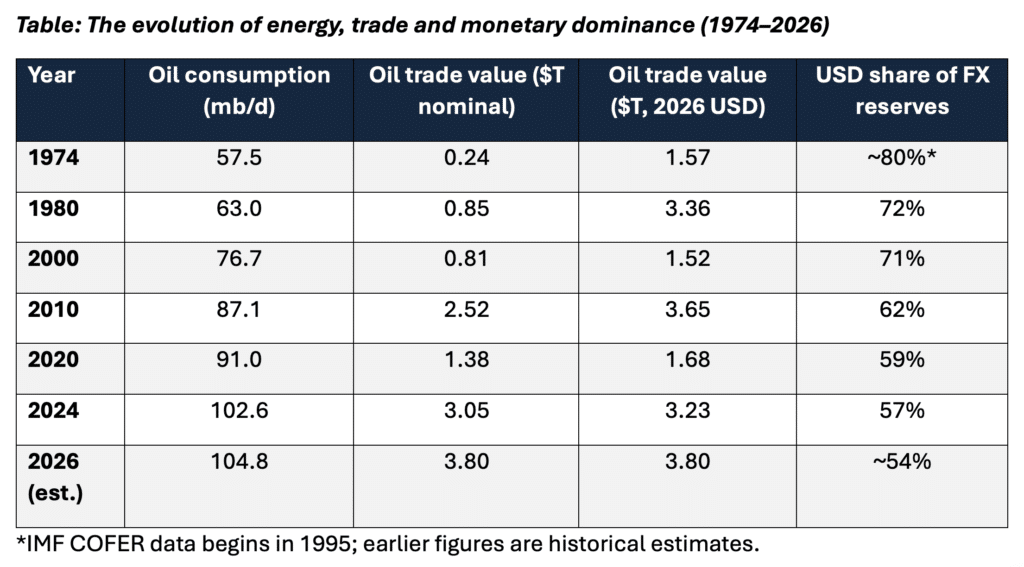
What the data reveals is not a break in the system, but a growing misalignment within it. The physical economy, measured in energy, has continued to expand steadily, while the monetary framework that once anchored it has gradually become less dominant. The dollar remains central, but no longer singular. The system, in other words, has not disappeared. It has begun to decentralise.
Energy remains global. The system that prices it is becoming less so.
A system that begins to move
However, systems built on flows are not static. Changes in energy trade patterns are gradually influencing financial arrangements. China has begun to diversify settlement mechanisms, reducing reliance on dollar-based transactions in certain contexts.
These shifts remain partial and incremental. But systems rarely change all at once. They evolve at the margins before they transform at the core.
The fragile arteries of the world
Energy systems depend not only on production but on movement. A significant proportion of global energy flows through a limited number of chokepoints, including the Strait of Hormuz, the Suez Canal and the Strait of Malacca. These are not merely logistical features. They are expressions of constraint within an otherwise global system.
Who is exposed
The consequences of disruption are uneven. Countries with significant domestic production, such as the United States, are relatively insulated. Others, including many European economies, remain more exposed due to their reliance on imports. China, while exposed, has taken steps to mitigate these risks through diversification and infrastructure development, including increased imports from Russia and the gradual emergence of alternative settlement mechanisms. These shifts remain incomplete. But they point in a direction.
The present tension
When disruptions occur or appear likely, markets react quickly. This reaction reflects not only expectations but underlying physical constraints. Energy systems cannot be adjusted instantly. And when flows are interrupted, the effects propagate.
The deeper pattern
Energy systems evolve over long time horizons. Infrastructure, supply chains and production capacity take years, often decades, to develop. As a result, decisions made today shape the distribution of power in the future. Across history, the specific sources of energy have changed. The underlying dynamic has not.
Where is power moving?
Power does not disappear; it moves, and it tends to follow energy. What we are witnessing today is not an abrupt break, but a gradual reallocation already visible across multiple layers of the global system, in electricity production, in industrial supply chains, in trade flows and, increasingly, in the architecture of currencies themselves.
Energy builds systems, and those systems, once established, generate power that rarely remains anchored where it originated. Yet such transitions are seldom recognised as they unfold. They take shape slowly, through infrastructure, through investment, through shifting dependencies, until, at some point, they become impossible to ignore.
The question, therefore, is not whether this transformation is taking place, but whether we understand it early enough to grasp its implications.
Eric Lefebvre
Read also: The fuel under the economy
Search:
Sponsors: