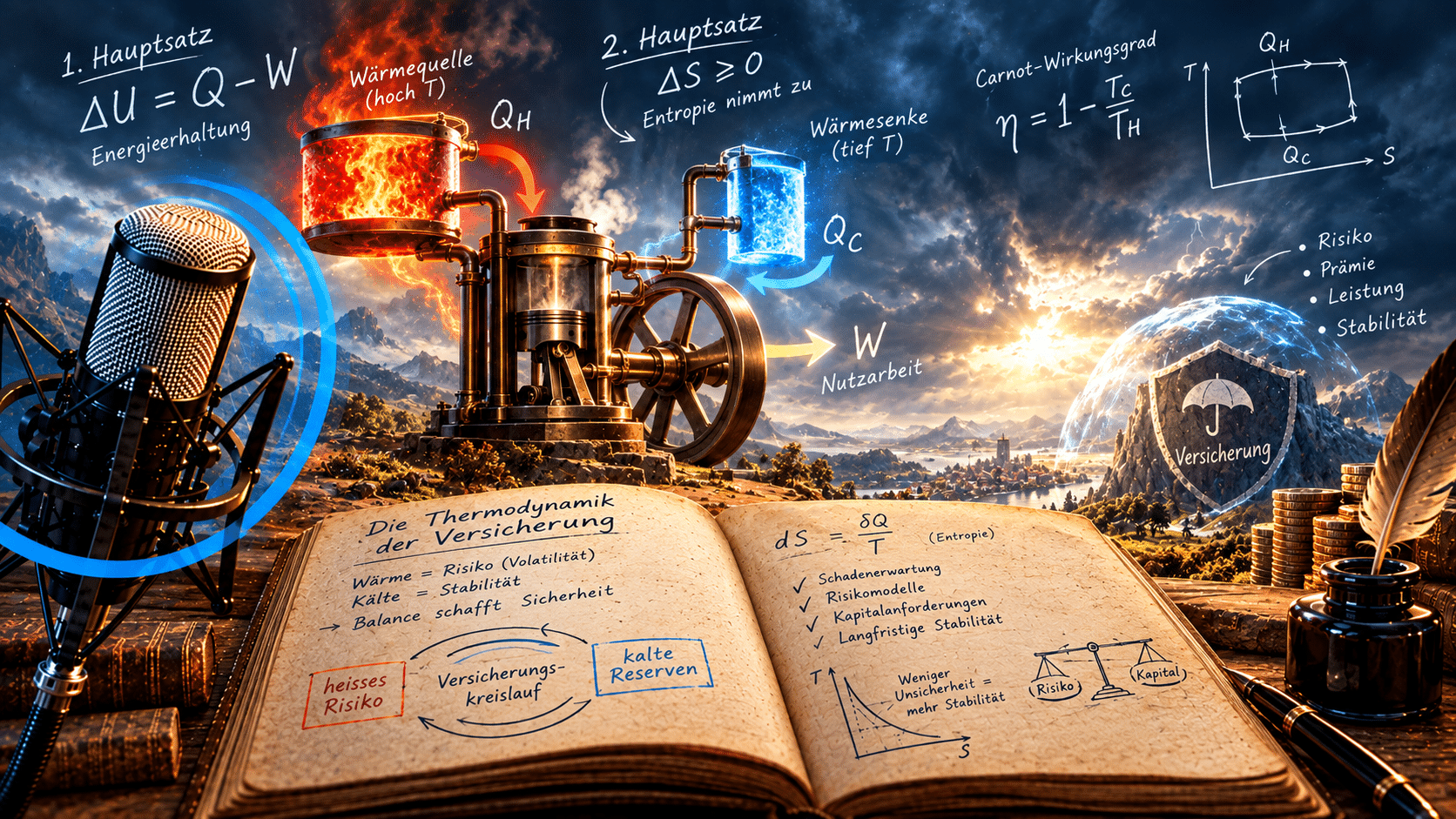
Energy is never lost; it is merely transformed. In the new episode of “Paul the Insurer,” this principle of physics is transformed into a surprisingly precise metaphor for the insurance industry: premiums as stored energy, claims as heat, and reinsurers as a cooling system. And looming over it all is entropy, which slowly eats away at any sense of order.
The first law of thermodynamics is easy to explain: Energy can neither be created nor destroyed; it merely changes form. Paul applies this directly to the insurance industry. There, energy circulates in the form of capital, time, effort, and trust. In this interpretation, a premium is more than just a payment. It is a reservoir that fills up as long as nothing happens and discharges in the event of a claim. The stored energy is converted into a benefit.
The image is appealing because it frees insurance from its paper-based image. What looks like a policy and fine print is, in reality, a system that shifts energy over time and across many people.
Friction, heat, loss
But not everything ever ends up where it’s supposed to. Energy is lost along the path from premium payment to claims settlement, and Paul identifies the sources of this loss with an engineer’s objectivity. Friction arises from administrative burdens, forms, and emails going back and forth. Heat escapes in the form of legal fees, claims-settlement costs, and delays. And inefficiency rears its head where outdated systems drag out simple cases.
So, like any engine, an insurance company consumes fuel just to keep running. That’s not a scandal—it’s physics. The only question is: how much?
Entropy in the claim file
The second law is the more uncomfortable one: Entropy is always increasing; systems tend toward disorder. Anyone who has ever tracked a claims file for months doesn’t need a degree in physics to understand this. A neat file turns into a tangled web of forms, emails, and conflicting reports. A well-structured underwriting portfolio loses its clarity as risks evolve, coverage changes, and no one keeps the documentation up to date. And legacy systems get patched over and over again until, as Paul puts it, they’re more chaos than code.
Insurers are devoting enormous resources to combating this breakdown: automation, training, audits, compliance. One might dismiss this as bureaucracy. From a thermodynamic perspective, it is simply the work required to maintain order.
The claims department as a heat engine
The model becomes particularly clear in the claims department. Paul describes it as a heat engine: claims flow in as heat, are processed and converted, and ultimately result in resolved cases. But no machine operates at full efficiency. Some cases drag on for months, others leave customers dissatisfied, and still others lead to disputes, lawsuits, or reputational damage.
Consequently, the goal is the same as in any engine room: as much usable power as possible, as little waste heat as possible. Perfect efficiency remains unattainable, but the gap to it is negotiable.
Cooling comes at a price
And what if the machine overheats? In the event of disasters or a surge in liability claims, reinsurers step in. In Paul’s analogy, they are the cooling system that absorbs the excess heat and allows the primary insurer to stabilize. This isn’t free. Cooling comes at a cost, and if it fails, the system overheats.
Order takes work
The episode concludes with a insight that extends beyond the industry: Nothing functions in a vacuum. Everything consumes energy, everything loses a little of it along the way, and without constant effort, order turns into chaos. For the insurance industry, this means that efficiency isn’t a state you achieve once and then maintain. It must be re-established every day, by systems and, even more so, by the people who operate them.
Binci Heeb
Paul the Insurer has more content that might interest you, such as a series of interviews with insurance industry executives.
See also: Don Quixote and the Insurers
Search:
Sponsors: