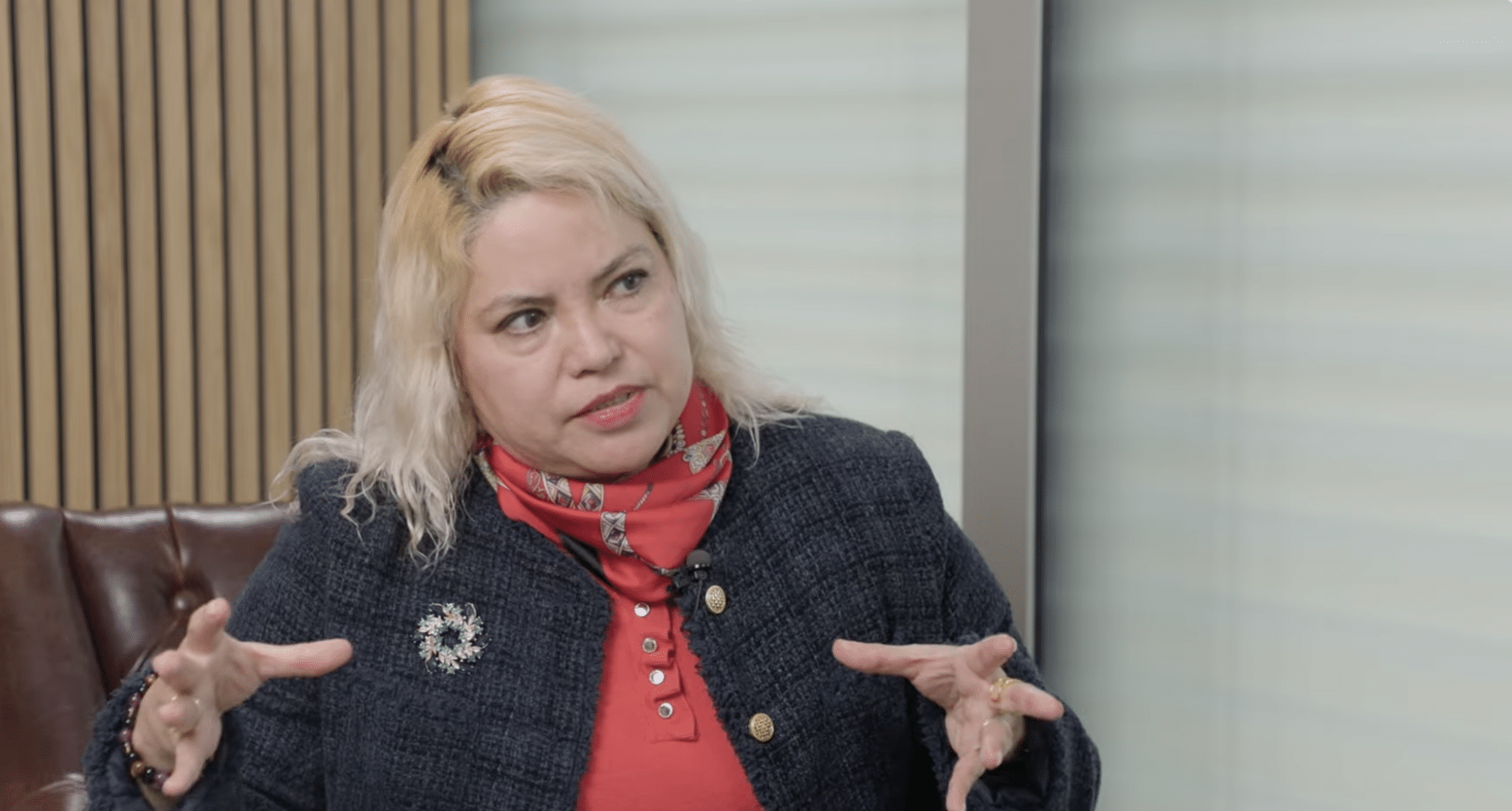
When Prof. Dr. Kathrin Kind talks about artificial intelligence and quantum computing, it rarely sounds like hype. The technologist, who has been working at the intersection of quantum computing, AI, and industrial scaling for over twenty years, prefers to take a broader view, going all the way back to Mosaic, the first graphics-capable web browser of the 1990s. In a conversation with Jakob Barandun on the Capricorn podcast, she paints a picture of the present that is shaped less by disruption than by responsibility: Anyone who wants to understand where artificial intelligence is leading us must first understand what it actually is—and what it will never be.
Kathrin Kind, founder of QuibitNexus, points out that artificial intelligence is by no means a recent invention. Its mathematical foundations date back to the 1950s. What has changed is computing power and the ability to translate abstract mathematics into images, videos, and intuitive interfaces. It was only when OpenAI made this capability accessible to a broad audience that the collective imagination—which has since been transforming entire industries—began to take shape. For Kind, this is a familiar pattern: she had already witnessed the same dynamic during the commercialization of the internet, when Netscape was displaced by Microsoft’s Internet Explorer because the company had stopped listening to the market.
Data Maintenance Instead of Data Generation: The Job of the Future
A central theme of the discussion concerns the world of work. Kind refutes the notion that traditional roles such as software development or data engineering will simply disappear. Rather, they are shifting. Particularly noteworthy is her reference to so-called data cleansing: Since training data must increasingly be removed from AI models—either as intellectual property or for regulatory reasons—a new profession is emerging, focused on the targeted removal of data from existing systems.
What’s noteworthy here is her reference to the order of magnitude: the actual algorithm behind ChatGPT is surprisingly compact. Its performance stems almost exclusively from the enormous amounts of training data. This fact demonstrates just how much AI systems continue to rely on human-generated, organic data. Without a continuous supply of new data, there is a risk of the so-called “model collapse” phenomenon.
Why Philosophy Is Becoming More Important, Not Less Important
Kind strongly advises young people to study philosophy in addition to mathematics and materials science. Her argument: There are several forms of intelligence—cognitive, motor, emotional, and metacognitive. While machines have mastered cognitive intelligence and, increasingly, physical intelligence as well, she believes that true emotional intelligence has so far remained merely pattern recognition—not a genuine emotion based on biochemical processes and evolutionary conditioning.
While machines have mastered cognitive and, increasingly, physical intelligence, they still lack (true) emotional intelligence. So far, machines have operated—from their perspective—based purely on pattern recognition: they lack genuine feelings rooted in biochemical processes and evolutionary conditioning.
She sees the real limit in metacognition—that is, the creative ability to create something entirely new out of nothing, as artists like Van Gogh or composers like Bach were able to do. According to Kind, this ability cannot be taught to a machine because even science does not yet fully understand the human subconscious. That is precisely why we need philosophers, psychologists, and humanities scholars who do not impose ethical guidelines as after-the-fact regulations, but rather build them into the technology from the very beginning.
The Price of Convenience: Why Handwriting Trains the Brain
Kind is particularly compelling when she discusses the cognitive consequences of constant AI use. Two researchers in the U.S. have shown that reading and writing by hand remain the most effective methods for forming new neural connections and preventing Alzheimer’s. If this skill is no longer practiced, there is a risk of a kind of mental atrophy.
Kind illustrates this using her own example: After years of relying on automatic grammar correction, she finds herself mixing up simple punctuation rules. Even more striking is her experience in automotive development: As a co-developer of early driver-assistance systems such as ACC Stop-and-Go, she experienced firsthand how quickly one comes to rely on automated systems—until a near-miss reminded her that automation does not replace attention, but rather redistributes it. Since then, she says, she has been consciously parking manually.
She puts this insight into practice in her personal life as well: Her family sets aside one day each weekend to be intentionally offline—a day when they put away their cell phones and spend time together cooking, reading, and playing. The catalyst was a vacation photo in which the whole family was staring at their screens instead of sharing the moment.
Quantum Computing: A New Computational Logic with a Narrow Range of Applications
In the second part of the interview, Kind explains the basics of quantum computing. She conducts her own research and development in this field, focusing on room-temperature-based photonic architectures as a more sustainable alternative to cryogenic systems operating near absolute zero. While classical computers are based on binary states, quantum computers use the principles of superposition and entanglement to process multiple states simultaneously. This makes them extremely powerful for narrowly defined use cases such as cybersecurity, chemical simulations, or the processing of highly complex data sets, but not for everyday applications.
According to Kind, error susceptibility remains a real hurdle: Depending on the architecture and algorithm, error rates of up to 40 percent could occur; in the case of photonic systems operating at room temperature, the error rates are somewhat lower but still significant. For this reason, quantum computers are currently mostly operated in a hybrid manner, in combination with classical high-performance computing, which serves as a control unit.
She sees personalized medicine as a particularly tangible future scenario: The simulation of DNA sequences and drug combinations—which would take classical systems decades to compute—could be reduced to a matter of hours using quantum computers.
The Clock Is Ticking: Post-Quantum Cryptography as a Mandatory Task
Kind strongly warns of a time window that is becoming particularly critical for the financial industry. Some U.S. companies are already anticipating a technological breakthrough as early as 2029 that could render today’s encryption standards obsolete. Companies of all sizes would therefore be well advised to start developing a post-quantum cryptography strategy now, as the deadline of 2030 is closer than many realize.
Change starts at the top, not in the IT department
Drawing on her many years of experience with large, traditionally structured industrial companies, Kind identifies four prerequisites for successful transformation. First and foremost, she says, it is crucial that management itself become AI-competent, regardless of age or hierarchical level, because technological understanding has long since become a new basic skill, comparable to PC literacy in the 1990s. Second, systematic training and change management structures are needed. Third, continuing education must be directly linked to specific role changes and business cases so that employees experience the transformation not as an abstract threat, but as a tangible next step. She expressly warns against age discrimination in this process: it has been proven that the combination of different generations within a team generates more innovative power than homogeneous, young teams alone.
Leadership is situational—or it disappears
According to Kind, the understanding of leadership must also change. Static, purely hierarchical authority no longer works. What is needed is situational leadership: the ability to switch between coaching, servant leadership, and—in genuine crisis situations—clearly authoritative leadership, depending on the situation. Any leader who stops listening and considers themselves untouchable will be displaced by younger, faster, and better-marketed competitors. She cites the examples of Netscape, Nokia, and Blockbuster as a cautionary tale: it was not a lack of technology or capital that brought these companies down, but rather the loss of the humility to listen to the market.
Gratitude as a Compass
When asked about her personal motto, Kind replies without hesitation: to wake up every morning with gratitude for what is already there. It’s a deliberately unspectacular conclusion to a conversation that otherwise ranges from quantum mechanics to neurobiology and corporate strategy—and it is precisely this that reminds us of what really matters in the end: not the question of what machines can do, but what humans want to remain conscious of.
Binci Heeb
Read also: When Bitcoin meets quantum physics
Search:
Sponsors: